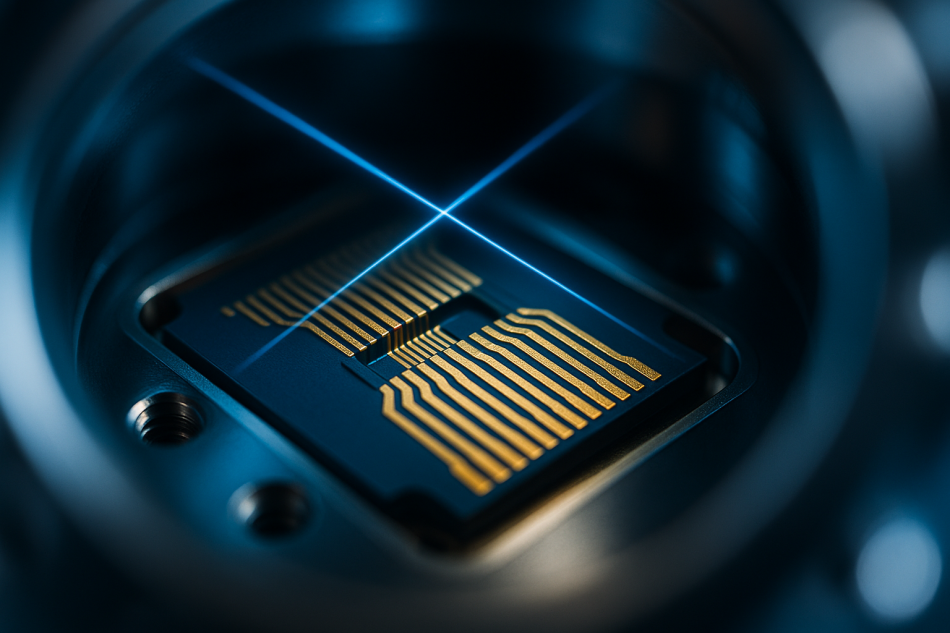

In most quantum computers, the qubits sit still. Superconducting circuits are etched into a chip and stay put; entangling two of them means routing signals through fixed wiring. Trapped-ion machines built on the QCCD architecture take the opposite approach. Instead of moving information between stationary qubits, they move the qubits themselves. Charged atoms glide along a surface trap like beads on an invisible track, shuffling into position whenever two of them need to interact.
QCCD stands for quantum charge-coupled device, a nod to the image sensors that once shuttled packets of charge across silicon. The idea was proposed in the early 2000s as a way to scale trapped ions past the handful you can hold in a single well. It is the design at the heart of Quantinuum's H-series machines, and it explains why those systems post some of the best gate fidelities and connectivity numbers in the business.
Why moving beats wiring
A trapped ion is a nearly perfect qubit. Every atom of a given isotope is identical, so there is no manufacturing spread to calibrate away. Held in a vacuum by oscillating electric fields, an ion can keep its quantum state for seconds, an eternity compared to the microseconds a superconducting qubit typically manages. The catch is that ions in a single trap interact through their shared motion, and that shared motion gets messy once you cram in more than a dozen or so. Add too many and the collective vibrations turn into a cacophony that degrades every gate.
QCCD sidesteps the crowding problem by refusing to keep all the ions together. The chip is carved into zones: some for storing idle qubits, some for performing gates, some for measurement. A mesh of electrodes creates moving potential wells, and by ramping voltages in sequence the machine slides an ion from one zone to the next. When two qubits need to entangle, the controller brings exactly those two into a gate zone, runs the operation on a clean pair, then sends them back to storage.
All-to-all, for real
The payoff is connectivity. On a fixed-lattice chip, a qubit can only directly interact with its immediate neighbors, and reaching a distant qubit means a chain of swap operations, each one an extra chance to make an error. Because a QCCD machine can physically carry any ion to any other, it offers genuine all-to-all connectivity. Any qubit can be a partner to any other with no routing overhead in the circuit itself. That freedom is worth a lot when compiling real algorithms, and it is part of why Quantinuum's systems tend to run deeper circuits than their raw qubit count would suggest.
The maneuvers involved are delicate. Moving an ion heats up its motion, and a hot ion makes a sloppy gate, so the machine periodically cools its qubits by co-trapping a second species of atom that acts as a refrigerant, carrying away vibrational energy through laser cooling without disturbing the stored quantum state. Ions also have to be split apart and merged back together, ferried around corners, and reordered, all without scrambling the information they carry. Each shuttle is a tiny orchestrated sequence of voltage changes timed to microseconds.
The scaling question
The obvious worry is speed. Shuttling takes time, and a circuit that moves ions constantly can run slower than one on a static chip. It also demands a lot of classical control: every electrode needs its own precisely timed voltage waveform, and the number of electrodes grows with the trap. Quantinuum's answer has been to push toward two-dimensional trap layouts with junctions, letting ions turn corners and take multiple routes rather than queuing single file along one track. The company's roadmap leans on this to grow qubit counts while holding fidelity steady.
Whether the ion highway ultimately scales to thousands of qubits or hits a traffic jam is still an open question. But the architecture has already delivered something rare: machines where the qubits are excellent, the connectivity is complete, and the errors are low enough to demonstrate the early building blocks of fault tolerance. In a field crowded with clever ways to hold a qubit still, the decision to keep them moving stands out.







