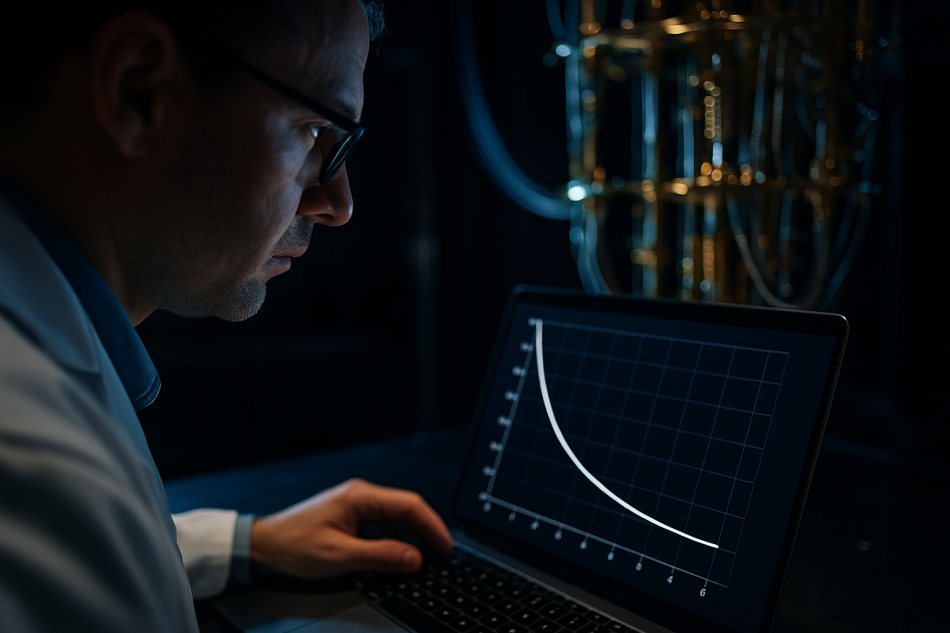

Ask a quantum engineer how good their machine is and you will get a lot of numbers. Qubit counts, coherence times, connectivity maps. But the number that decides whether an algorithm survives long enough to finish is quieter and harder to pin down: how well does a single gate actually work? A gate is one operation, a microwave pulse or laser flash that flips or rotates a qubit. If each one is 99.9 percent faithful, a thousand of them still leave you with a coin flip. Measuring that fidelity honestly is the job of a technique called randomized benchmarking.
Why you can't just measure a gate directly
The naive approach is to apply one gate, look at the qubit, and see if it did the right thing. The problem is that everything else in the measurement is also broken. Preparing the qubit in a starting state has error. Reading it out at the end has error, often the largest error in the whole chain. If you run a single gate and see a 2 percent failure, you have no idea how much of that came from the gate itself versus the sloppy preparation and readout bracketing it. You are trying to weigh a feather while standing on a bathroom scale that drifts.
Randomized benchmarking sidesteps this by refusing to trust any single run. Instead of one gate, it applies a long random sequence of them, then measures how quickly the qubit forgets where it should be.
The clever part: sequences that undo themselves
The trick works with a special family of operations called Clifford gates, chosen because they are easy to track on a classical computer. The routine builds a random sequence of these gates, then computes one final gate that should mathematically reverse the entire sequence and return the qubit to its exact starting point. In a perfect world, no matter how long the random string was, the qubit lands back home every time.
Real hardware is not perfect, so it drifts. Run a sequence of 10 gates and the qubit usually comes home. Run 100 and it comes home less often. Run 500 and it is nearly random. By plotting how the success rate decays as the sequences get longer, you get a curve, and the steepness of that curve tells you the average error per gate.
The elegance is what the curve throws away. State preparation and readout errors do not change with sequence length. They shift the whole curve up or down but do not affect how fast it falls. Because randomized benchmarking reads the error from the decay rate rather than the absolute height, those unwanted errors get factored out automatically. You extract the gate fidelity without needing a clean scale to weigh it on.
Why randomize at all
The randomness matters because coherent errors are sneaky. If a gate consistently over-rotates by a hair, running the same gate many times could make the error pile up, or cancel out, depending on the pattern. Either way you would get a misleading answer. By scrambling the sequence differently on every run and averaging over hundreds of them, benchmarking turns those structured mistakes into a single, well-behaved average error that decays smoothly. It gives you one honest number instead of a lucky or unlucky one.
What the number does and doesn't tell you
When a company reports "99.9 percent single-qubit gate fidelity" or "99.5 percent two-qubit fidelity," that figure almost always came from a randomized benchmarking experiment or a close cousin of it. Those numbers are the currency of the field because they connect directly to error correction: the threshold theorem sets a rough ceiling on how noisy gates can be before error correction stops helping, and benchmarking is how you check which side of the line you are on.
But an averaged number hides detail. It tells you the typical error, not the worst case, and not the shape of the error. A gate could pass benchmarking with a good score while quietly leaking population into states outside the computational space, a failure mode this basic version does not catch. That is why engineers layer on variants: interleaved benchmarking to isolate one specific gate, cycle benchmarking to probe crosstalk when many gates fire at once, and purity benchmarking to separate random noise from coherent drift.
None of it is glamorous. It is the quiet, repetitive measurement work that happens before a chip ever runs an interesting algorithm. But every roadmap milestone, every claim of a better qubit, rests on somebody running thousands of scrambled sequences and watching how fast the answer falls apart.







