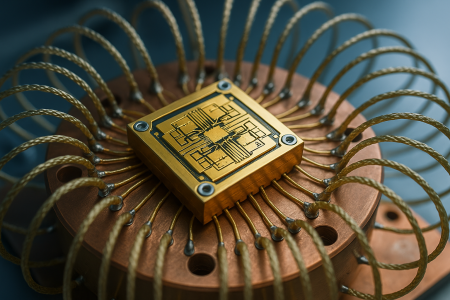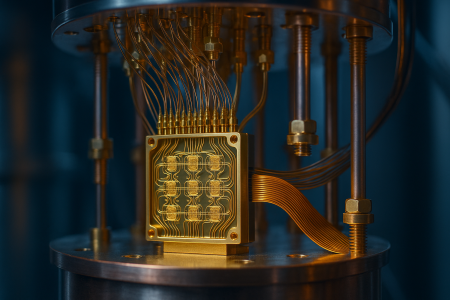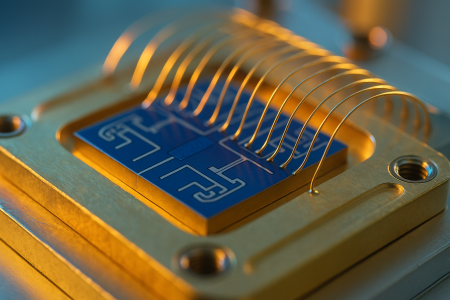

For years, a superconducting quantum chip looked like a single tile of silicon or sapphire with everything printed on one face. The qubits, the resonators that read them out, the control lines, the couplers that link neighbors, all crowded onto the same two-dimensional surface. That worked when a processor held a handful of qubits. It stops working when you want a hundred or a thousand.
The crowding that forced a change
The trouble is geometry. Every qubit needs at least one line to drive it, often another to read it, and sometimes more to tune its frequency or flip a coupler on and off. On a flat chip, those lines have to snake in from the edges. Add more qubits in the middle of the grid and there is simply no room to route wiring out to them without crossing over other signals or forcing qubits farther apart. The signals also start to interfere. A control line running past a qubit it was not meant to touch leaks energy into it, a nuisance engineers call crosstalk.
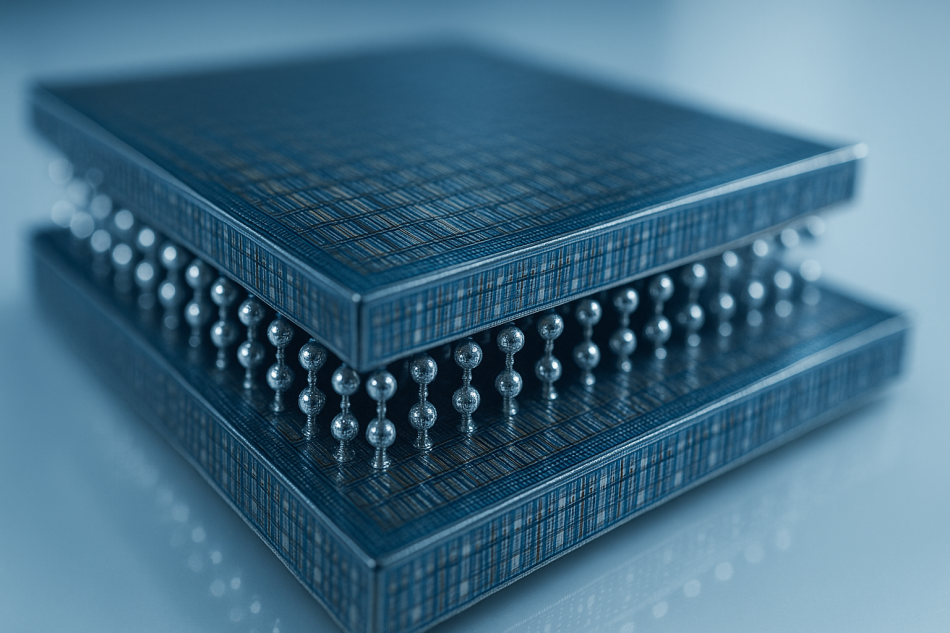
Flip-chip packaging solves the space problem the same way a city solves it: build up instead of out. Instead of one chip, you make two. One carries the qubits and the delicate structures that store quantum information. The other, an interposer, carries the wiring, the readout resonators, and the routing that fans signals out to the world. The two chips are then flipped face to face and bonded together with a forest of tiny metal pillars, usually indium bumps, that connect specific points on one layer to matching points on the other.
Why two layers beat one
The immediate payoff is real estate. Signals can now travel through the interposer and pop up directly underneath the qubit they need to reach, rather than fighting their way across a congested surface. Qubits in the interior of a large array become reachable. Just as important, the layer that holds the qubits can be kept clean and simple, which matters because every extra structure on that surface is a chance to introduce loss and shorten how long a qubit stays coherent.
Separating the two functions lets each material do its job. The qubit chip can be made from a low-loss substrate optimized for coherence. The interposer can be denser and busier, carrying the dirty work of signal routing without contaminating the qubits. Bump bonds also let designers place ground connections close to where they are needed, which tames stray electromagnetic modes that would otherwise slosh around inside the package and corrupt gates.
The new headaches
Stacking chips introduces problems of its own. The gap between the two layers has to be controlled to within a fraction of a micron, because that spacing sets the strength of the coupling between qubits and their readout structures. Bond too close and you change the electrical behavior; bond unevenly and different qubits behave differently. The indium bumps must survive being cooled from room temperature to a few thousandths of a degree above absolute zero, a trip that stresses every joint as materials contract at different rates.
There is also the question of yield. A processor is only as good as its worst connection. A single failed bump among thousands can orphan a qubit or break a readout path, and testing those connections buried between two chips is far harder than probing a surface. Manufacturers have leaned on techniques borrowed from the classical semiconductor industry, where flip-chip bonding has been routine for decades, but quantum devices demand tolerances and cleanliness that ordinary chip packaging never worried about.
A stepping stone, not the destination
Flip-chip is best understood as the first move toward genuinely three-dimensional quantum hardware. Several leading superconducting efforts now treat two-layer integration as standard, and roadmaps point toward more layers still: separate tiers for qubits, for readout, for wiring, eventually for control electronics brought in from the side or from below. Each added layer buys room to grow but multiplies the ways a package can fail.
None of this makes headlines the way a qubit-count announcement does. But the shift from flat chips to stacked ones is one of the quiet engineering decisions that determines whether a processor can scale at all. You cannot wire a thousand qubits on a single crowded surface. Going vertical is how the field bought itself room to keep growing.