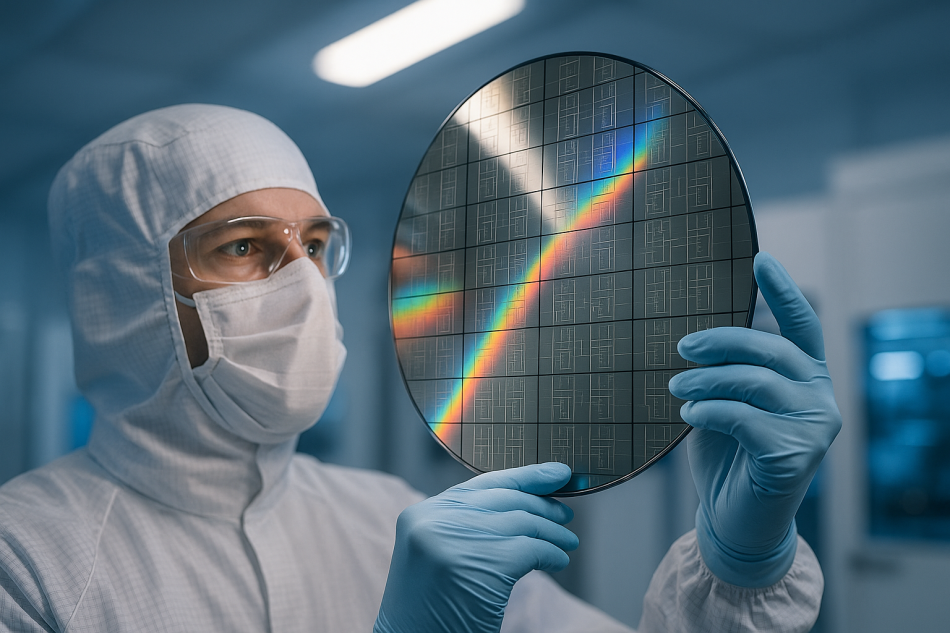

Most quantum computing startups begin with a hero experiment: a handful of qubits coaxed into working inside a one-of-a-kind rig, then a long slog to add more. PsiQuantum made a different wager from the start. The company decided that nothing it built would matter unless it could be manufactured in enormous quantities, so it designed its machine around a commercial semiconductor foundry rather than a physics lab bench.
Qubits made of light
PsiQuantum's qubits are single photons. A photon is appealing because it barely interacts with its surroundings, which is both its strength and its curse. It will not pick up the thermal noise that haunts superconducting circuits, and it can travel long distances through optical fiber. But a photon cannot sit still in a register waiting for the next instruction, and getting two photons to interact deterministically is notoriously hard. Light simply passes through light.
The company encodes information in the paths or timing of photons moving through waveguides etched into silicon. Instead of forcing two photons to collide, it relies on measurement. When photons meet at a beam splitter and detectors register the outcome, the act of measuring can entangle the surviving photons or stitch smaller entangled states together. Everything hinges on steering, splitting, delaying, and detecting single particles of light with brutal precision on a chip.
Fusion instead of gates
PsiQuantum's architecture is built on a scheme it calls fusion-based quantum computing. Rather than assembling one giant entangled cluster all at once, the machine generates a flood of small, identical resource states and then performs entangling measurements, called fusions, to knit them into the large protected structure a computation needs. Those fusion measurements double as the error-correction syndrome extraction, so detecting and fixing errors is baked into the same operation that builds the state.
The great enemy of this approach is loss. A photon that gets absorbed in a waveguide or missed by a detector is a qubit that simply vanishes, which is a different failure mode than the bit-flips and phase-flips that plague matter qubits. Fusion-based designs are built to tolerate a surprising amount of this, treating lost photons much like the erasure errors other platforms covet because a known blank is easier to correct than a silent mistake. Still, every component has to be made exceptionally low-loss, and that requirement shapes the entire chip.
Why the foundry matters
Here is the part that sets PsiQuantum apart. The company partnered with GlobalFoundries to make its photonic chips on an existing 300-millimeter semiconductor line, the same kind of facility that churns out conventional silicon products by the wafer. The pitch is blunt: a useful, fault-tolerant photonic machine will need something on the order of a million physical qubits, and no hand-assembled approach reaches that number. Only an industrial process does.
The architecture still needs cooling, but not the near absolute zero of superconducting processors. The photonic components can run warm, while the single-photon detectors, built from superconducting nanowires, sit at a few kelvin. That is cold, yet far more forgiving than the millikelvin temperatures that force other machines into elaborate dilution refrigerators. PsiQuantum has described a modular plan in which many chips are linked by optical fiber and housed in cryogenic cabinets, rather than a single monolithic processor.
Building the buildings
The company has moved beyond chips to concrete and steel, committing to large utility-scale facilities, including sites tied to government-backed investment in Australia and in the United States. That is an unusual sequence. Most of the field is still measuring coherence times and gate fidelities on tabletop systems, while PsiQuantum is pouring foundations for machines it has not finished designing in full. The bet is that manufacturing, cooling, and photon loss are the real bottlenecks, and that solving them at scale beats polishing a small demonstrator.
There are obvious risks. The company has been relatively quiet about intermediate milestones, which makes its progress harder to judge than rivals who publish qubit counts and benchmark scores. Photonic error correction demands components that are both numerous and nearly flawless, a punishing combination. If any single loss figure refuses to fall far enough, the whole scaling argument strains.
What makes PsiQuantum worth watching is the clarity of its thesis. It did not ask how to make a better qubit. It asked how to make a billion mediocre ones cheaply, and designed everything backward from that answer. Whether that gamble pays off will say a lot about whether quantum computing becomes a manufacturing problem or stays a physics one.







