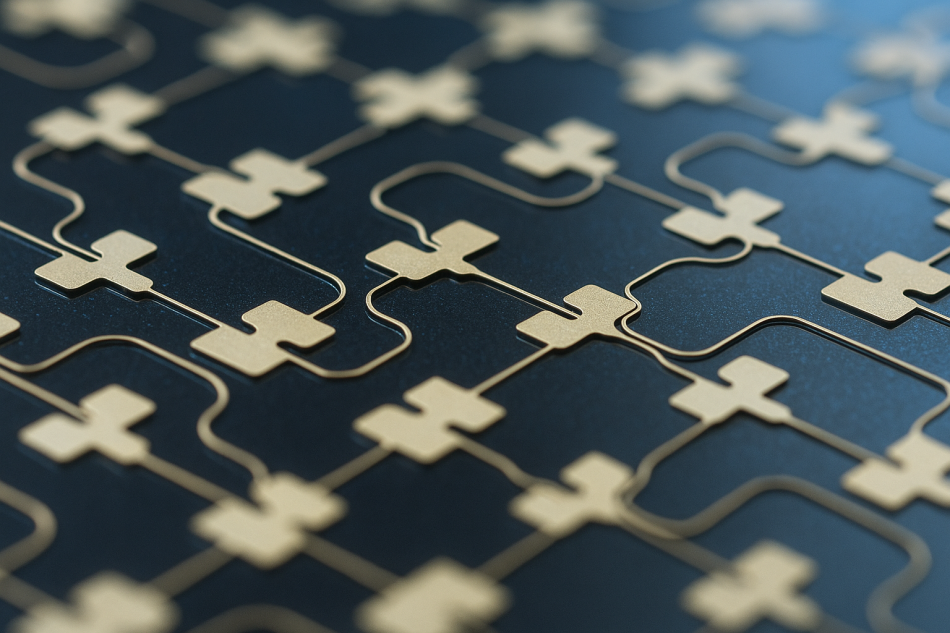

Write a quantum algorithm on paper and you can pretend any qubit can interact with any other. Real hardware is not so generous. On a superconducting chip, a qubit usually couples only to the two, three, or four neighbors it is physically wired to. Trapped-ion machines are friendlier, but even there the all-to-all luxury has limits once a system grows. So between the clean circuit a programmer draws and the pulses that actually fire, something has to give. That something is the SWAP shuffle.
The mismatch nobody can ignore
A two-qubit gate, the kind that creates entanglement, needs its two qubits to be adjacent on the chip. If the algorithm calls for an interaction between qubit 3 and qubit 19, and those two sit on opposite corners of the lattice, the hardware simply cannot do it directly. There is no wire between them.
The fix is to physically move the quantum information closer. A SWAP gate exchanges the states of two neighboring qubits, so by chaining several SWAPs you can walk a qubit's state across the chip, step by step, until it lands next to its partner. Do the interaction, then optionally walk it back. It works, and it is the reason any nontrivial program runs on a connectivity-limited machine at all.
Why every swap hurts
Here is the catch. A SWAP is not free. In most superconducting hardware it is built from three two-qubit gates, and two-qubit gates are the noisiest operations in the whole repertoire. On today's machines they fail somewhere around a few tenths of a percent to a couple percent of the time. Stack a few dozen of them on top of the gates your algorithm actually needs, and the errors pile up fast. A circuit that looks modest on paper can balloon into something with twice as many gates once it has been fitted to the chip, and the extra depth eats into the qubit's limited coherence window.
This is why chip topology matters so much. IBM's heavy-hex lattice deliberately keeps each qubit's neighbor count low to suppress unwanted crosstalk, but the tradeoff is sparser connectivity, which means more routing. Google's grid gives each qubit four neighbors, a denser web that needs fewer swaps but invites more crosstalk. There is no free lunch. Every connectivity choice is a bet about which problem is cheaper to fight.
The job of the transpiler
The piece of software that solves this is usually called a transpiler, or a compiler, and the specific puzzle it chews on is known as qubit mapping and routing. It has two decisions to make. First, the initial layout: which logical qubit in your program gets assigned to which physical qubit on the chip. A smart layout puts qubits that interact a lot near each other from the start, so fewer swaps are needed later. Second, the routing itself: when two qubits that need to interact are far apart, where exactly to insert SWAP gates to bring them together with the least damage.
Both decisions are genuinely hard. Finding the provably optimal routing is the kind of combinatorial problem that explodes as the circuit grows, so compilers lean on heuristics. One widely used approach, often called a SABRE-style router, scans forward through the circuit, scores candidate swaps by how much they help upcoming gates, and greedily picks the best, sometimes running the circuit backward and forward to polish the starting layout. The goal is always the same: minimize the number of inserted swaps, because each one is a liability.
- Fewer swaps means a shallower circuit and a better shot at a correct answer.
- Better initial layout can cut the swap count dramatically before routing even begins.
- Hardware-aware routing can steer around a qubit that happens to be having a bad day, with worse error rates than its neighbors.
Why it matters for the roadmap
Routing overhead is one of the quietest reasons quantum advantage is hard to reach. You can advertise a chip with hundreds of qubits, but if a useful circuit on it requires thousands of extra swaps, the effective computation you can finish before noise swamps it shrinks. This is part of why vendors chase higher connectivity, faster gates, and architectures like modular interconnects or shuttling ions, all of which change the routing math. It is also why metrics that account for real circuits, rather than raw qubit counts, give a truer picture of a machine.
In the fault-tolerant future, the problem does not vanish, it transforms. Logical qubits built from surface codes talk to each other through lattice surgery, and arranging those operations on a two-dimensional patch of hardware is its own routing puzzle. The shuffle never really ends. It just moves up a level.







