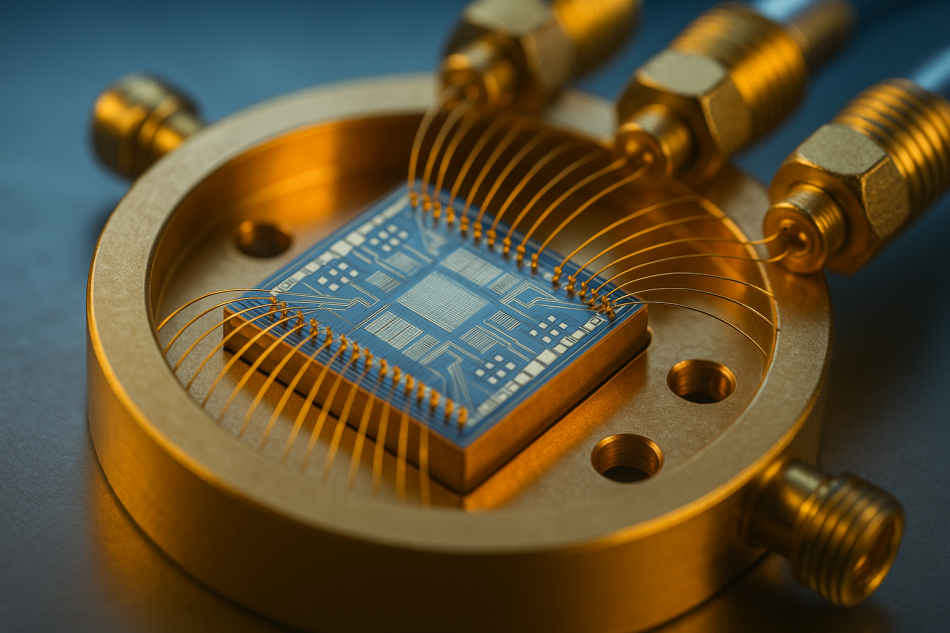

Every useful quantum program eventually needs two qubits to talk. A single qubit can rotate and twirl all day, but entanglement, the resource that makes quantum computing worth the trouble, demands a two-qubit gate. On superconducting chips that use tunable couplers, the solution is to briefly bring two qubits into resonance and let them swap energy. IBM took a different road. Its machines run on fixed-frequency transmons, qubits whose energies are baked into the metal at fabrication and never change. That choice buys long coherence and immunity to a whole class of control noise. It also creates a puzzle: how do you entangle two qubits that refuse to move?
The problem with standing still
A fixed-frequency transmon is a little like a tuning fork cast in solid aluminum. It rings at one pitch, cleanly, for a long time. Two such forks sitting side by side, each tuned to a slightly different pitch, barely influence each other. That is exactly what you want for a quiet memory, because a qubit that ignores its neighbors also ignores stray signals. But a gate requires precisely the opposite. You need the two qubits to feel one another strongly, and only when you say so.
Tunable-coupler architectures solve this by adding a dial. The cross-resonance approach solves it with a clever bit of driving instead. Rather than moving qubit A to meet qubit B, you shout at qubit A using B's frequency.
Driving one qubit at its neighbor's pitch
Here is the heart of the trick. Take a control qubit and a target qubit, weakly coupled through a shared bus. Apply a microwave tone to the control qubit, but set that tone not to the control's own frequency, rather to the frequency of the target. Because the two qubits share a small always-on coupling, the drive leaks across. The control qubit barely responds, since you are singing off-key to it. The target, however, hears a tone at its own pitch, and crucially, the way it responds depends on the state of the control qubit.
If the control is in its ground state, the target rotates one way. If the control is excited, the target rotates the other way. That conditional rotation is the seed of a controlled-NOT, the workhorse entangling gate. Let the drive run for the right duration and you weave the two qubits together without ever retuning either one.
The mess that comes with the method
Nature does not hand out clean gates. The cross-resonance drive produces the wanted conditional term, but it also stirs up a crowd of unwanted ones. The control qubit picks up its own direct rotation. Classical crosstalk through the wiring adds a spurious signal. There is a static coupling term that lingers whether or not the drive is on. Left alone, these contaminants smear the gate and cap its fidelity.
Much of the engineering progress on IBM-style chips has gone into scrubbing those terms away. Two techniques dominate. The first is an echo sequence: run the cross-resonance pulse, flip the control qubit with a fast pulse, run the drive again with reversed sign, and flip back. The unwanted single-qubit error cancels while the useful two-qubit interaction survives. The second is active cancellation, applying a second tone directly to the target that is tuned to erase the leftover classical crosstalk. Together these pushed two-qubit error rates from the percent range down toward a few tenths of a percent.
Why frequency crowding sets the ceiling
The cross-resonance gate works best when the control and target frequencies sit a specific distance apart, close enough to couple, far enough to stay distinct. On a small chip this is easy. On a large one it becomes a packing problem. Every qubit has a frequency fixed at fabrication, and manufacturing scatter means some neighbors land too close, creating frequency collisions that spoil gates or leak energy into the wrong place. This constraint helped push IBM toward its sparse heavy-hex layout, where each qubit has fewer neighbors to collide with, and toward tighter laser-trimming of junctions to hit target frequencies.
A gate that scaled
The appeal of cross-resonance is that it needs no extra hardware. No flux lines, no tunable couplers, no additional control wires snaking into the fridge. The entangling operation rides on the same microwave channels already used to flip single qubits. For a technology where every added wire is a thermal load and a failure point, that economy matters. The cross-resonance gate is not the flashiest entangler on the menu, but it quietly powered the machines that first carried quantum computing out of the lab and onto the cloud.







