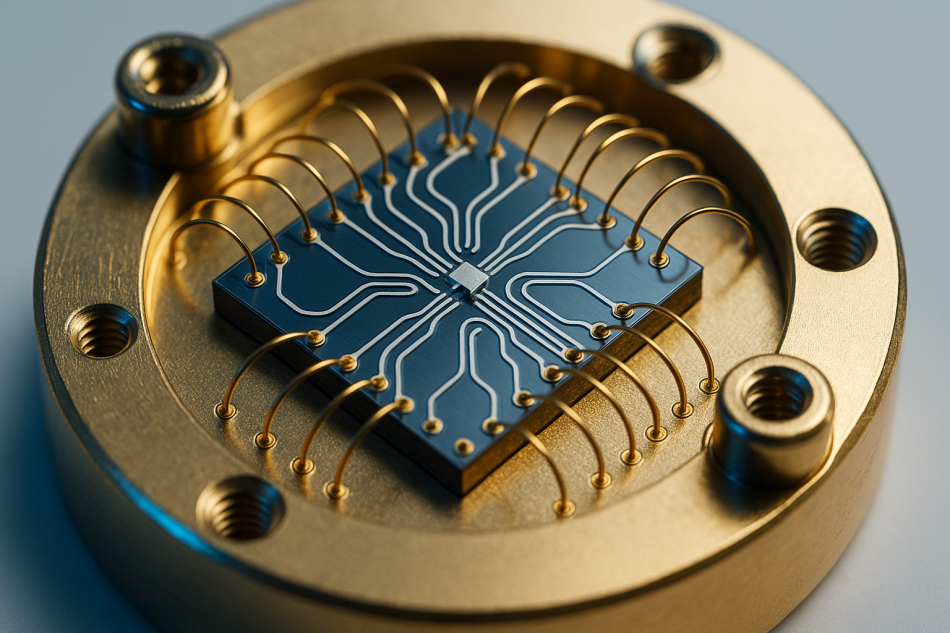

Most superconducting quantum computers run on a qubit called the transmon, a design so dominant that it powers nearly every machine IBM, Google, and Rigetti put on the cloud. The transmon earned its place by taming charge noise, but it paid a price: its energy levels are crowded close together, which makes fast, clean gates harder to pull off. A group of researchers tied to the Finnish company IQM and Aalto University proposed a different trade. They called their invention the unimon.
A Qubit Built From One Junction
At the heart of almost every superconducting qubit sits a Josephson junction, a sliver of insulator between two superconductors that behaves like a nonlinear inductor. That nonlinearity is what turns an otherwise boring resonator into a qubit, bending its ladder of energy levels so the lowest two can be addressed on their own. Too little nonlinearity and you cannot isolate a clean two-level system. Too much and the qubit becomes sensitive to stray noise.
The unimon threads this needle by placing a single Josephson junction inside a short superconducting transmission-line resonator, shunted by a grounded inductance. The geometry does something clever. The environment partially cancels the junction's own capacitance, which lifts the qubit's anharmonicity, the gap that separates the useful transition from the next one up the ladder. In plain terms, the unimon gives itself more breathing room between its working levels than a transmon does, without inviting the charge noise that plagued earlier high-anharmonicity designs.
Why Anharmonicity Matters
When you drive a qubit with a microwave pulse, you want all that energy to flip the 0 and 1 states and nothing else. If the third level sits too close, part of the pulse leaks population up the ladder, a leakage error that error correction struggles to catch. Engineers fight this with carefully shaped pulses, but shaping takes time, and slower gates mean more chances for the qubit to decohere. A larger anharmonicity relaxes that tension. You can drive the unimon harder and faster while keeping leakage low.
The design also aims for a sweet spot where the qubit frequency becomes insensitive to flux noise, one of the slow drifts that erode coherence in flux-tunable devices. The team reported single-qubit gate fidelities above 99.9 percent in their first demonstration, placing the fledgling qubit in the same league as mature transmons despite having far less engineering history behind it. For a brand-new qubit type, that is the headline that makes other labs look twice.
IQM's Angle
IQM is one of Europe's more visible quantum hardware companies, building superconducting processors from its base in Espoo and supplying on-premises machines to supercomputing centers rather than renting time purely over the cloud. The unimon fits a broader strategy of co-design, where the company tries to shape the qubit, the chip layout, and the control electronics together instead of accepting the transmon as a fixed starting point. If a qubit can be made intrinsically cleaner and faster, every layer above it, from calibration routines to error-correcting codes, gets easier.
None of this means the transmon is finished. It benefits from a decade of accumulated know-how, fabrication recipes, and tooling that a newcomer cannot match overnight. The unimon still has to prove it scales to arrays of many connected qubits, that its fabrication yields consistently, and that two-qubit gates between unimons reach the same quality as the single-qubit numbers. Those are exactly the questions that separate a promising physics result from a processor you can build a roadmap around.
The Bigger Picture
The appearance of a genuinely new superconducting qubit is rarer than it sounds. Most progress in the field comes from refining the transmon or its cousins, the fluxonium and the cat qubit, rather than inventing a fresh architecture. The unimon is a reminder that the basic circuit element of a quantum computer is still an open design space, and that small teams can still change its ground rules. Whether it becomes the backbone of IQM's future machines or a stepping stone to something else, it widens the menu of choices engineers have when they sit down to build the next generation of chips.
The quiet lesson is that scaling a quantum computer is not only a matter of adding qubits. Sometimes the leverage comes from making each qubit a little smarter about the noise it was always going to face.







