
Most quantum processors are stuck with the layout they were built with. A superconducting chip has its qubits soldered into fixed positions, and if two of them want to interact but aren't neighbors, the machine has to route information through a chain of intermediaries. Trapped-ion systems face the same wiring problem, but one branch of the field solves it in a way that sounds almost mechanical: it picks the qubits up and carries them.
What a QCCD actually is
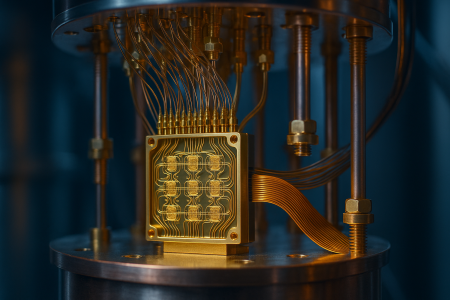
The approach is called the quantum charge-coupled device, or QCCD, a name borrowed from the image sensors in old digital cameras. The idea comes from the trapped-ion community, and it underpins Quantinuum's H-series machines. Instead of packing every ion into one crowded trap and firing lasers at the whole cloud, a QCCD chip is divided into zones. Some zones are for storing ions. Others are for performing gates, or for measuring a qubit, or for cooling it back down after it has been jostled around.
The ions are charged, so they respond to electric fields. Beneath the surface of the chip sits a grid of tiny electrodes. By ramping the voltages on those electrodes up and down in a carefully choreographed sequence, engineers create moving electrical wells that scoop up an ion and slide it from one zone to the next. It is a bit like a bucket brigade run by software. When two specific ions need to be entangled, the machine shuttles both of them into a gate zone, brings them side by side, applies the laser pulses, and then moves them apart again.
Why bother moving atoms around
The payoff is connectivity. On a QCCD machine, any qubit can be brought next to any other qubit, because position is no longer fixed. That gives you what people call all-to-all connectivity, and it matters enormously for real algorithms. A program that would require dozens of extra shuffling operations on a fixed grid can run more directly when the hardware itself does the shuffling with atoms.
There is a second, subtler benefit. Cramming many ions into a single trap makes the physics harder. The ions share vibrational modes, and the more of them you have, the more crowded and hard to control those modes become. By splitting ions across zones and only bringing a handful together at a time, a QCCD keeps each gate operation clean. That is a big reason Quantinuum's machines have posted some of the lowest two-qubit gate error rates in the industry.
The cost of the choreography
Nothing is free. Every time an ion is transported, accelerated, and stopped, it can pick up extra motional energy, effectively heating up. A hot ion makes for a sloppy gate, so the architecture leans heavily on sympathetic cooling: a second species of ion rides along and absorbs the excess energy through laser cooling, without disturbing the qubit's stored information. Managing two species, keeping them sorted, and timing all the voltage ramps is a serious engineering burden.
Shuttling also takes time. Moving ions, splitting and merging traps, and swapping their order all consume microseconds that add up over a long circuit. Compared with a superconducting gate that fires in tens of nanoseconds, ion operations are slow to begin with, and transport widens that gap. The bet is that far higher fidelity and full connectivity are worth the slower clock, because fewer operations fail and fewer error-correction resources are wasted.
Scaling the grid
The long-term vision looks less like a single racetrack and more like a two-dimensional junction grid, sometimes drawn as a repeating lattice with intersections where ions can turn corners. Researchers have demonstrated the tricky maneuvers this requires, including swapping the order of two ions and steering them through X-shaped and T-shaped junctions without losing them. Scaling to thousands of qubits means building chips with far more zones, more electrodes, and the control electronics to drive them all in concert.
The QCCD is a wager that the path to a useful quantum computer runs through quality and flexibility rather than raw qubit count. Whether it wins depends on how gracefully the transport tricks scale once the grids get large. For now, it remains one of the few architectures where the answer to "how do two distant qubits talk" is simply to bring them together.