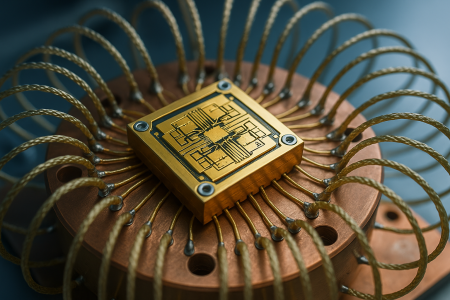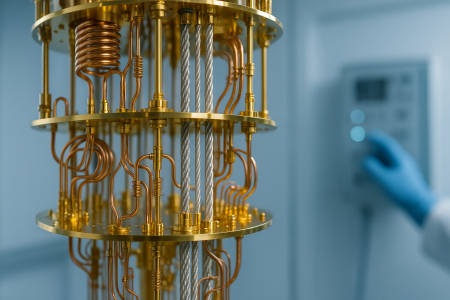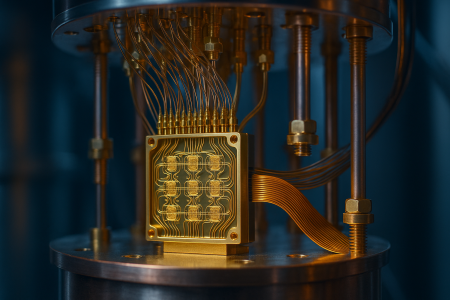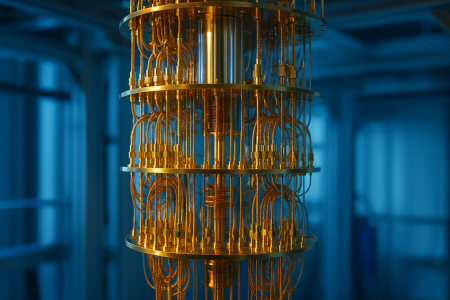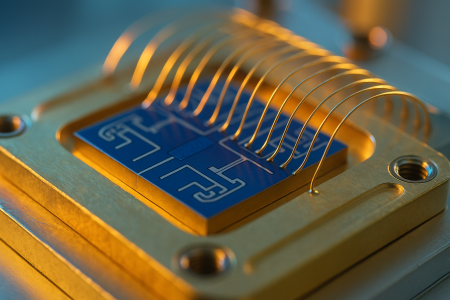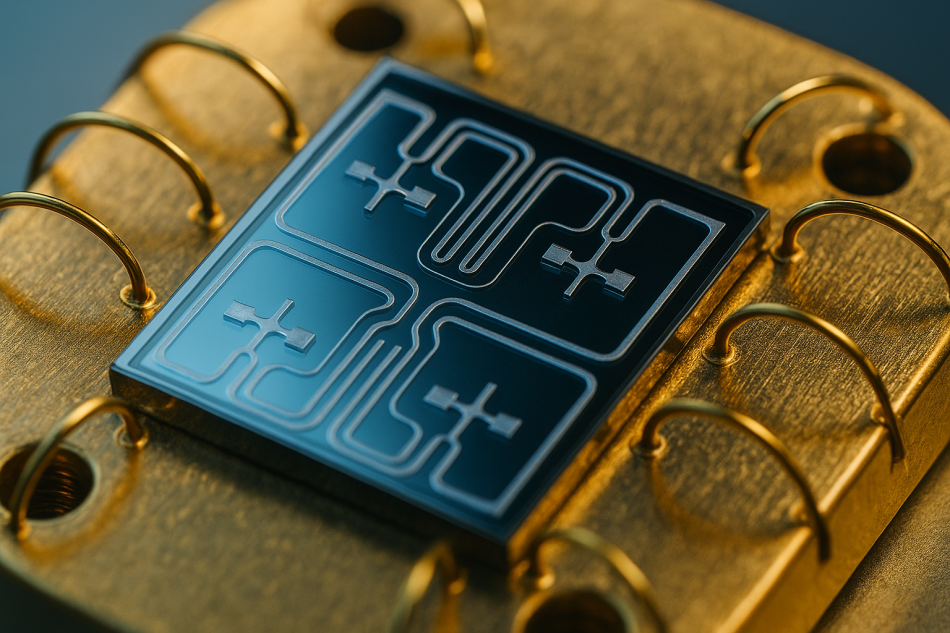

Peer inside a superconducting quantum processor from IBM, Google, or Rigetti and you will find, at the core of every qubit, a device so small you would need an electron microscope to see it clearly. It is called a Josephson junction, and it is the single component that turns an ordinary electrical circuit into something that can behave like a quantum bit. Without it, a superconducting qubit is just a resonator that hums at one frequency. With it, the circuit gains the strange, uneven energy structure that lets engineers isolate two levels and call them 0 and 1.
A sandwich a few atoms thick
A Josephson junction is deceptively simple to describe. Take two pieces of superconducting metal, usually aluminum, and separate them with a barrier of insulator so thin it is measured in nanometers. In most fabrication recipes the insulator is aluminum oxide, formed by letting a whisper of oxygen react with the metal surface. Classically, an insulator should block current. But when the gap is thin enough and the metal is cold enough to superconduct, pairs of electrons tunnel straight through it without any voltage pushing them. This is the Josephson effect, predicted by Brian Josephson in 1962 while he was still a graduate student.
What makes the junction special for quantum computing is not just that current flows. It is how the current relates to the quantum phase across the barrier. In an ordinary inductor, energy grows in a smooth, symmetric bowl, and the allowed energy levels are evenly spaced like rungs on a ladder. Evenly spaced rungs are useless for a qubit, because any pulse that drives the 0-to-1 transition would just as happily drive 1-to-2 and beyond. The junction bends that bowl into a lopsided shape. Its energy depends on the cosine of the phase, not a simple square, and that nonlinearity spreads the rungs unevenly.
Why the unevenness matters
That unevenness is called anharmonicity, and it is the whole point. Because the gap between the first two levels differs from the gap between the second and third, a carefully tuned microwave pulse can nudge the qubit from 0 to 1 while leaving the higher states alone. The transmon design, which dominates the industry today, deliberately trades some of that anharmonicity for insensitivity to electrical noise, but it still leans entirely on the junction to provide any anharmonicity at all. Remove the junction and the trick evaporates.
Engineers also use the junction as an adjustable knob. By wiring two junctions together in a small loop, called a SQUID, they can tune the effective inductance with a magnetic field, which shifts the qubit frequency on demand. That tunability underpins many two-qubit gates and the tunable couplers that switch interactions on and off. The same element that defines the qubit also helps control it.
The blessing and the curse
The junction gives, and the junction takes away. Because so much of a qubit's identity is set by that thin oxide layer, tiny variations in its thickness and area translate directly into variations in qubit frequency. A junction that comes out a few percent off target lands the qubit at the wrong frequency, which is a major source of the yield and frequency-crowding headaches that plague large chips. Fabrication teams spend enormous effort trying to make junctions reproducible across a wafer.
The oxide is also a suspected home for two-level defects, microscopic imperfections in the amorphous barrier that can absorb energy from the qubit and shorten its coherence time. Some of the field's recent material experiments, including swapping metals and refining deposition, are aimed squarely at cleaning up the junction and its surroundings. There is even active research into so-called junction-free or high-quality-barrier approaches, though nothing has displaced the classic aluminum-oxide-aluminum recipe at scale.
A component the whole field is built on
It is worth appreciating how much rides on this one part. When a company announces a processor with hundreds of qubits, it is announcing hundreds or thousands of these junctions, each fabricated within tight tolerances, each cooled to a fraction of a degree above absolute zero, each expected to behave. The roadmaps that promise error-corrected machines assume that junction fabrication keeps improving in uniformity and quality. The physics of the Josephson effect has been settled for decades. The engineering of making millions of nearly identical junctions is very much a live problem, and it is one of the quiet reasons superconducting quantum computing is both so far along and so hard.