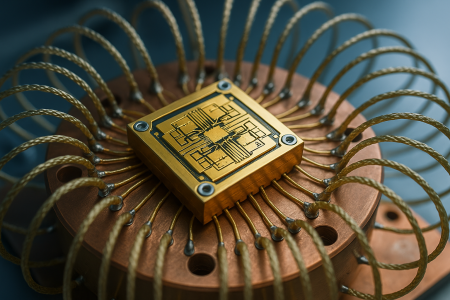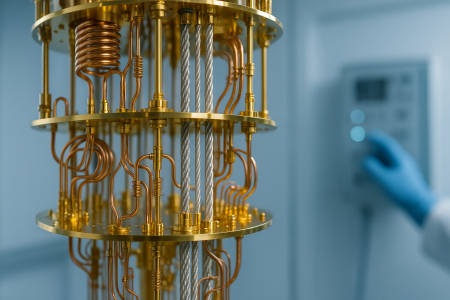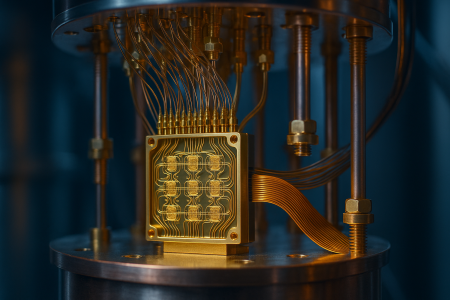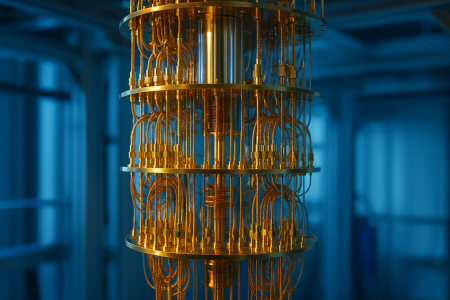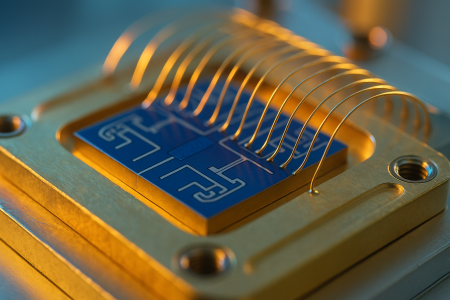

Strip away the gold-plated wiring, the refrigerators the size of a phone booth, and the racks of control electronics, and most of today's quantum computers come down to a single ingredient repeated over and over: the Josephson junction. It is a stunningly simple object. Two pieces of superconducting metal, usually aluminum, are separated by an insulating barrier so thin it is measured in atoms. Yet that little sandwich is what turns an ordinary electrical circuit into a qubit.
Why an ordinary circuit won't do
A qubit needs two things a normal circuit can't provide. First, it has to store energy without losing it, which is why superconductors are used at all: below a critical temperature, they carry current with zero resistance. Second, and this is the subtle part, the circuit has to be nonlinear. In a plain loop of wire and capacitor, the energy levels are evenly spaced, like rungs on a ladder set at equal intervals. If you try to nudge the system from its ground state to the first excited state, the same nudge will happily kick it higher still. You can't isolate a clean two-level system, which is exactly what a qubit is supposed to be.
The Josephson junction breaks that even spacing. When superconducting current tunnels across the thin insulating gap, it behaves in a way that classical physics forbids. The result is a nonlinear inductor, which bunches the energy levels together unevenly. Now the gap between the lowest two states differs from the gap to the next one up. Engineers can tune their microwave pulses to talk only to those bottom two levels and leave the rest alone. That single trick is what makes the transmon, the workhorse of superconducting quantum computing, possible.
Built from a shadow
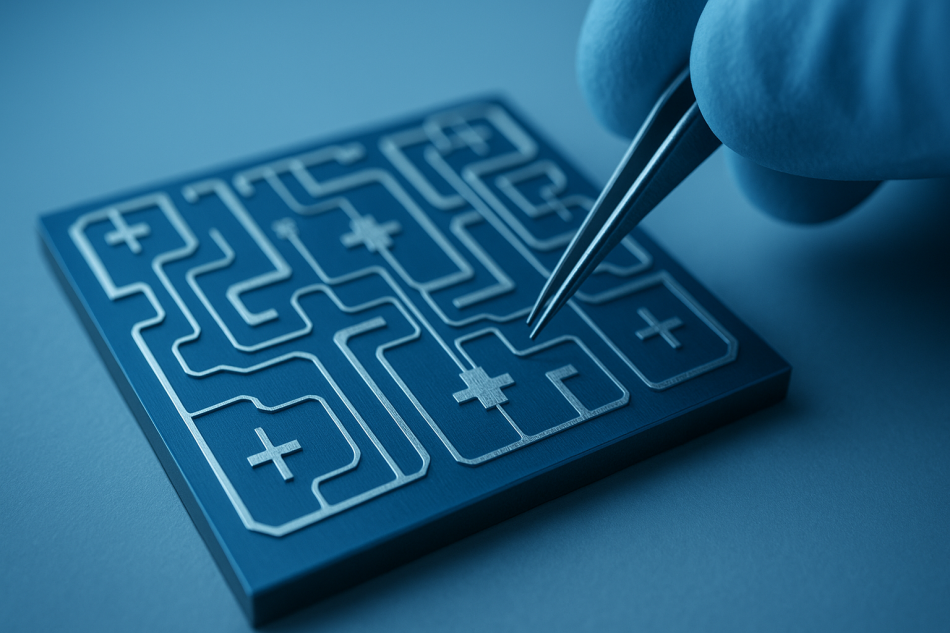
Making one of these junctions is closer to a darkroom process than to conventional chip manufacturing. The most common recipe is called shadow evaporation, or the Dolan bridge technique. Engineers pattern a suspended stencil above the chip, then evaporate a layer of aluminum at one angle. They let the fresh metal sit in oxygen for a controlled time so a barrier of aluminum oxide grows across the surface, just a nanometer or two thick. Then they evaporate a second aluminum layer from a different angle, so it overlaps the first only where the stencil's shadow allows. Where the two layers meet, separated by that grown oxide, you have your junction.
The elegance hides a headache. The tunneling current through a junction depends exponentially on the barrier thickness. Add or subtract a single layer of atoms and the junction's properties shift dramatically. That is why two junctions fabricated side by side in the same run can end up with qubit frequencies that differ by more than the designers wanted. In a machine with hundreds of qubits, some of them will inevitably drift close enough in frequency to interfere with each other or with the control signals meant for their neighbors.
The variability problem
This fabrication scatter is one of the quieter reasons scaling is hard. It isn't enough to make a good junction; you have to make thousands of nearly identical ones, and then be able to predict which frequency each will land on before you wire up the control hardware. Teams have attacked the problem from several directions. Some laser-trim junctions after fabrication, gently annealing them to nudge each qubit toward a target frequency. Others have moved away from the classic Dolan bridge toward overlap or Manhattan-style geometries that promise tighter, more repeatable control of the junction area.
The barrier itself is also under suspicion. Amorphous aluminum oxide is riddled with defects known as two-level systems, tiny microscopic fluctuators that can absorb a qubit's energy and shorten its coherence. Researchers are experimenting with crystalline barriers, epitaxial growth, and alternative materials in the hope of building junctions that are both more uniform and less lossy.
Why it still matters
You could be forgiven for thinking the junction is a solved problem, given how casually roadmaps promise thousands of qubits. But every one of those qubits inherits the junction's quirks. Frequency scatter drives the calibration burden. Barrier defects cap coherence times. Aging, where a junction's resistance slowly creeps over weeks after fabrication, complicates the whole predict-and-tune pipeline. The path to a large, reliable machine runs straight through this one component.
It is a strange fact of the field that a device Brian Josephson predicted as a graduate student in 1962, decades before anyone talked about quantum computers, now sits at the center of a multibillion-dollar engineering race. The physics is settled. Manufacturing millions of these switches to the same spec, run after run, is the work that remains.