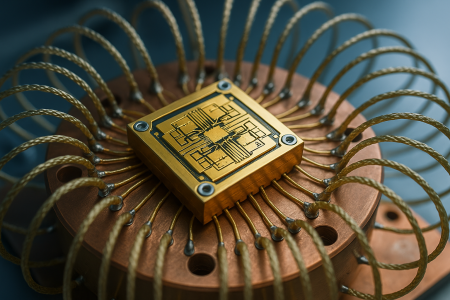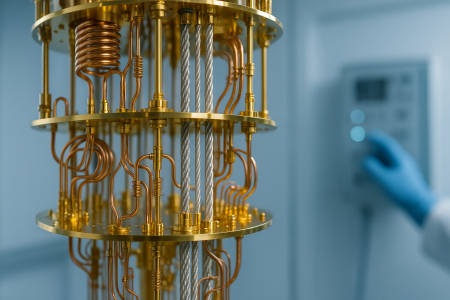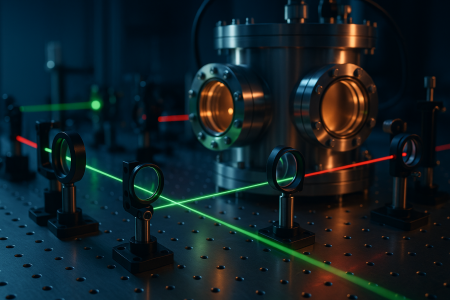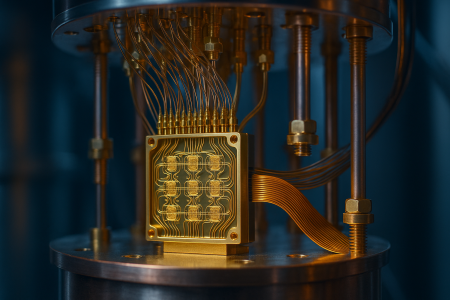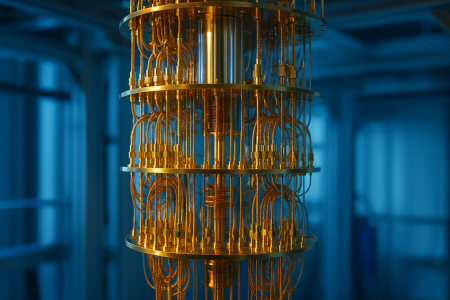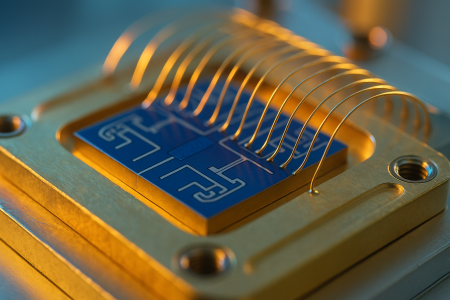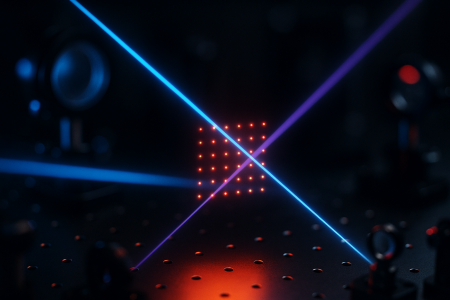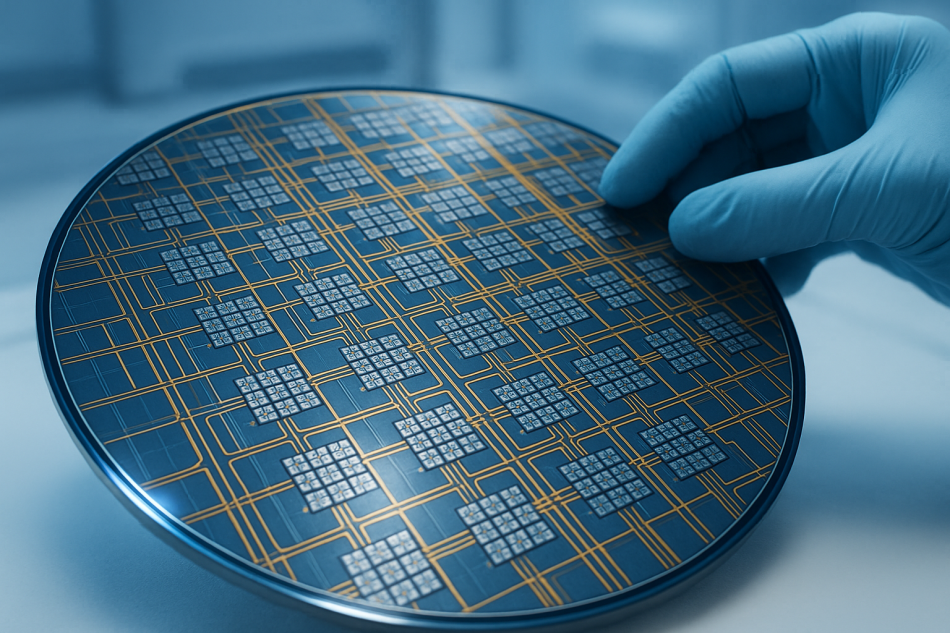

Ask how big a quantum computer is and you will get a number: 100 qubits, 1,000 qubits, someday a million. It sounds like counting transistors. It is not. The qubits in that headline are almost always physical qubits, the fragile bits of hardware etched onto a chip or held in a vacuum trap. The qubit that actually runs an algorithm without collapsing into nonsense is a different animal entirely. It is called a logical qubit, and it is built out of many physical ones stitched together.
Two ways to count
A physical qubit is a single quantum object: a superconducting loop, a trapped ion, a neutral atom. Left to its own devices it forgets its state in microseconds to milliseconds, and every gate you apply to it has some chance of going wrong. Today's best physical qubits fail somewhere around one time in a thousand per operation. That sounds impressive until you realize a useful algorithm may need billions of operations in sequence. A one-in-a-thousand error rate guarantees the answer is garbage long before the program finishes.
A logical qubit is the fix. Instead of trusting one physical qubit to hold your information, you spread that information across a whole cluster of them and constantly check for errors using extra qubits set aside for the job. The redundancy lets the machine detect and correct mistakes faster than they accumulate. The result behaves like a single, far more reliable qubit. Its effective error rate can be pushed arbitrarily low by adding more physical qubits, as long as the underlying hardware is already good enough to sit below a critical threshold.
The exchange rate
Here is the catch that makes the two numbers so different. The ratio of physical qubits to a single logical qubit is not two or three. Depending on the error-correcting code and the target reliability, it can be dozens, hundreds, or over a thousand. A commonly cited figure for surface-code machines is that a single high-quality logical qubit might demand around a thousand physical qubits once you account for the correction machinery and the buffer needed to run deep algorithms.
Run the arithmetic and the famous roadmap milestones look different. A processor advertising a few thousand physical qubits might deliver only a handful of logical ones. The million-qubit targets that companies talk about are, in large part, an admission of this exchange rate: you need that many physical qubits precisely because the useful count after error correction is so much smaller. When a vendor claims a genuine logical qubit, it is a far more meaningful statement than a raw hardware tally.
Why the distinction gets blurred
Marketing has a strong incentive to quote the bigger number, and for years there was no logical qubit to quote at all. The entire current era of hardware runs on bare physical qubits with software tricks to squeeze out approximate answers. That is why you hear about noisy machines that can run interesting demonstrations but cannot be trusted for exact, long computations.
What has changed recently is that logical qubits have stopped being purely theoretical. Experiments across several hardware platforms have demonstrated the core promise: that adding more physical qubits to a logical block actually lowers its error rate rather than raising it. Crossing that line, from redundancy that hurts to redundancy that helps, is the moment quantum error correction earns its keep. It means the strategy scales, at least in principle.
What to watch for
When you read the next hardware announcement, a few questions separate hype from substance:
- Is the quoted number physical or logical? If it is not stated, assume physical.
- What is the logical error rate, and does it improve as the code grows? A single number tells you little; the trend tells you whether the approach works.
- How many logical qubits can the machine hold at once, and can they interact? One protected qubit is a science result. Dozens that can run gates together start to resemble a computer.
The logical qubit is the unit that ultimately matters, because it is the one an algorithm designer can actually program against without worrying that noise will erase the work. Physical qubits are the raw material. The real measure of progress is how efficiently a machine converts thousands of the former into even one dependable copy of the latter, and how many of those it can juggle at the same time. Until the field routinely reports both numbers, the qubit count on the box is only half the story.