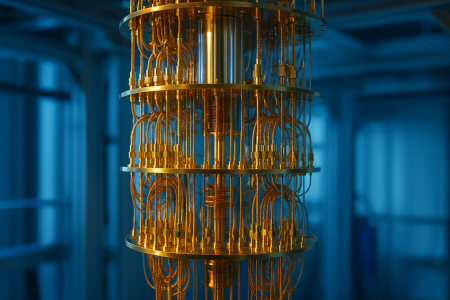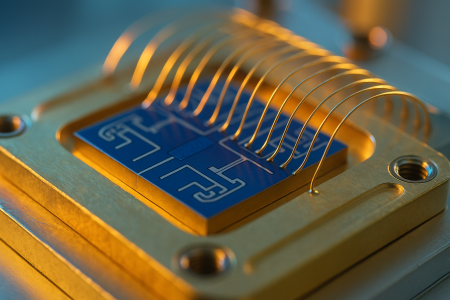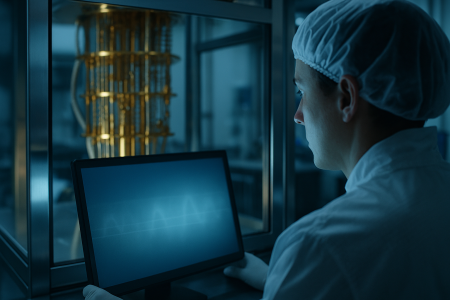

Ask a quantum physicist which problem a quantum computer is actually built for, and the answer is rarely codebreaking or stock portfolios. It is chemistry. Simulating molecules and materials is the application that maps most cleanly onto what these machines do, and it is the reason names like IBM, Google, Quantinuum, and a long list of startups keep pointing at drug discovery and battery design when they describe the payoff.
Why molecules are quantum in the first place
The electrons that hold a molecule together do not behave like tiny billiard balls. They exist in a haze of overlapping probabilities, entangled with one another, occupying states that classical physics cannot cleanly describe. To predict how a molecule will react, bind to a protein, or conduct electricity, you need to track that quantum behavior.
A classical computer can do this, but the cost explodes. Each additional electron multiplies the number of configurations the machine has to juggle. Push past a few dozen strongly interacting electrons and even the world's largest supercomputers fall back on approximations. Some of those approximations are excellent. Some quietly fail for exactly the molecules chemists care about most, like the iron-rich clusters at the heart of nitrogen-fixing enzymes.
A quantum computer sidesteps the explosion because its qubits are themselves quantum objects. Instead of storing every possibility as a separate number, it represents the molecule's quantum state directly in hardware. The matching of problem to machine is the whole appeal. Richard Feynman pointed at this idea decades ago: to simulate nature, build your simulator out of the same stuff nature uses.
What that looks like in practice
The textbook target is the ground-state energy of a molecule, the lowest-energy arrangement of its electrons. Get that number accurately and you can predict reaction rates, stability, and a great deal of useful chemistry. The leading near-term approach is a hybrid one. A quantum processor prepares a trial state and measures it, a classical computer adjusts the parameters, and the two trade results back and forth until the energy settles. This is the variational quantum eigensolver, and it has been run on real hardware for small molecules like hydrogen and lithium hydride.
Those demonstrations are genuine, but they are also tiny. The molecules involved can be solved on a laptop in seconds. The point was never the chemistry. It was proving the machinery works end to end, from circuit to measurement to answer.
Where it gets hard
The gap between a hydrogen molecule and an industrially interesting catalyst is enormous, and noise is the reason. Estimating a molecule's energy precisely means running deep circuits and measuring the same quantity many times to beat down statistical error. On today's noisy processors, the errors pile up faster than the useful signal. Researchers lean on error-mitigation tricks to claw back accuracy, but those tricks cost exponentially more measurements as the system grows.
There is also a sampling cost specific to chemistry. The energy of a molecule breaks into a sum of many separate terms, sometimes thousands, each of which must be measured on the quantum chip. Clever grouping schemes help, but the bill remains steep. Estimates for simulating a serious catalyst at chemical accuracy tend to land on hundreds or thousands of fault-tolerant logical qubits running billions of operations, which means error correction at full strength, not the noisy machines we have now.
Why people still bet on it
Despite the distance, chemistry stays at the top of the list for a simple reason: the value is concrete and the science is real. A better catalyst for making ammonia fertilizer would touch the global energy budget. Faster screening of candidate molecules could shorten the brutal timelines of drug development. New battery electrolytes and room-temperature superconductors are the kind of materials a true quantum simulator could illuminate where classical methods stall.
The honest near-term story is more modest. Quantum chemistry on current hardware is mostly a research tool and a proving ground, often paired with classical supercomputers that do the heavy lifting while the quantum chip handles a small, hard core of the problem. Companies are building software stacks now so that the moment error-corrected machines arrive, the chemistry workflows are ready to scale.
That is the bet. Not that quantum computers will replace the chemist's toolkit tomorrow, but that the first problem worth the staggering cost of a fault-tolerant machine will be the one written into the molecules themselves.