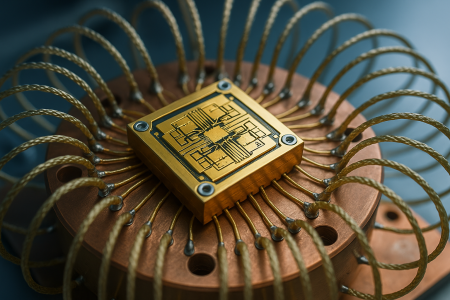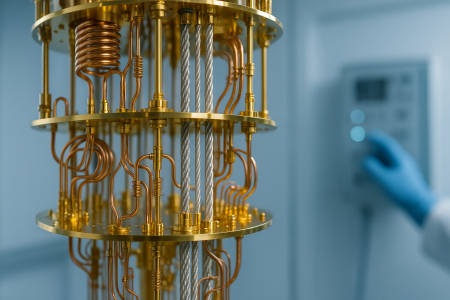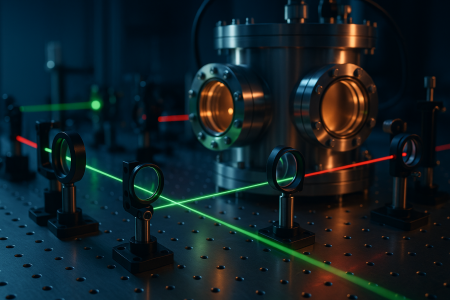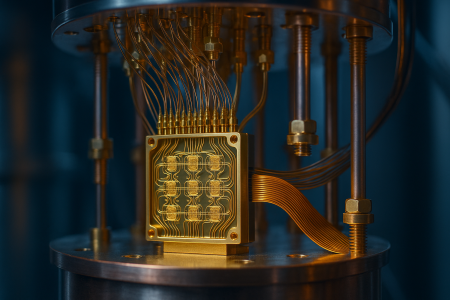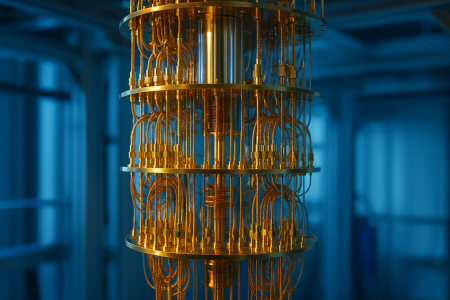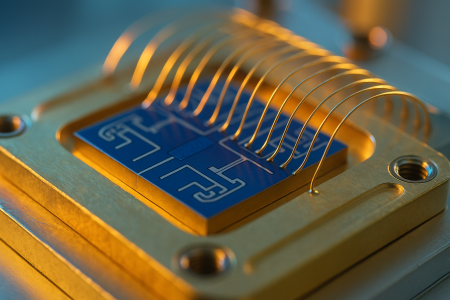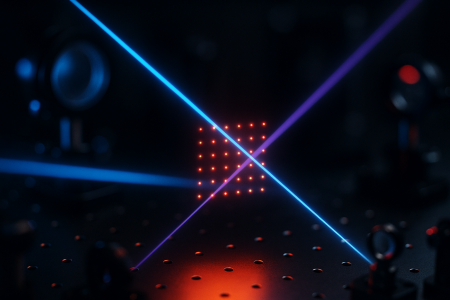

Ask a physicist to draw a quantum algorithm and you will get a tidy diagram of boxes and lines: a Hadamard here, a controlled-NOT there, a rotation somewhere else. It looks like a universal language. It is not. Every real quantum computer can only perform a small, fixed menu of physical operations, and that menu is different from one machine to the next. Before your program can run, it has to be rewritten entirely in terms of whatever moves the target hardware happens to support. That rewriting is one of the most consequential and least glamorous steps in the whole stack.
Why hardware only knows a few moves
A qubit does not understand the abstract idea of a Hadamard gate. It understands a laser pulse of a certain duration and phase, or a microwave burst at a particular frequency, or a carefully shaped voltage. Each of those physical actions implements one specific operation with high fidelity. Everything else the machine can do is built by stringing those primitives together.
The set of primitives a machine executes directly is called its native gate set. Superconducting processors from Google and IBM tend to favor a couple of single-qubit rotations plus one two-qubit entangling gate, such as a CZ or an iSWAP-like interaction, chosen because that is what their couplers do cleanly. Trapped-ion systems from IonQ and Quantinuum lean on Mølmer-Sørensen interactions, which entangle ions through their shared motion. Neutral-atom machines build entanglement from the Rydberg blockade. None of these speaks the textbook CNOT natively. They approximate it.
The transpiler does the translating
The software that performs the rewrite is usually called a transpiler or compiler. Feed it a circuit written in convenient abstract gates and it produces an equivalent circuit built only from the target machine's native operations. A single CNOT might become a short sequence of rotations wrapped around the hardware's real entangling gate. A three-qubit Toffoli, trivial to write down, can decompose into six or more two-qubit gates plus a pile of single-qubit rotations.
That decomposition is where the cost hides. On today's noisy hardware, every physical gate you add is another chance for an error to creep in, and two-qubit gates are by far the noisiest. A program that looks lean on paper can balloon once it is expressed in native operations, and the deeper the resulting circuit, the more the final answer degrades. Two transpilers targeting the same chip can produce circuits of very different length for the same algorithm, which is why compiler quality is a real competitive lever, not an afterthought.
Routing on top of translating
Translation is only half the job. Most processors cannot entangle any two qubits at will; they can only interact with physical neighbors. So the transpiler also has to map the abstract qubits in your program onto physical qubits on the chip, and when two qubits that need to talk are not adjacent, it inserts SWAP operations to shuffle their states into position. Each SWAP is itself several two-qubit gates. A poor mapping can double the gate count before any useful computation happens.
This is why a circuit that runs beautifully on an all-to-all connected ion trap may run poorly on a fixed-lattice superconducting chip, and vice versa. The algorithm is the same. The dialect and the road network are not.
Why this matters for the roadmaps
As machines grow, the compiler layer grows with them. Vendors now ship increasingly sophisticated toolchains that fuse redundant rotations, cancel gates that undo each other, and search for qubit mappings that minimize SWAP traffic. Some go further and let advanced users drop below the gate abstraction entirely, shaping the analog pulses that implement each operation to squeeze out a little more fidelity.
For error-corrected machines the stakes shift again. Logical operations have their own native set, and the compiler must express algorithms in terms of what a given error-correcting code makes cheap or expensive, which is often not what looks natural on paper. The mismatch between how humans want to describe quantum programs and what silicon and atoms actually do is not going away. Bridging it, cleverly, is quietly one of the field's most valuable engineering problems.