
Building a single logical qubit out of error-correcting code is hard enough. But a useful computation needs those logical qubits to interact, to entangle, to feed results into one another. The obvious question rarely gets asked in the hype: once you have wrapped your delicate quantum information inside a surface code, how do two of these protected blobs actually perform a gate together? The leading answer has an unusually physical name. It is called lattice surgery, and it works roughly the way it sounds.
Why you can't just wire them together
In a bare quantum processor, two qubits interact through a direct entangling gate. You bring them close, apply a pulse, and they become correlated. That approach breaks down the moment you switch to logical qubits. A logical qubit in the surface code is not a single physical thing you can poke. It is a patch of many physical qubits arranged on a grid, with the actual information smeared across the whole patch in a way that no single measurement can reveal. That smearing is the point. It is what makes the code able to catch and fix errors. But it also means there is no single spot to grab when you want to interact two logical qubits.
You could try to physically move one patch next to another and run gates between the individual physical qubits along the boundary. That works in principle, but it is clumsy, and it risks the very thing error correction is supposed to prevent: letting an error on one physical qubit corrupt the protected information before the code can respond.
Merging and splitting patches
Lattice surgery takes a cleaner route. Picture two square patches of surface code sitting on a chip with a gap between them. To perform a joint operation, you temporarily switch on the error-correction measurements in that gap, stitching the two patches into one larger patch. This is the merge. The combined patch is now measured as a single object over several rounds of error correction. Then you turn those middle measurements off again, splitting the two patches back apart.
The clever part is what that merge-and-split sequence accomplishes. It effectively measures a joint property of the two logical qubits, something like the parity of both qubits taken together, without ever measuring either one individually. In the language of quantum gates, that joint parity measurement is exactly the ingredient you need to build a controlled-NOT between the two logical qubits. No fragile physical qubit ever holds the whole answer, and the error correction keeps running the entire time.
Why it fits the hardware
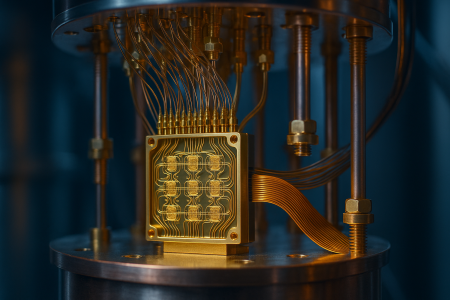
Lattice surgery became the favored scheme for a practical reason: it only needs interactions between physical qubits that sit right next to each other on a two-dimensional grid. That matches how superconducting chips and many other platforms are actually laid out. You do not need to route long-distance connections or shuttle qubits across the device. You just extend the existing pattern of nearest-neighbor measurements into the gap and then retract it. Everything happens through the same syndrome-extraction machinery the processor already runs to detect errors.
There is a cost, and it is one of the reasons big error-corrected machines look so large on paper. Each logical operation consumes space and time. Merging two patches means the region between them has to be dedicated to that operation for several rounds. Complex algorithms schedule these merges and splits like traffic through an intersection, and the layout of patches on the chip starts to resemble a floor plan, with corridors reserved for qubits that need to reach each other. Combined with the magic-state factories needed for the harder gates, lattice surgery is a big part of why researchers talk about millions of physical qubits to run a useful fault-tolerant program.
From diagrams to demonstrations
For years lattice surgery lived mostly in theory papers, sketched as colored tiles being fused and cut. That has started to change. Groups working with both superconducting and neutral-atom hardware have demonstrated the basic merge-and-split moves on small codes, showing that two encoded qubits can be entangled through the procedure while the error correction stays active. These are early, small-scale results, not full fault-tolerant computers. But they matter because lattice surgery is the connective tissue of the whole fault-tolerant vision. Every roadmap that promises logical qubits doing real work is, underneath the marketing, promising that operations like these will scale. Getting the cut-and-paste to work reliably is one of the quiet milestones on the road to a machine that can actually finish a hard calculation.