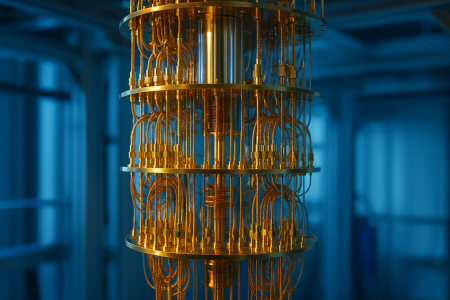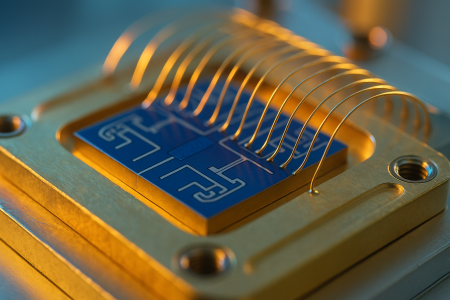

Ask how a quantum computer works and you will usually hear a familiar story. You prepare some qubits, apply a choreographed sequence of gates that rotate and entangle them, and read out the result at the very end. That is the circuit model, and it underpins the machines built by IBM, Google, IonQ and most others. But it is not the only way to compute with quantum mechanics, and a competing idea has quietly shaped the roadmaps of the biggest photonic quantum computing efforts.
Compute by taking apart
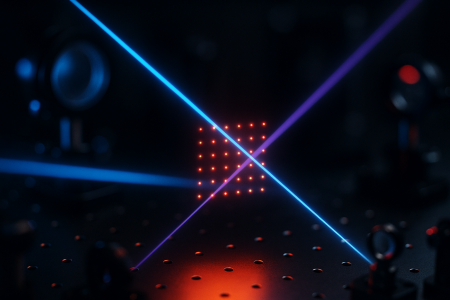
The alternative is called measurement-based quantum computing, sometimes the one-way model. The name captures its strangeness. Instead of building up a computation step by step with gates, you first create a large, highly entangled resource state known as a cluster state. Think of it as a grid of qubits all pre-woven together into one enormous knot of correlations. The actual program has not been run yet. All the useful structure is latent in the entanglement.
You then run the computation by measuring qubits, one after another, and throwing them away. Each measurement destroys a qubit but nudges the quantum information along into the ones still standing. The trick is that you get to choose the angle at which you measure each qubit, and that choice is your program. A different pattern of measurement angles carries out a different algorithm on the same starting cluster. By the time you reach the last handful of unmeasured qubits, they hold the answer.
It feels backwards, and in a sense it is. In the circuit model, entanglement is generated as you go. In the one-way model, entanglement is the fuel you burn. Computation becomes an act of controlled demolition rather than construction.
The feed-forward catch
There is a wrinkle that makes this harder than it sounds. Quantum measurements are random. When you measure a cluster qubit, you get one of two outcomes essentially by chance, and each outcome applies a slightly different unwanted rotation to the information that flows onward. If you ignored this, the randomness would scramble your result.
The fix is adaptivity. You keep a running record of the outcomes and use them to adjust the measurement angles for later qubits, correcting for the accumulated randomness on the fly. This is called feed-forward, and it demands fast classical processing sitting right beside the quantum hardware, reading each outcome and computing the next basis in real time. The classical controller is not an afterthought here. It is woven into the middle of the computation.
Why photonics loves it
Measurement-based computing might sound like an academic curiosity, but it is the natural fit for light. Photons make wonderful carriers of quantum information because they barely interact with their environment, which means long-lived coherence. That same aloofness makes it painfully hard to get two photons to interact strongly enough for a clean two-qubit gate. Circuit-model gates on photons tend to be probabilistic and lossy.
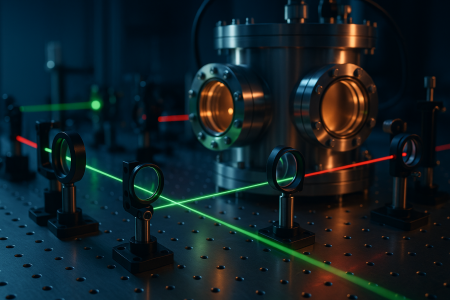
Measurement, on the other hand, is something photonic systems do superbly. Single-photon detectors are fast and precise. So the strategy adopted by companies pursuing photonic machines is to stitch together small entangled bundles of photons into a large cluster or its close cousin, then compute by detecting photons. Related schemes go by names like fusion-based quantum computing, where small resource states are fused together with measurements to build the fabric of the computation itself.
The bookkeeping is the same underneath
It is worth stressing that the one-way model is not more powerful than the circuit model, nor less. Anything one can do, the other can do, and there are recipes for translating between them. A circuit with a certain number of gates maps to a cluster of a certain size and a corresponding measurement pattern. The choice between them is engineering, not physics: which model plays to the strengths of your hardware and the weaknesses you are trying to route around.
Error correction carries over too. Fault-tolerant versions of the one-way model weave the redundancy of codes like the surface code directly into the structure of the cluster, so that measuring the resource state also performs the syndrome extraction that catches errors. For photonic architectures betting on room-temperature operation and manufacturable chips, that unification of computation, measurement and error correction into a single flow of detections is a large part of the appeal.
The circuit model still dominates the headlines and the qubit-count races. But when you read a photonic company's roadmap and see talk of cluster states and fusions rather than gates, this is the machine they mean. It computes by letting qubits go.