
Every superconducting qubit faces the same awkward trade-off. To find out what state it is in, you have to connect it to the outside world through a readout resonator and a transmission line. That connection is how the answer gets out. It is also a hole through which the qubit's energy can leak away. The faster and easier you make the readout, the faster the qubit tends to decay. Solving that tension is the job of a small, unglamorous piece of on-chip engineering called the Purcell filter.
Why reading a qubit is dangerous
A transmon qubit does not get measured directly. Instead it is coupled to a nearby microwave resonator whose frequency shifts slightly depending on whether the qubit is a 0 or a 1. You send a pulse at the resonator, listen to how it bounces back, and infer the qubit state from the phase or amplitude of the returning signal. This is dispersive readout, and it is the workhorse method across most superconducting machines.
The problem is named after Edward Purcell, who noticed decades ago that an atom's rate of spontaneous emission depends on its electromagnetic surroundings. A qubit coupled to a resonator that is itself coupled to an open transmission line can dump its energy down that line, even when you are not trying to measure it. The qubit behaves as if it has sprung a slow leak. This Purcell decay sets a ceiling on the qubit's T1 lifetime that has nothing to do with material defects or stray radiation. It is purely a consequence of the readout wiring being too welcoming.
The tug-of-war between speed and life
Designers could simply weaken the coupling between resonator and qubit, or between resonator and line. That would slow the leak. But it would also slow the measurement, because a weakly coupled resonator responds sluggishly and takes longer to reveal the qubit state. Slow readout is its own enemy: the longer you spend measuring, the more chance the qubit has to decay during the measurement itself, and the fewer shots you can run per second. On large machines that also drags down throughput metrics that vendors care about.
What engineers want is a connection that behaves differently depending on frequency. It should be wide open at the resonator's frequency, so the measurement signal flows freely and the readout is quick. It should be nearly closed at the qubit's frequency, so the qubit cannot see the outside world and cannot leak. That is exactly what a Purcell filter provides.
A frequency-selective gate
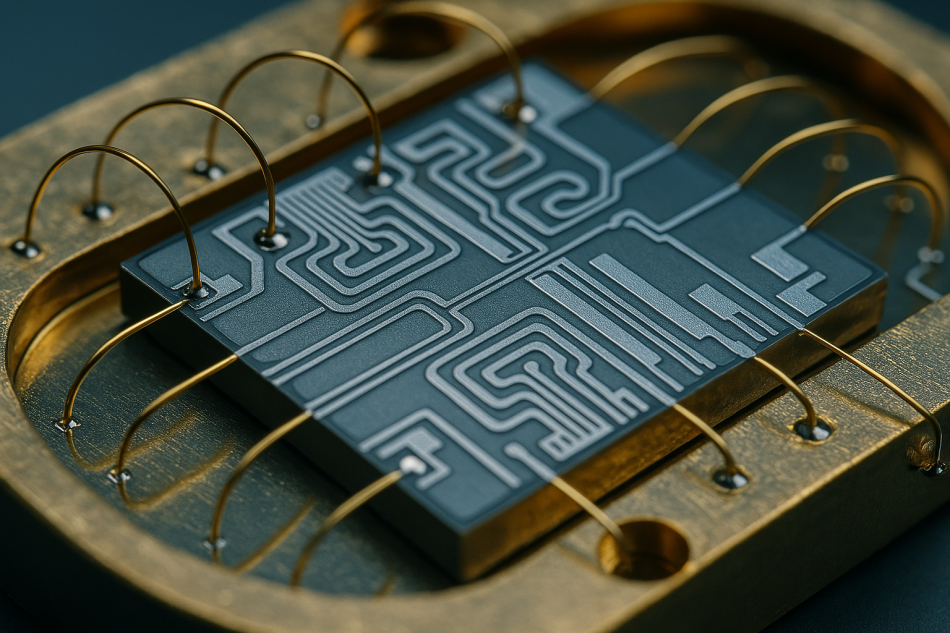
The filter is essentially a second microwave structure placed between the readout resonator and the transmission line. It is tuned to pass signals near the readout frequency and to reject signals near the qubit frequency. Because the qubit and resonator sit at deliberately different frequencies, the filter can treat them differently. To the measurement pulse the filter looks transparent. To the qubit's energy trying to escape, the filter looks like a wall.
Filters come in a few flavors. A simple bandpass filter uses a resonant element tuned to the readout band. A notch or stub filter is engineered to present a very high impedance precisely at the qubit frequency, choking off that escape route while leaving the readout path clear. More recent designs put a single filter in front of many qubits at once, so an entire row of readout resonators shares one piece of frequency-selective plumbing rather than each needing its own.
Why it matters for scaling
Purcell filters look like a detail, but they sit at the heart of a broader theme in quantum hardware: you cannot optimize the qubit in isolation. Coherence time, readout fidelity, and readout speed are entangled through the wiring, and improving one usually costs another unless you add a clever structure to break the trade. The filter is what lets a designer push readout to hundreds of nanoseconds while keeping qubit lifetimes in the hundreds of microseconds.
As processors grow, the pressure only intensifies. Fast, high-fidelity measurement is essential for error correction, which demands repeated mid-circuit readout of many qubits without disturbing their neighbors or draining them. A shared or compact Purcell filter that scales to hundreds and eventually thousands of readout channels is now part of serious hardware roadmaps. It rarely makes headlines next to qubit counts. But every time a machine reads its qubits quickly and still boasts long coherence, some version of Purcell's old insight is quietly doing its job on the chip.