
A quantum computer rarely runs a program just once. It runs the same circuit hundreds or thousands of times, collects the statistics, and reads an answer out of the pattern. That means before every fresh run, the machine has to return each qubit to a known starting point, almost always the ground state labeled zero. Skip that step, or do it badly, and the next calculation begins with garbage smuggled in from the last one.
This chore has a name: reset. It sounds trivial next to gates and error correction, but reset quietly sets the pace of the whole machine. If clearing the qubits takes longer than running the circuit itself, most of the computer's time is spent waiting, not computing.
The lazy way and why it hurts
The simplest reset is patience. A superconducting qubit left alone will eventually decay from its excited state back to the ground state on its own, the same T1 relaxation that limits how long it can hold information. Just wait several times the T1 lifetime and the qubit almost certainly settles to zero.
The trouble is arithmetic. If a qubit's T1 is around a hundred microseconds, waiting long enough to be confident it has relaxed can eat several hundred microseconds per run. Multiply that by thousands of shots and dozens of qubits sitting idle in parallel, and the machine spends the bulk of its day doing nothing but cooling off. Worse, relaxation is probabilistic. Wait and you get a qubit that is probably in the ground state, not certainly. Those leftover excitations become a background error that no amount of clever gate work can undo.
Reset by measurement
The faster approach is to look. A mid-circuit measurement tells the control system whether a qubit is in zero or one. If it reads one, the machine applies a pulse to flip it back to zero. This is conditional, or feed-forward, reset: measure, decide, act, all inside a few microseconds.
It works, but it leans on two hard things. The readout has to be fast and accurate, because a misread leaves the qubit in the wrong state. And the classical electronics have to react quickly, deciding whether to send a correction pulse before the next operation begins. That closed loop, sensing a quantum state and feeding a decision back into the hardware in real time, is the same machinery that error correction depends on, so getting reset right is good practice for the harder job ahead.
Draining the energy away
A third family of methods skips both waiting and measuring. Instead, engineers give the qubit's excitation somewhere to go quickly. By coupling the qubit to a lossy readout resonator and driving the pair with carefully tuned microwave tones, they can shuttle the unwanted energy out of the qubit and dump it, pulling the qubit toward the ground state in a fraction of the natural relaxation time. This unconditional reset needs no measurement result, which sidesteps readout errors, though it demands precise calibration and adds another knob that can drift out of tune.
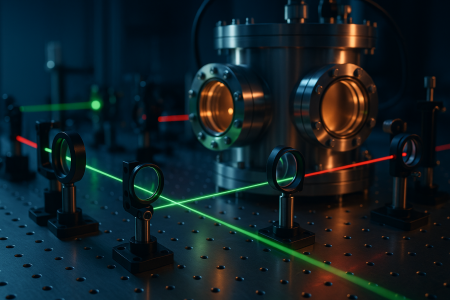
Trapped-ion and neutral-atom machines face their own version of the problem. There, resetting a qubit often means optical pumping: hitting the atom with laser light tuned so it keeps cycling until it lands in the desired state and stays there because that state no longer absorbs the light. It is remarkably clean, but it takes time and the scattered photons can disturb neighboring qubits if the geometry is not careful.
Why it shows up on the spec sheet
Reset rarely makes headlines, yet it feeds straight into the metrics that do. A machine's effective speed depends on how quickly it can cycle through shots, and reset is a fixed tax on every cycle. Reset fidelity, the odds a qubit truly lands in zero, becomes part of the total error budget alongside gate and readout errors. And in an error-corrected machine, ancilla qubits used to detect errors must be reset again and again during a single computation, so a slow or leaky reset would poison the very process meant to keep the machine honest.
None of this is glamorous. But a quantum computer is only as useful as the number of clean, trustworthy runs it can churn through in a day, and that number starts with an empty qubit. Getting to zero, fast and reliably, is one of the least celebrated skills a quantum machine has to master.