
Ask a superconducting qubit whether it is a zero or a one, and it will tell you. The trouble is the volume. The signal that leaves a qubit during readout carries roughly the energy of a handful of microwave photons, a whisper measured in billionths of a billionth of a watt. By the time that whisper reaches room-temperature electronics, it has to survive several feet of cable and a jungle of ordinary amplifiers, each of which adds its own hiss. Without help, the qubit's answer would drown long before anyone could read it.
The noise floor is not optional
Every amplifier adds noise. That is not a manufacturing flaw; it is baked into quantum mechanics. A phase-insensitive amplifier must, at minimum, add the equivalent of half a photon of noise for every unit of signal it boosts. That number is called the standard quantum limit, and the best commercial amplifiers used in radio astronomy and communications sit far above it, adding tens of photons of noise. Feed a qubit's few-photon signal into one of those and the answer vanishes into the background before the first stage of gain finishes.
The fix was to build a different kind of amplifier, one made from the same superconducting parts as the qubit itself. The Josephson junction, the nonlinear element at the heart of a transmon, turns out to be an excellent ingredient for amplification. Arrange a few junctions into a resonant circuit, pump it hard with a microwave tone, and the circuit will boost a weak incoming signal while adding almost nothing of its own. These devices are called Josephson parametric amplifiers, or JPAs. The good ones approach the quantum limit, adding close to that irreducible half-photon and no more.
Squeezing a signal out of nothing
The word parametric points at how the trick works. Instead of drawing energy from a power supply the way a normal transistor amplifier does, a parametric amplifier borrows energy from a strong pump tone and hands it to the weak signal. The circuit's resonant frequency is wiggled rapidly by the pump, and through that wiggling the faint qubit signal gets pumped up in strength. Because the process is driven by the pump rather than by dissipation, it can be remarkably quiet.
Some versions go further and produce squeezed light, rearranging quantum noise so that it piles up in one quadrature the readout does not care about while thinning out in the one it does. In principle this lets a measurement dip below the standard quantum limit for the part of the signal that matters. In practice, most labs are happy just to get near the limit reliably, run after run.
The bandwidth problem
The first JPAs had a nasty limitation. Because they relied on a sharp resonance, they could only amplify a narrow sliver of frequency and only handle a small signal before they saturated. A processor with dozens of qubits, each read out at its own frequency, needs something broader. That pushed the field toward the traveling-wave parametric amplifier, or TWPA. Instead of a single resonant pocket, a TWPA strings thousands of Josephson junctions into a long transmission line. The signal travels down the line alongside the pump, gaining strength the whole way. The result is an amplifier with gain across a wide band, enough to read many qubits at once through a single line.
Both flavors matter because readout is the choke point between a quantum processor and the classical world. Error correction, in particular, lives or dies on fast, accurate measurement. A surface code needs to measure its check qubits over and over, thousands of times, while the computation runs. Every measurement that comes back ambiguous forces the decoder to guess, and every guess erodes the protection the code is supposed to provide. A quieter first amplifier means shorter measurements, cleaner outcomes, and a decoder that spends less time untangling noise it should never have seen.
The unglamorous first inch
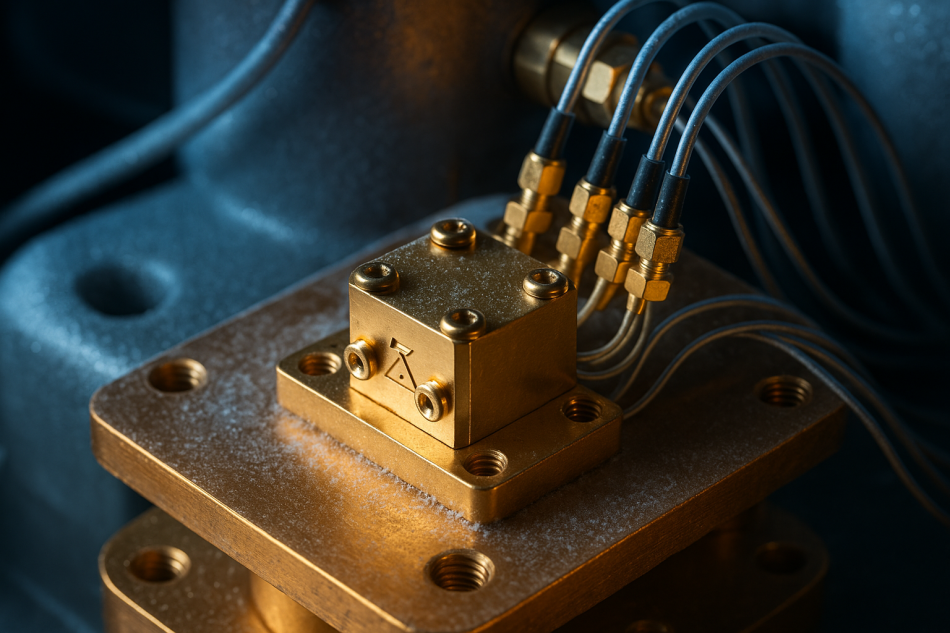
These amplifiers sit at the coldest stages of the dilution refrigerator, bolted just downstream of the qubit chip, because putting a warm, noisy component anywhere near the signal would defeat the purpose. They rarely make headlines. No roadmap slide brags about its parametric amplifiers. Yet the entire promise of a large fault-tolerant machine rests partly on this first inch of the signal chain, where a qubit's whisper either survives to be heard or disappears into the hiss forever.







