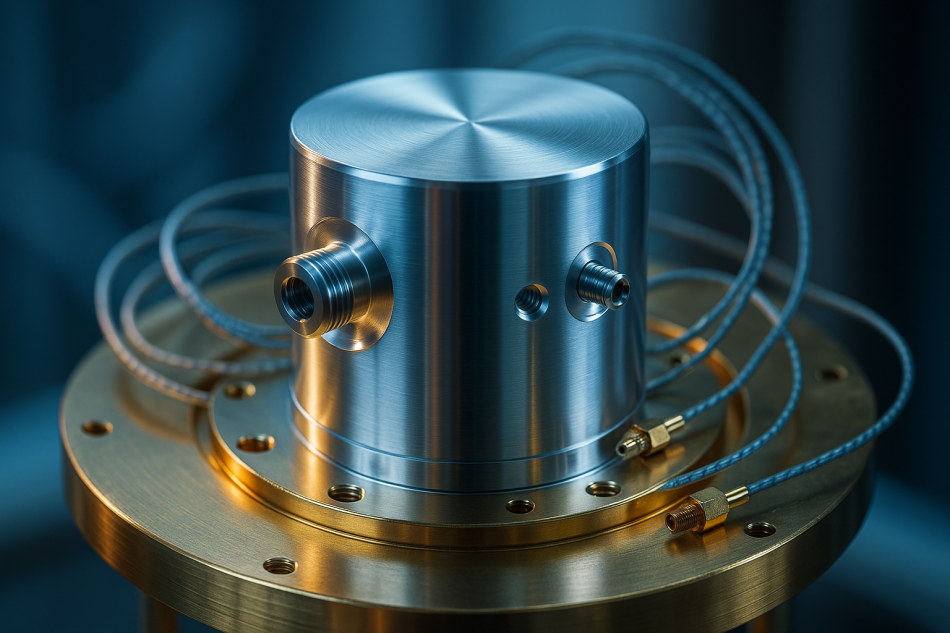

Most schemes for protecting quantum information look like a committee. Take the surface code: dozens or hundreds of physical qubits huddle together, constantly checking each other's work, so that one logical qubit can survive the chaos. It works, but it is expensive. A single fault-tolerant qubit might swallow a thousand imperfect ones.
There is another way to build in redundancy, and it hides in an unexpected place. Instead of spreading a qubit across many two-level systems, you can hide it inside the infinite ladder of states of a single quantum oscillator. That is the idea behind bosonic codes, and the most striking of them is the GKP code, named after Daniel Gottesman, Alexei Kitaev, and John Preskill, who proposed it in 2001.
An oscillator has room to hide
A superconducting cavity, or a mechanical mode, or a trapped ion's motion, is a harmonic oscillator. It does not have just two states. It has a whole tower of energy levels, and inside that tower there is a rich continuous space to play with, described by two quantities that behave like position and momentum. A single such mode carries, in principle, an unlimited amount of structure.
The trick is to encode one logical qubit not in the lowest two levels but in a carefully chosen pattern spread across that space. The GKP code does this by building a grid. Picture a checkerboard laid over the oscillator's position-momentum plane. The logical zero lives on one set of grid points, the logical one on another, interleaved. Because the information is smeared across a lattice, small nudges in either position or momentum move the state a little without pushing it all the way to a neighboring grid point.
Errors become a rounding problem
This is where the ruler metaphor earns its keep. The most common thing that goes wrong in a real oscillator is a small drift in position or momentum, or the loss of a single quantum of energy, which shifts the state by a tiny amount. In a GKP code, correcting that error means measuring how far the state has slipped from the nearest grid line and gently pushing it back. It is quantum error correction reframed as rounding to the nearest tick mark on a ruler.
The catch is that a perfect grid state would need infinite energy, an unphysical thing. Real GKP states are approximate: fuzzy peaks instead of infinitely sharp ones. The fuzzier the grid, the smaller the errors you can catch before you lose track of which tick you are near. Making sharper, more energetic grid states has been one of the central experimental challenges.
From theory to a real cavity
For years GKP was a beautiful idea that seemed too delicate to build. That changed as superconducting cavity experiments and trapped-ion setups grew precise enough to sculpt these grid states and, crucially, to correct them. Groups working with microwave cavities coupled to a single transmon qubit have prepared GKP states and run the error-correction cycle, pushing a logical qubit past the break-even point where the encoded information outlives the raw components it is made from. Trapped-ion teams have done the same using the vibrational motion of a single ion.
What makes bosonic codes appealing is hardware economy. A GKP qubit needs one high-quality cavity and one ancilla qubit to steer it, rather than a whole lattice of matched qubits. That is a very different resource curve.
Not a rival, a building block
The most interesting future is probably not GKP versus the surface code. It is GKP inside the surface code. Because a GKP qubit already cleans up small analog errors on its own, feeding these pre-protected qubits into a larger code gives the outer layer an easier job. The measurements that come out of a GKP qubit carry extra information about how confident the correction was, and a decoder can use that to fix more mistakes. Several proposals stack the two, using bosonic modes as unusually reliable bricks.
None of this makes the surface code obsolete, and GKP states remain finicky to prepare and keep sharp. But the philosophy is worth holding onto. A qubit does not have to be a lonely two-level object surrounded by bodyguards. It can be a pattern woven into the ruler of a single oscillator, where an error is just a small step off the grid.







