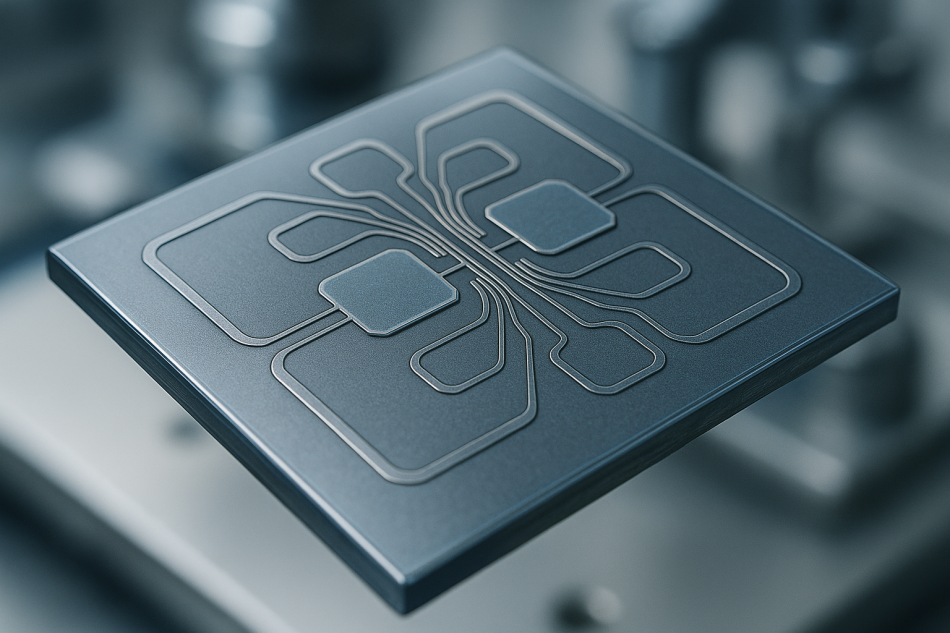

For most of the last two decades, superconducting qubits were built from a short list of metals: aluminum for the delicate Josephson junction, and niobium or aluminum again for the big resonators and capacitor pads that surround it. These materials were chosen partly for physics and partly for convenience. Aluminum grows a clean, self-limiting oxide. Niobium has a high superconducting transition temperature. Both are easy to pattern in a standard fabrication line. The trouble is that the qubits made from them kept hitting an invisible ceiling on how long they could hold a quantum state.
The enemy is the surface
A transmon qubit stores its information in a fragile superposition, and every microsecond that superposition survives is precious. Coherence time, usually written T1 and T2, sets how much computing you can do before the state decays into noise. For years, engineers cleaned up the obvious loss channels: better shielding, better filtering, purer silicon or sapphire substrates. But a stubborn source of decay remained, and it lived in the last place anyone could easily fix.
The problem is oxide. When a metal film sits in air, its surface reacts and grows a thin, disordered layer a few nanometers thick. That layer is riddled with two-level systems, tiny defects that can flip between states and absorb energy from the qubit at exactly the wrong moment. Niobium is especially bad here. It forms not one oxide but a messy stack of several oxide phases, some of which are lossy and some of which are not even fully superconducting. The qubit's electric field crowds into the edges of the metal, right where this dirty oxide sits, and bleeds energy into it.
Why tantalum works
The insight, pursued most visibly by a team at Princeton working with collaborators, was almost embarrassingly simple: change the metal to one with a cleaner oxide. Tantalum, like niobium, superconducts and can be sputtered into thin films. But its native oxide, tantalum pentoxide, is a single, stable, well-behaved compound. It is the same material used in high-quality capacitors precisely because it is low-loss. Grow your qubit's big electrodes out of tantalum instead of niobium, and the parasitic two-level systems that used to drain the qubit largely go quiet.
The payoff was dramatic. Tantalum transmons demonstrated coherence times crossing into the few-hundred-microsecond range, roughly doubling and in some cases tripling what comparable niobium devices delivered. That is not a marginal tweak. For a technology where every extra microsecond means more gates before an answer dissolves, doubling the memory of a qubit is the kind of jump that reshapes what circuits become possible.
A materials-science problem in disguise
What makes the tantalum story instructive is what it says about where quantum computing bottlenecks now live. The physics of the transmon is well understood. The junction works. The control electronics work. Increasingly, the frontier is chemistry and metallurgy: which metal, which substrate, how the surface is etched, whether the interface between metal and sapphire is atomically clean. Small changes in a recipe, like a gentler etch that leaves fewer residues or an annealing step that heals the crystal, can move coherence times more than any clever circuit design.
- Tantalum grows a single stable oxide, unlike niobium's lossy oxide stack.
- Coherence times pushed into the several-hundred-microsecond range.
- The gains came from materials, not new qubit architectures.
- Surface preparation and substrate cleaning matter as much as the metal choice.
Not a finish line
Tantalum is not the last word. Researchers are already exploring other clean-oxide metals, alternative substrates, and even encapsulation schemes that keep the surface from oxidizing at all. Titanium nitride and various alloys are in the mix. Each candidate faces the same balancing act: it has to superconduct, survive fabrication, and leave behind as few lossy defects as possible.
The broader lesson is that scaling a quantum computer is not only about adding qubits. A machine full of noisy qubits is a machine full of expensive error correction overhead, because every physical qubit that decays too fast must be propped up by many more just to protect a single logical one. Quieter qubits lower that tax across the whole system. That is why a change as unglamorous as a different sputtering target can ripple all the way up to the roadmap. Sometimes the biggest step toward a fault-tolerant machine is picking a better metal.







