
There is a quiet ceiling hanging over every superconducting quantum computer. You can etch more qubits onto a chip, but only up to a point. Push past a few hundred and the fabrication yield sags, the control wiring runs out of room, and the whole assembly grows harder to keep uniform across its surface. A single flawed junction can drag down the qubits around it. Making the chip larger does not make these problems smaller. It makes them worse.
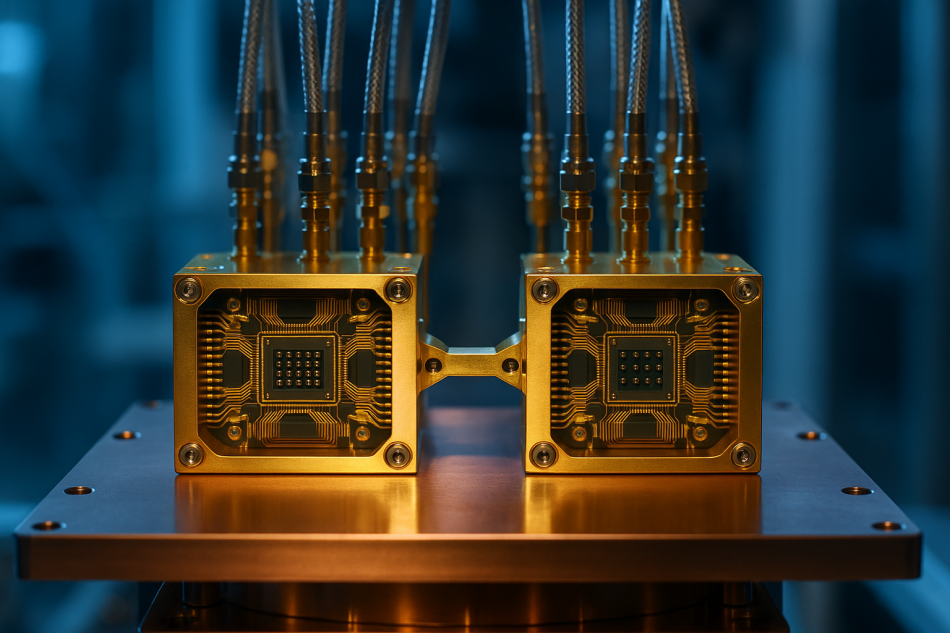
So a growing number of companies have made a different bet. Instead of one enormous processor, build many modest ones and connect them. If two chips can share entanglement across a link, then in principle a program does not care whether its qubits live on the same slab of silicon. The machine behaves as one computer even though it is physically several. This is the quantum interconnect, and it has become one of the central engineering problems in the field.
Two ways to bridge a gap
There are broadly two flavors of link, and they suit different hardware.
The first is a short, direct connection between neighboring chips. IBM's roadmap, for example, leans on couplers that stitch adjacent processors together at their edges, so a qubit near the boundary of one tile can talk to a qubit on the next. These are microwave-frequency connections, kept cold inside the same refrigerator. The advantage is speed and fidelity, because the signal never has to leave the millikelvin environment. The limit is distance. You are essentially tiling a floor with chips inside one fridge, and a fridge only holds so many tiles.
The second flavor is a longer-range optical link. Trapped-ion and neutral-atom groups are especially drawn to this, because their qubits already interact with light. The idea is to convert a qubit's state into a photon, send that photon down a fiber, and use it to entangle a qubit in a distant module, possibly in an entirely separate cabinet. Superconducting groups are exploring microwave-to-optical conversion to do something similar. Optical links promise real modularity, the kind that could someday span a room or a building. The catch is that generating and catching single photons cleanly is hard, and every conversion step leaks fidelity.
Why entanglement is the hard currency
Connecting two chips is not the same as connecting two classical processors with a cable. In a classical machine you copy bits from one place to another. In a quantum machine you cannot copy an unknown state, so the link has to do something subtler. It has to create entanglement between a qubit here and a qubit there, and then that shared entanglement becomes a resource the program can spend.
The usual trick is teleportation. Build an entangled pair spanning the two modules, then use it, along with a couple of classical measurement results, to move a quantum state from one side to the other without ever transmitting the state directly. The link itself only needs to manufacture good entangled pairs. Everything else rides on top. That is why so much of the interconnect effort is really about one number: how fast and how faithfully you can mint entanglement between modules.
The trouble is that these cross-module links are almost always the weakest joints in the machine. A gate between two qubits on the same chip might reach fidelity well above 99.9 percent. A link across modules is often noticeably noisier and slower. Route too much of your computation through it and you squander whatever quality you built into the individual chips.
Designing around the seams
The practical response is to treat interconnects as scarce. Compilers and error-correcting codes are being reworked so that most operations stay local, on-chip, where fidelity is high, while the precious cross-module links carry only what must cross. Some proposals purify the entanglement first, combining several mediocre links into one good one before spending it. Others design the error-correction layout so that logical qubits straddle a seam only where the code can tolerate it.
None of this is settled. It is entirely possible that the winning architecture stays monolithic longer than expected, or that one link technology suddenly pulls ahead. But the direction of travel is clear. The path to a machine with hundreds of thousands of qubits almost certainly does not run through a single heroic chip. It runs through many ordinary ones, taught to hold hands across a cold, carefully engineered gap.







