
In the arms race to build a useful quantum computer, most companies talk about quality first: cleaner gates, longer coherence, fewer errors. Atom Computing, a startup founded in 2018 and based in California, made a different opening bet. It went after quantity. In late 2023 the company announced a processor holding more than 1,200 atomic qubits, the first machine to publicly cross the thousand-qubit mark. The number was a headline, but the interesting part is how they got there and what it does and does not buy them.
Atoms held in beams of light
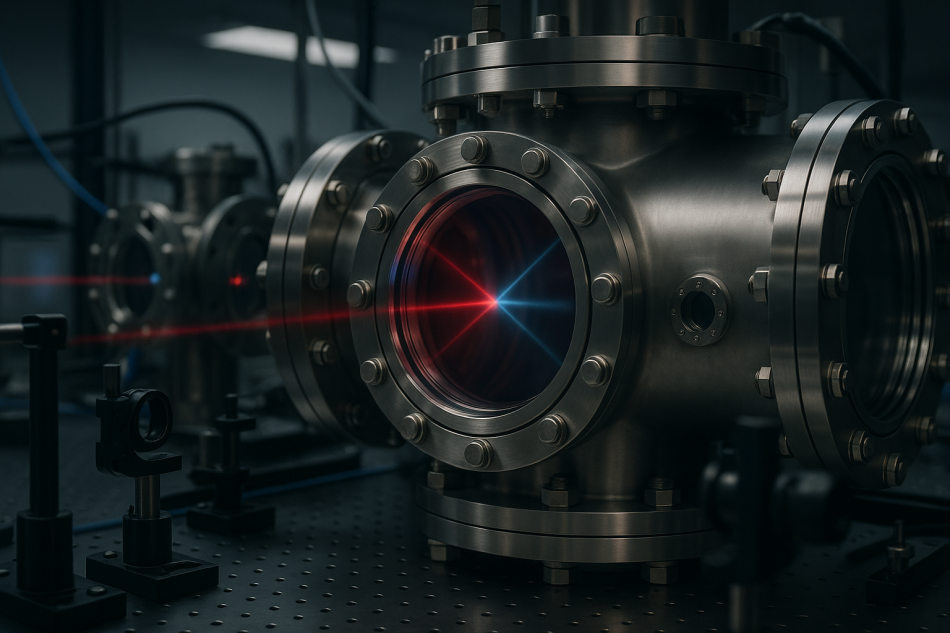
Atom Computing's qubits are individual neutral atoms, suspended in a vacuum chamber by tightly focused laser beams called optical tweezers. Each tweezer is a tiny well of light that traps a single atom. Arrange thousands of these tweezers in a grid and you have a register of qubits, each one identical to the next because atoms of the same element are, by nature, perfect copies. There is no fabrication variation to fight, no two junctions that came out slightly different on a wafer. That uniformity is the quiet advantage neutral-atom builders keep pointing to.
The company's first machine used strontium atoms. Its second-generation system moved to a design built around the nuclear spin of the atom, which is exceptionally well shielded from the outside world. That shielding matters because the nuclear spin barely notices stray magnetic and electric fields, so the information stored in it survives for a long time. Atom Computing has reported coherence times stretching into tens of seconds, dramatically longer than the microseconds typical of superconducting qubits. A qubit that remembers its state for seconds gives you enormous room to run a long computation or, more importantly, to run many rounds of error correction.
Why the count alone is not the win
Crossing a thousand qubits sounds like crossing a finish line. It is closer to reaching the starting blocks. Those 1,200-plus atoms are physical qubits, the raw, noisy kind. A fault-tolerant machine bundles many physical qubits into a single protected logical qubit, and the exchange rate can be brutal, often hundreds or thousands of physical qubits per logical one depending on the error rates and the code. So a thousand physical atoms might yield only a handful of logical qubits once error correction is layered on top.
This is exactly why Atom Computing's roadmap pairs its scaling story with an error-correction story. The company has worked with partners on demonstrations of logical qubits built from its atoms, showing that the platform can detect and begin correcting errors rather than just accumulating them. Neutral-atom systems have a structural feature that helps here: the atoms can be physically moved around inside the chamber while the computation runs. Shuttling atoms lets the machine bring any two qubits together to interact, sidestepping the fixed-neighbor wiring constraints that box in chip-based designs. That mobility is well suited to the flexible connectivity many error-correcting codes want.
The engineering that scaling demands
Adding atoms is not free. Every additional tweezer needs light, and splitting one laser into thousands of stable, individually controllable spots is a serious optics problem. The system relies on devices that steer and shape laser beams with high precision, plus imaging cameras fast enough to check where every atom sits between operations. Neutral-atom machines also have to reload atoms that inevitably escape their traps, a housekeeping task that grows with register size. Doing this quickly, without disturbing the qubits still doing work, is one of the harder unsung challenges in the field.
There is also the matter of gates. Atom Computing entangles qubits by nudging atoms into highly excited Rydberg states, where their swollen electron clouds feel each other across relatively large distances. Getting those gates fast and reliable across a large array, uniformly, is the difference between a big register and a big useful register.
A different shape of the same problem
Atom Computing's approach draws a clear contrast with the superconducting camp, where companies like IBM and Google fight to add qubits a few dozen at a time on refrigerated chips. Neutral atoms scale more gently in some ways and more awkwardly in others. You get free uniformity and long memory, but you pay in optical complexity and slower operation cycles.
The honest scorecard is that no single number settles the race. A thousand atoms is a real achievement and a real signal that the platform can grow. Whether it becomes a machine that solves problems classical computers cannot depends on the far less flashy work of pushing gate fidelity up and error rates down, so that all those atoms translate into logical qubits worth trusting. Atom Computing has placed its chips on scale first, quality close behind. The coming years will show whether that order was the right call.







