
Most trapped-ion quantum computers look like optics labs that got out of hand. Beams from a dozen lasers thread through mirrors and lenses, each one tuned to nudge a single ion into the right state. The physics is gorgeous and the fidelities are the best in the business, but the hardware is fussy, bulky, and hard to reproduce. Oxford Ionics, a company spun out of the University of Oxford, made a contrarian wager: strip out most of the lasers and let a silicon chip do the steering instead.
What sits on the chip
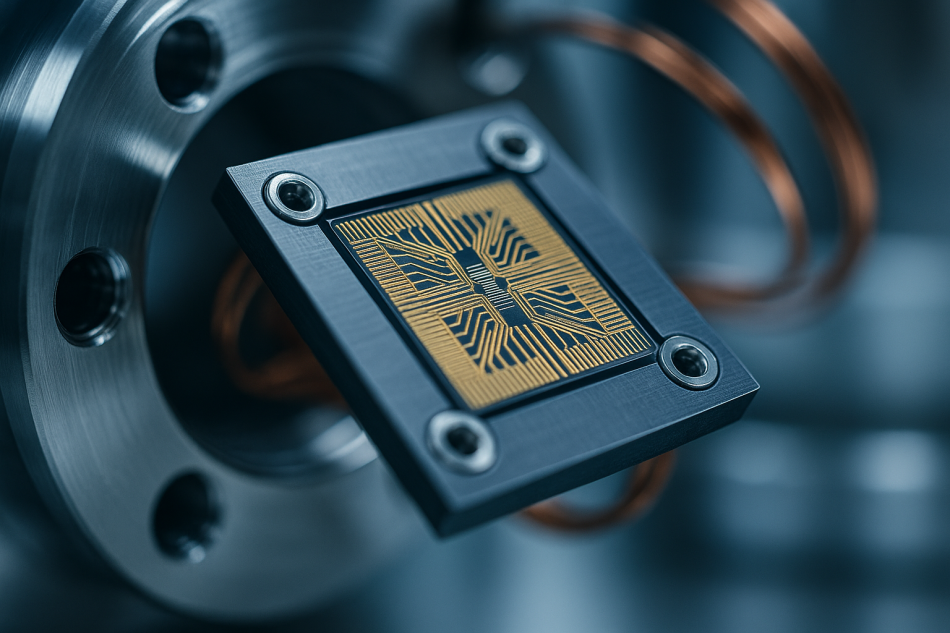
The trap itself is a patterned surface of metal electrodes fabricated in a standard semiconductor foundry. Charged atoms, hovering a fraction of a millimeter above that surface, are held in place by carefully shaped electric fields. That much is common to many surface-trap designs. The twist is how the qubits are controlled. Instead of aiming laser beams to drive the transitions that flip and entangle ions, Oxford Ionics uses what it calls electronic qubit control, delivering the necessary fields through circuitry built into the chip. Microwave and radio-frequency signals, plus tailored magnetic-field gradients, take over jobs that lasers usually handle.
The appeal is manufacturability. A trap that relies on etched wiring rather than a bespoke optical bench can be printed the way any other integrated circuit is printed. If the design lives in a foundry process, copies come off the line looking identical, which is exactly what you want when you are trying to scale from a handful of qubits to thousands.
Why bother, when lasers already work
Trapped ions are famous for quality. Their qubits hold coherence for a long time, and gate operations can be extraordinarily accurate. The catch has always been the surrounding apparatus. Every ion you add typically means more optical paths to align and stabilize, and alignment does not scale gracefully. Vibration, thermal drift, and the sheer part count fight you at every step. By pushing control into the chip, Oxford Ionics is betting it can keep the intrinsic accuracy of ions while borrowing the reproducibility of the semiconductor industry.
The company has reported gate performance that lands in the top tier for any platform: single-qubit operations with error rates down in the parts-per-million range, and two-qubit entangling gates comfortably past 99.9 percent. Those numbers matter because error correction only pays off once physical gates are clean enough to sit below the fault-tolerance threshold. The cleaner the raw gate, the fewer physical qubits you need to protect one logical qubit, which changes the arithmetic of building a useful machine.
The tradeoffs nobody skips
Electronic control does not make the hard problems disappear; it moves them. Driving fast, high-fidelity entangling gates with fields rather than focused light usually means engineering strong, precisely shaped magnetic-field gradients close to the ions, and doing that without heating the atoms or introducing new noise sources is delicate work. Routing signals to many trap zones on a growing chip runs into the same wiring bottleneck that haunts superconducting machines, and ion computers still need to shuttle atoms between zones to bring distant qubits together for a gate. None of that is trivial. The claim is not that it is easy, but that it is the kind of engineering a chip fab and a control-electronics team can grind down, as opposed to an optical-alignment problem that resists automation.
Why the industry is watching
The bet drew attention beyond the usual circle when IonQ, itself a trapped-ion company, moved to acquire Oxford Ionics in a deal valued at roughly a billion dollars. That pairing is telling. IonQ has its own ion-trap heritage and its own roadmap counted in what it calls algorithmic qubits, and folding in a chip-native control approach signals where at least one major player thinks scaling has to go: away from hand-built optics and toward wafers.
Whether ions-on-a-chip becomes the dominant recipe or one strong option among several, the underlying logic is hard to ignore. The platforms that win are likely to be the ones that can be copied, not just demonstrated. Oxford Ionics is arguing that a quantum computer should be built more like a microprocessor and less like a physics experiment, and the rest of the field is paying close attention to whether the etched trap can keep its promises as the qubit count climbs.







