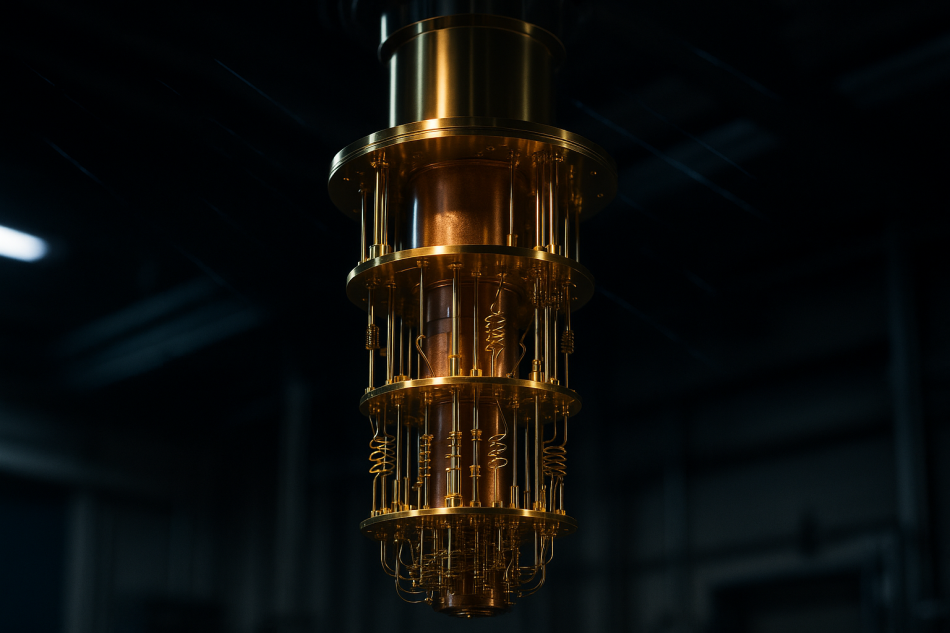

Quantum error correction rests on a quiet assumption: that mistakes happen one qubit at a time, more or less at random, in scattered spots a code can outvote. Spread enough physical qubits around a logical one and the errors average out. But nature occasionally breaks that promise all at once. A cosmic ray, or a stray gamma photon from trace radioactivity in the lab, can strike a superconducting chip and knock out a large fraction of its qubits in a single instant.
What actually happens
Superconducting qubits live on a silicon or sapphire substrate cooled to a few thousandths of a degree above absolute zero. When an energetic particle plows into that substrate, it deposits energy that ripples outward as phonons, tiny packets of vibration. Those phonons travel across the chip and slam into the superconducting films that form the qubits. There they break apart Cooper pairs, the paired electrons that make superconductivity work, generating a flood of stray charges called quasiparticles.
Quasiparticles are poison for a qubit. They shorten its lifetime and scramble its state. A single strike can raise the quasiparticle density across millimeters of chip, meaning dozens of qubits sitting far apart suddenly lose coherence together. Researchers at Google measured exactly this in 2022, watching bursts sweep through their processor and degrade qubits simultaneously in a way ordinary noise never does. The events were rare, roughly once every ten seconds to once a minute depending on the setup, but each one was catastrophic while it lasted.
Why error correction hates this
The surface code and its cousins are built to fix independent errors. Give the code a low enough per-qubit error rate and it drives the logical error rate down exponentially as you add qubits. That math falls apart the moment errors become correlated across space. A cosmic ray hit does not nudge one data qubit; it corrupts a whole neighborhood at once, overwhelming the code's ability to vote on what went wrong. Worse, it can hit the ancilla qubits that perform the measurements the decoder relies on, so the machine is briefly blind to its own damage.
For a large fault-tolerant computer running for hours, this is not a nuisance, it is an existential threat. A single burst every minute could reset progress on a long calculation, the quantum equivalent of a power flicker wiping a rendering job. And the problem gets worse with scale: a bigger chip is a bigger target.
Fighting back
The response is coming from several directions at once, and none of it involves clever software alone.
- Shielding and depth. Some cosmic ray flux can be cut by moving experiments underground or wrapping cryostats in lead, much as neutrino detectors do. This trims muons from the sky but does little against radioactivity in the materials right next to the chip.
- Gap engineering. By tailoring the superconducting gap across different parts of a qubit, physicists can steer quasiparticles away from the sensitive junction, giving them somewhere to drain rather than lingering where they do harm.
- Phonon traps. Adding metal islands or downgraded regions on the substrate can absorb phonons before they spread, shrinking the blast radius of a single hit from most of the chip to a small patch.
- Detection and pause. If the machine can sense a strike in real time, it can flag the affected cycle as an erasure, telling the decoder to distrust that data, or simply pause and recover rather than trusting garbage.
The uncomfortable reminder
Cosmic ray strikes are a useful corrective to the tidy story often told about scaling quantum computers. Adding qubits helps only if the errors behave the way the theory assumes. Rare, correlated, chip-spanning events sit in a blind spot that no amount of extra qubits fixes on its own. They force hardware teams to think like radiation physicists and error-correction theorists to widen their models beyond independent noise.
The encouraging part is that the field spotted the problem early, before million-qubit machines exist, and the mitigations are already showing up in real devices. A quantum computer that wants to run for hours will have to be, in part, a well-shielded particle detector that knows when the sky has just interfered with its arithmetic.







