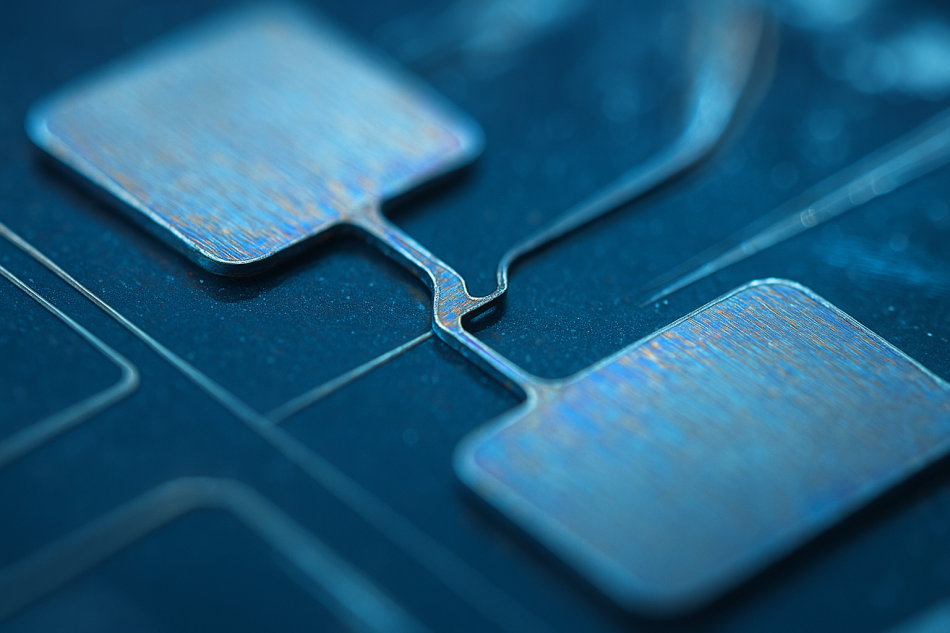

A superconducting qubit is, at heart, a beautifully engineered circuit. But it lives on a chip made of imperfect materials, and those imperfections fight back. The most stubborn adversary has an oddly familiar name: the two-level system, or TLS. It is, in a sense, a tiny accidental qubit, one that nobody wanted and nobody can fully find. And it has been sabotaging superconducting quantum computers since the very first ones were built.
An unwanted twin
A TLS is an atomic-scale defect that can sit in one of two configurations, flipping between them like a microscopic switch. Picture a single atom in a disordered oxide that can tunnel between two nearby resting spots, or a dangling chemical bond that can point one way or another. Because it has two states separated by a small energy gap, it behaves like a two-level quantum system, exactly the kind of thing a qubit is supposed to be. The trouble is that these defects exist by the millions in the amorphous, glassy layers of a real device.
They cluster where the materials are messiest: the native oxide that grows on the surface of aluminum or niobium, the interface between the metal and the silicon or sapphire substrate, and the tunnel barrier of the Josephson junction itself. Anywhere the crystal structure breaks down into disorder, TLS defects appear.
How they drain a qubit
The damage happens through resonance. A superconducting qubit stores its information in an electromagnetic mode oscillating at a few gigahertz. If a nearby TLS happens to have an energy gap at that same frequency, the two can exchange energy. The qubit hands over its excitation to the defect, the defect eventually dumps that energy into heat or radiation, and the quantum information is gone. This is one of the leading contributions to the dreaded T1 decay, the timer that measures how long a qubit holds its state before relaxing.
Even when a TLS is not perfectly on resonance, it still causes harm. The electric fields of these defects nudge the qubit's frequency around, and because TLS defects themselves drift and switch over time, that nudging is unpredictable. Engineers see it as calibration that will not hold still: a qubit that behaved beautifully in the morning develops a mysterious dip in performance by afternoon because a defect wandered into resonance with it.
Chasing ghosts
What makes TLS defects so maddening is that they are individually invisible. You cannot point a microscope at a chip and see them. They reveal themselves only statistically, through the loss they cause and through spectroscopy that shows sharp dips in qubit performance at particular frequencies. Run the same measurement again days later and the pattern has shifted, because the defect landscape has quietly rearranged.
Researchers have learned to map these dips by sweeping a tunable qubit across a range of frequencies and watching where its lifetime collapses. Each collapse marks a defect. Do this over hours and you can watch individual TLS drift, appear, and vanish. It is a bit like listening for creaks in an old house to locate the loose boards, except the boards move on their own.
Fighting back with materials
The most direct weapon is cleaner materials. Because so many TLS live in surface oxides and interfaces, the field has poured effort into reducing that disorder. Switching from aluminum and niobium to tantalum, which forms a thinner and more stable oxide, produced some of the largest coherence gains in years. Careful cleaning of the substrate before deposition, etching away lossy oxide layers, and encapsulating surfaces to keep them from oxidizing have all pushed lifetimes upward.
Design choices help too. Spreading the qubit's electric field over a larger area dilutes its overlap with any single defect, so geometries with big capacitor pads tend to suffer less. Some groups are experimenting with crystalline junction barriers to replace the glassy amorphous oxide where the worst defects hide.
Why it matters for the roadmap
Every plan to build a fault-tolerant quantum computer assumes that physical qubits keep getting better, because error correction only works once error rates dip below a threshold. TLS defects sit right in the path of that progress. They are not a bug to be patched in software; they are baked into the atoms of the device. That is why some of the quietest but most consequential work in quantum computing is happening not in algorithm labs but in vacuum chambers and deposition tools, where researchers fight, one oxide layer at a time, to starve these hidden defects of the flaws they feed on.







