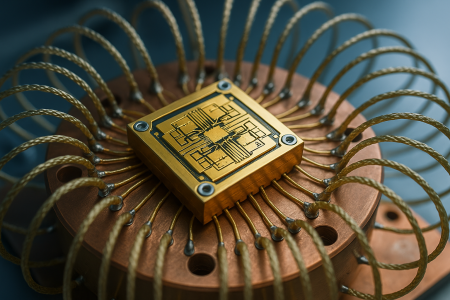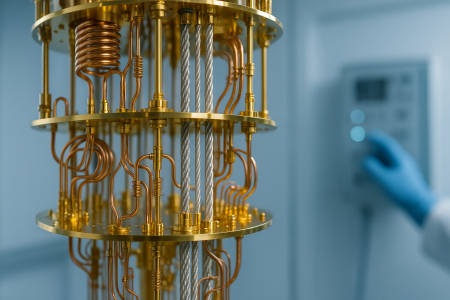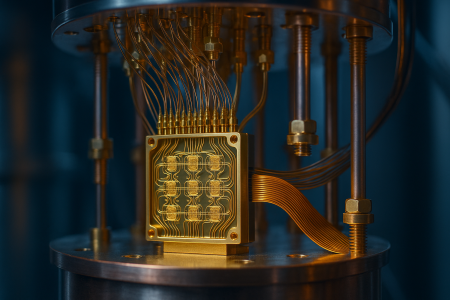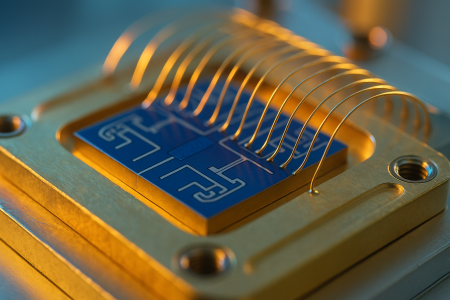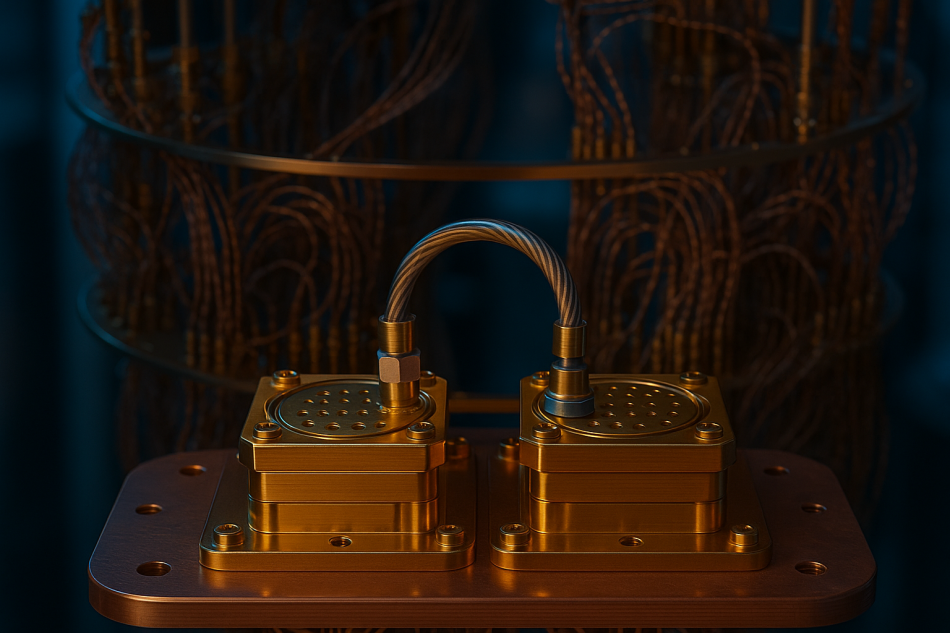

There is a ceiling on how big a single quantum chip can get. Fabrication yield drops as you cram more qubits onto one piece of silicon or sapphire, the wiring gets impossibly dense, and a dilution refrigerator can only cool so much hardware. So the leading builders have quietly shifted strategy. Instead of one enormous chip, they want many modest chips stitched together into a single machine. The stitches are called interconnects, and getting them right is now one of the quietest, hardest problems in the field.
Why a wire won't do
Connecting two classical computers is easy. You send electrical pulses or light down a cable, and if a bit gets corrupted you resend it. Quantum information does not tolerate that treatment. A qubit's state cannot be copied, so you cannot make a backup and retransmit. Any link that carries quantum information has to preserve delicate superposition and entanglement while moving it, often across a temperature gradient of hundreds of degrees or through meters of cabling. A single stray photon of heat can scramble the message.
That leaves builders juggling several kinds of connection, each solving a different range problem.
Three distances, three tricks
The shortest link is chip-to-chip inside one cold package. Superconducting groups build tiny bump bonds or short bridges so that qubits on the edge of one tile can entangle with qubits on the neighboring tile, as if the seam were not there. The goal is to make the boundary invisible to a running algorithm. IBM has described exactly this kind of short-range coupler as the way to tile many chips into one larger effective processor.
The next distance up is a link between two separate modules sitting in the same fridge or in adjacent fridges. Here the industry uses cryogenic cables, sometimes carrying microwave photons that hop from one processor to another. These links are slower and noisier than an on-chip connection, so architects treat them like precious express lanes. You route as little quantum traffic across them as possible, and you spend error-correction resources shoring up whatever does cross.
The longest link is the one that lets a machine grow without limit: sending quantum information as light between distant modules. Trapped-ion and neutral-atom companies have a natural advantage here. An ion can emit a photon that is entangled with the ion's own state, and if two photons from two separate traps meet at a beam splitter and interfere, the two distant ions become entangled. That optical bridge can stretch across a room or, in principle, across a building. Superconducting systems, which speak in microwaves rather than light, need extra hardware called a transducer to convert microwave qubits into optical photons and back, a device that is still frustratingly lossy in the lab.
The cost of every hop
None of these connections is free. An interconnect operation is usually slower and more error-prone than a gate between two neighbors on the same chip. If a normal two-qubit gate fails once in a thousand tries, a link between modules might fail once in fifty. That gap forces a hard design choice. The people mapping algorithms onto the machine have to keep tightly coupled work clustered inside a single module and treat cross-module communication as expensive. It is the same instinct a chip designer uses to keep hot data close to the processor core.
Error correction complicates the picture further. A fault-tolerant logical qubit is spread across many physical qubits, and if that logical qubit straddles two modules, the connecting link has to be good enough not to poison the whole code. Researchers are exploring codes that tolerate a noisier interconnect by using it sparingly, and hardware teams are racing to push link fidelity high enough that modular machines behave like one seamless device.
Why it matters for the roadmaps
Almost every serious roadmap now assumes modularity. The million-qubit machines that companies sketch for the next decade are not single monster chips. They are racks of modules lashed together by interconnects. That means the winner of the scaling race may not be whoever builds the best qubit, but whoever builds the best quantum plumbing between them. A brilliant processor that cannot talk to its neighbor is a dead end. The unglamorous connector, the thing nobody puts on a press slide, is quietly becoming the part that decides how big quantum computers can actually get.