
The standard recipe for a fault-tolerant quantum computer is brute force. Take a hundred or a thousand shaky physical qubits, wire them into a lattice, and let the majority vote away the errors that keep creeping in. That is the surface code, and it works on paper. It also demands a staggering amount of hardware. There is a stranger, more elegant alternative that refuses to spread the redundancy across many parts. Instead it stuffs all of it into one.
A qubit made of many photons
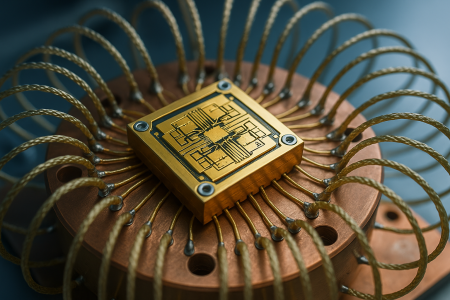
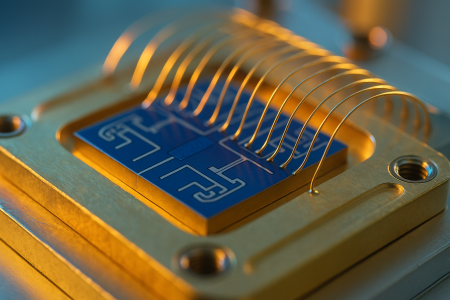
The idea is called a GKP state, after the three physicists who proposed it in 2001: Daniel Gottesman, Alexei Kitaev, and John Preskill. Rather than storing quantum information in the on-off of a single two-level system, it uses a harmonic oscillator, a system that can hold many quanta of energy at once. In practice that oscillator is usually a microwave resonator, a tiny superconducting cavity that rings with photons, or a vibrating mode in an optical or mechanical system.
An oscillator has a continuous range of states, described by two quantities that behave like position and momentum. The GKP trick is to encode a single logical qubit in a comb of sharp peaks spread across that continuous space, a regular grid of bumps in what physicists call phase space. The zero and one of the qubit correspond to two interleaved grids, offset from each other. Because the information lives in the spacing of the grid rather than in any one spot, small nudges can be spotted and undone.
Why a grid catches errors
Here is the appeal. The dominant errors in an oscillator are small displacements. A stray photon leaks in or out, or the cavity drifts a little in position or momentum. If your qubit is a periodic grid, a tiny shift moves every peak slightly off its slot. Measure how far the peaks have wandered from the nearest grid line, and you learn the error without learning which logical state you are holding. Then you push everything back onto the grid. The redundancy that a surface code buys with hundreds of qubits is baked into the geometry of a single mode.
That is the dream. The reality is that GKP states are hard to make. A perfect grid would require infinite energy, so real versions are smeared, finite approximations that only partly resist errors. Building one means coaxing a cavity into a fragile, highly non-classical shape and then nudging it repeatedly to keep it there, a process that itself introduces noise. For years the states were more of a theorist's fantasy than lab equipment.
From theory to the fridge
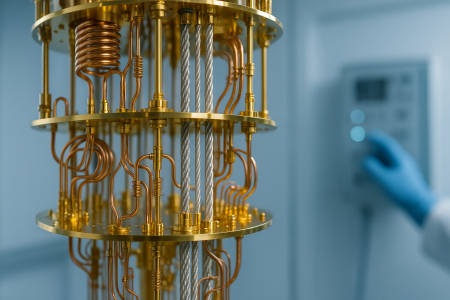
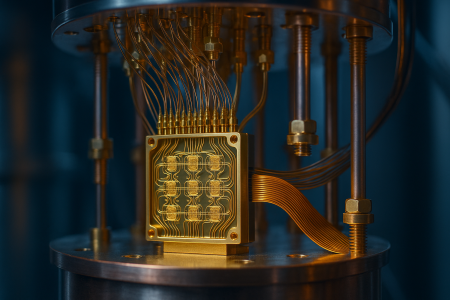
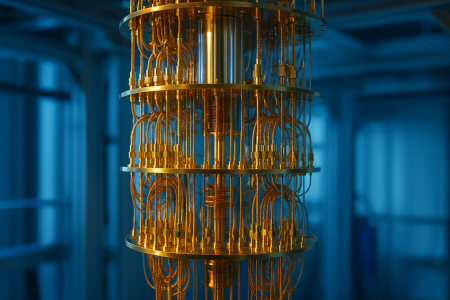
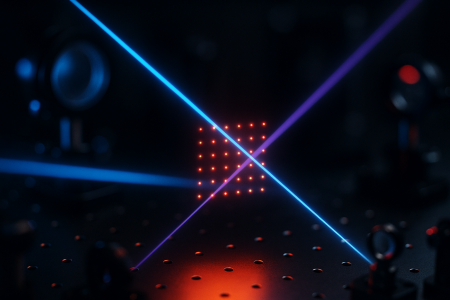
That changed over the past several years. Groups at Yale used a superconducting cavity coupled to a transmon qubit to prepare GKP states and run rounds of stabilization, showing that active correction could actually extend the life of the encoded information past the break-even point where correction stops hurting and starts helping. Trapped-ion experiments have produced grid states in the motion of a single atom. And a handful of companies have made bosonic encoding the center of their strategy rather than a curiosity. Nord Quantique, a Canadian startup, is betting that GKP-style redundancy in each cavity can slash the qubit count a useful machine needs. Amazon and others have explored related bosonic codes, including the cat-qubit approach that protects against a different slice of the error zoo.
A different kind of overhead
The bosonic bet does not make error correction free. You still need a second layer, an outer code that ties several GKP qubits together, to catch the errors the grid alone misses. But if each physical device already does most of the work, that outer layer can be far smaller. Instead of a thousand physical qubits per logical one, the ratio might fall to dozens. For a field where the wiring, the refrigeration, and the control electronics all scale with qubit count, shrinking that number is not a footnote. It could be the difference between a machine that fits in a room and one that never gets built.
None of the leading roadmaps have crowned a winner. Grid states demand exquisite control and forgive very little. But the underlying insight, that a single oscillator can carry its own life raft, is one of the more beautiful ideas in the field, and it is no longer confined to the blackboard.