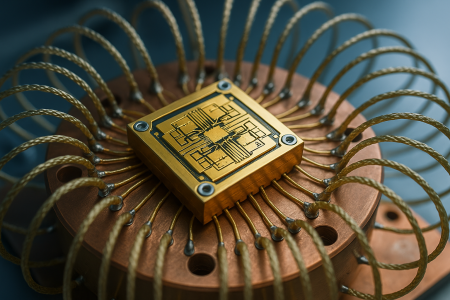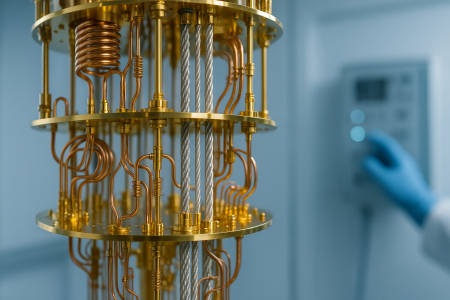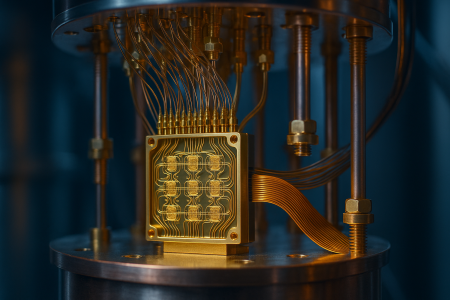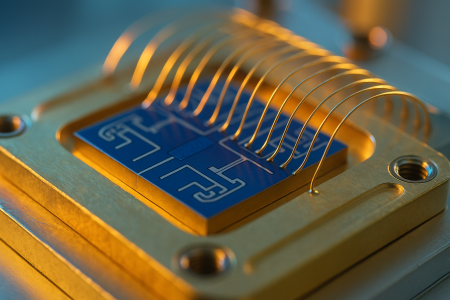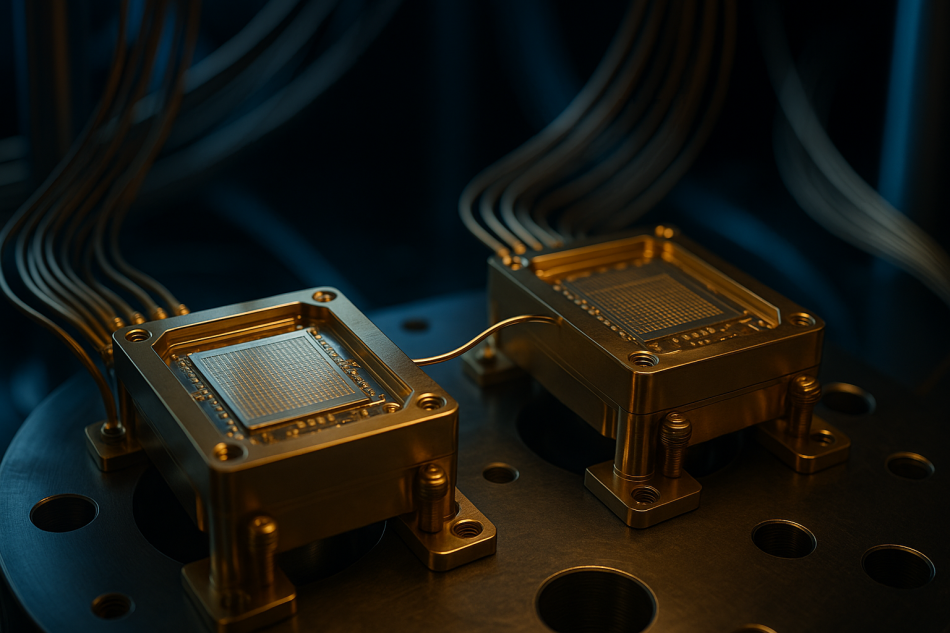

There is a ceiling on how big a single quantum chip can get. Fabrication yield drops as the wafer grows, wiring gets impossibly crowded, and a chip that fills a dilution refrigerator still needs thousands of coax lines threaded down to it. Rather than fight that ceiling forever, most of the field has quietly agreed on a different plan: build modest chips that work well, then wire many of them together into one logical machine. The piece of hardware that makes this possible, the quantum interconnect, has become one of the most consequential and least glamorous parts of a roadmap.
Why one big chip stops making sense
A monolithic processor sounds ideal. Every qubit sits on the same silicon, gates are fast, and there is no traffic between chips to worry about. But the practical limits pile up. The odds that all several thousand qubits on a wafer come out usable shrink with area. The refrigerator can only host so much wiring before it stops cooling. And a single defect, a stray cosmic ray strike or a bad fabrication run, can spoil the whole device. Splitting the machine into modules turns a yield nightmare into a manufacturing line. If one module is faulty, you swap it rather than scrapping a giant chip.
The catch is that a quantum computer is only as powerful as its ability to entangle qubits across the whole system. A collection of isolated modules is just a collection of small computers. To count as one machine, the modules must share quantum information, and doing that without destroying the fragile states they carry is the entire challenge.
Two ways to bridge the gap
There are broadly two flavors of interconnect, and the leading companies are betting on different mixes of them.
- Short-range electrical couplers join neighboring chips almost directly, through a superconducting cable or a bridge that carries microwave photons a few centimeters. IBM has pursued this on its roadmap, describing on-chip couplers that stitch tiles into a larger lattice and cables that link adjacent processors so gates can reach across the seam. The advantage is speed and relatively high fidelity; the limit is distance, since these links only work between chips sitting close together in the same cold environment.
- Long-range optical or photonic links convert a qubit's state into a flying photon that can travel down an optical fiber to another module, potentially in another refrigerator or another rack. Trapped-ion and neutral-atom groups favor this route because their qubits already emit photons naturally. The photon carries entanglement between distant nodes, letting you scale out horizontally rather than cramming everything into one fridge. The price is that photonic links are slower and lossier, so they generate entanglement probabilistically and often need many attempts to succeed.
Most serious plans use both: fast local couplers to build a large module, and slower networked links to tie modules into a still larger system. Quantinuum, IonQ, and others have described architectures where multiple ion-trap or atom modules exchange entanglement over photonic channels, while superconducting players lean on cryogenic cables and couplers for the near term.
The entanglement budget
An interconnect is not a passive wire. Every link introduces loss and noise, and error correction is unforgiving about where that noise lands. Moving a logical qubit across a chip boundary can cost far more physical operations than a gate inside a single tile, which means the boundary itself becomes a bottleneck the compiler has to plan around. Designers now speak of an entanglement budget: how many high-quality links per second the interconnect can supply, because that rate caps how fast error-corrected data flows between modules. A machine can have plenty of qubits and still crawl if its chips cannot talk quickly enough.
This is why interconnect fidelity and rate show up on roadmaps next to qubit counts. A link that entangles two modules with 99 percent fidelity a few times per second is a science demo. A link that does it hundreds of times per second with error rates low enough to fold into a code is the difference between a modular computer and a filing cabinet of small ones.
Why it matters for the million-qubit dream
Almost every published path to a fault-tolerant machine with a million physical qubits assumes modularity somewhere. Nobody expects a single chip to hold that many. The question is whether the interconnect can keep pace with the qubits it joins. Get it right, and scaling becomes a matter of building and connecting more of the same proven module. Get it wrong, and the machine chokes at every seam. The unglamorous cable, in other words, may decide which architecture actually reaches useful scale first.