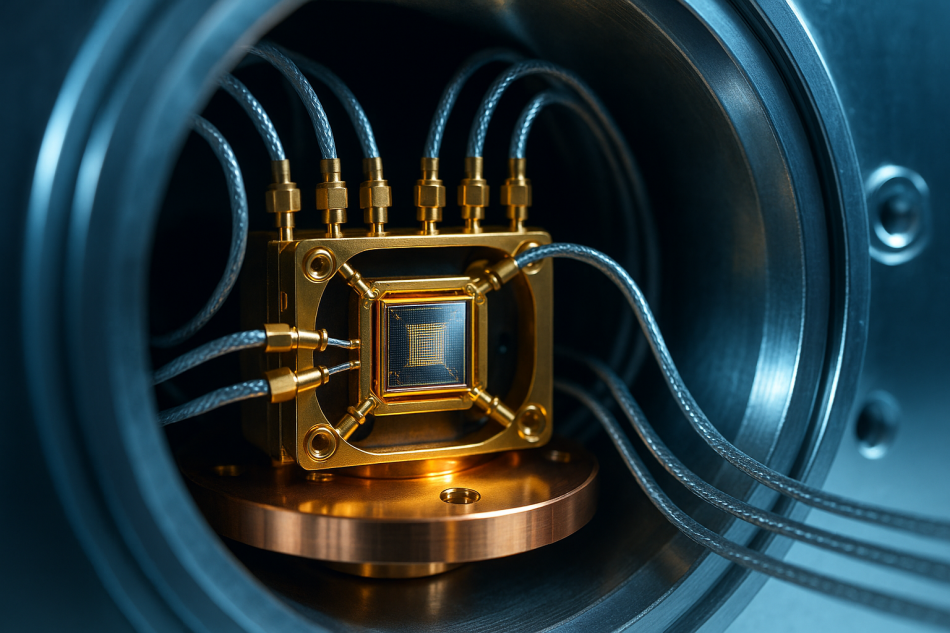

Every quantum program begins with a demand that sounds trivial and turns out to be surprisingly hard: start from zero. Not an approximate zero, not a mostly-zero, but a crisp, known starting state for every qubit on the chip. The field even has a name for this requirement. It is one of the DiVincenzo criteria, the short checklist a system has to satisfy to count as a quantum computer, and it reads simply as the ability to initialize qubits to a fiducial state like all-zeros.
If initialization sounds like the least interesting part of the whole enterprise, consider how often it has to happen. A quantum computer does not run a circuit once and report an answer. It runs the same circuit thousands of times to build up statistics, and each of those runs has to begin with a fresh reset. A machine that takes a long time to blank its qubits between shots is a machine that spends most of its day waiting.
The lazy way and why it fails
The simplest reset is to do nothing. Leave a superconducting qubit alone and it will eventually relax from its excited state down to the ground state on its own, a process governed by the qubit's energy-relaxation time, usually written as T1. Wait several multiples of T1 and the odds are good that the qubit has fallen back to zero.
The trouble is that T1 is now the very thing designers have spent years stretching out. A longer-lived qubit holds quantum information better, which is wonderful during a computation and maddening at reset time, because the same stubbornness that preserves a state also makes it slow to decay. Passive reset can eat tens or hundreds of microseconds, dwarfing the gates that do the actual work. On a machine with better qubits, the lazy reset gets slower, not faster.
Forcing the issue
So builders reset qubits actively instead. One family of techniques measures the qubit first and then applies a correction. The control system reads out whether the qubit is in zero or one, and if it finds a one, it fires a pulse to flip it back. This conditional, feedback-driven reset leans on fast mid-circuit measurement and classical logic that can decide and react in a fraction of a microsecond.
Another family skips the measurement entirely. The idea is to give the qubit's unwanted energy somewhere to go in a hurry. Engineers couple the qubit, usually through a tunable coupler or a carefully chosen drive, to a lossy element such as a readout resonator or a dedicated dump mode. Drive the system the right way and any population sitting in the excited state is shuttled into that lossy mode and swept out to the cold environment, leaving the qubit parked at zero. Because the escape route is deliberately leaky, this can happen in a few hundred nanoseconds rather than the long natural wait.
Trapped-ion machines face their own version of the problem and solve it with light. A technique called optical pumping bombards an ion with laser photons tuned so that the ion keeps absorbing and re-emitting until it falls into a specific state and can no longer respond. Once it lands there, the light has nothing left to push, and the ion is initialized with very high fidelity.
The leakage problem lurking underneath
Reset also has to cope with qubits that have wandered out of bounds. Real qubits are not perfect two-level systems; they have higher energy levels a qubit can accidentally climb into during gates and readout. A reset that only knows how to handle zero and one will miss a qubit stuck on a higher rung. That is why modern reset schemes often include explicit steps to drain leakage, pulling population down from those extra states before the next run begins. Leaving leakage unaddressed quietly poisons error correction, where a single confused qubit can spread trouble through a logical block.
Why the stopwatch matters
All of this feeds directly into throughput. Benchmarks that measure how many circuit layers a machine can execute per second count reset time as part of the budget, right alongside gate and measurement durations. A reset that drops from microseconds to hundreds of nanoseconds, with high enough fidelity that the qubit really is at zero, multiplies the useful work a processor delivers in a day. The blank slate, it turns out, is as engineered as anything written on it.







