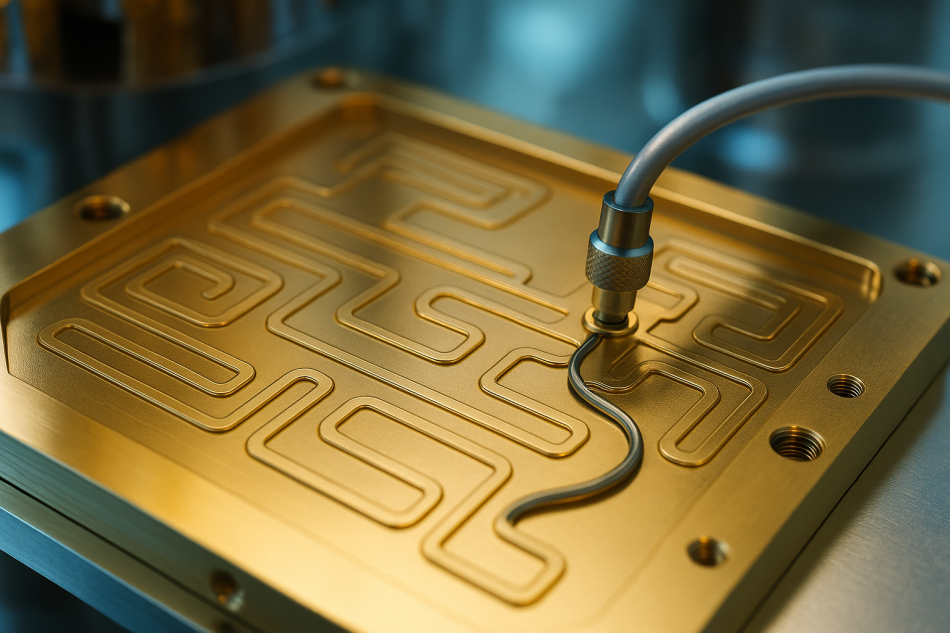

Every quantum computation ends the same way: you have to look. After the gates are done, each qubit holds a fragile superposition that collapses the instant you read it, delivering a zero or a one. Doing that reliably, quickly, and for thousands of qubits at once turns out to be one of the quieter engineering battles inside a quantum machine. The trick that keeps it from becoming impossible is multiplexed readout, the practice of stuffing many qubits' answers down a single cable.
Why reading is hard
In a superconducting processor, a qubit does not announce its state directly. Instead, each qubit is coupled to a tiny microwave resonator, a little electromagnetic pocket that rings at a specific frequency. The clever part is that the resonator's exact pitch shifts slightly depending on whether the qubit is a zero or a one. So to read the qubit, you send a faint microwave pulse at the resonator, listen to how the reflected signal comes back, and infer the state from the phase and amplitude of what returns. This is called dispersive readout, and it has the enormous virtue of being gentle enough to interrogate the resonator without crushing the qubit's neighbors.
The problem is scale. If every qubit needed its own dedicated input line, output line, and amplifier chain running from room temperature down into the dilution refrigerator, the wiring would swamp the machine long before you reached the qubit counts people actually want. Coaxial cables carry heat. Connectors take space. Amplifiers are precious. A processor with a thousand qubits cannot afford a thousand separate readout paths.
One line, many tones
Multiplexing solves this by giving each resonator a slightly different resonant frequency, spacing them out across a band like radio stations across a dial. Because the tones do not overlap, a single feedline can host a whole row of resonators, each one tuned to its own channel. To read them all, control electronics send a combined pulse, a sum of many frequencies at once, down the shared wire. Each resonator responds only to its own tone and ignores the rest. The reflected signal comes back as a chord, a superposition of every qubit's answer layered together.
The job of the electronics is then to separate that chord back into individual notes. Digital signal processing pulls each frequency apart, measures how its phase and amplitude shifted, and assigns a zero or a one to the corresponding qubit. In practice, eight, sixteen, or more qubits can share one output line this way. The savings cascade: fewer cables, fewer feedthroughs, fewer of the expensive low-noise amplifiers that sit at the cold stages and boost the whisper-quiet return signal before it can be read.
The crowding problem
Nothing in quantum hardware is free, and multiplexing has its own tensions. The resonators have to be spaced far enough apart in frequency that their responses do not blur into each other, but the usable band is finite, so there is a ceiling on how many you can pack onto one line. Push them too close and a strong signal from one qubit can bleed into its neighbor's channel, corrupting the readout. Fabrication scatter makes this worse, because the etched resonators never land exactly on their intended frequencies, and two that drift toward the same pitch become a collision you cannot untangle.
Speed matters too. Readout is often the slowest step in a quantum circuit, and in error-corrected machines the measurement has to finish fast enough for a classical decoder to act on the results before the qubits drift. Multiplexing helps by letting you measure a whole batch at once rather than one at a time, but the amplifier has to stay honest across the entire band, handling several tones without distorting any of them. That demand has driven a wave of work on broadband parametric amplifiers designed specifically to serve multiplexed lines.
Why it matters
Readout fidelity sits in the same sentence as gate fidelity when engineers rate a processor. A fast, accurate, space-efficient way to read qubits is not a side detail. It is a precondition for the error correction schemes that measure stabilizers over and over, thousands of times a second, across every logical qubit. The shared wire is one of the unglamorous reasons those schemes can run at all. As processors climb toward the qubit counts that fault tolerance demands, the ability to listen to many qubits through one channel is quietly doing some of the heaviest lifting in the fridge.







