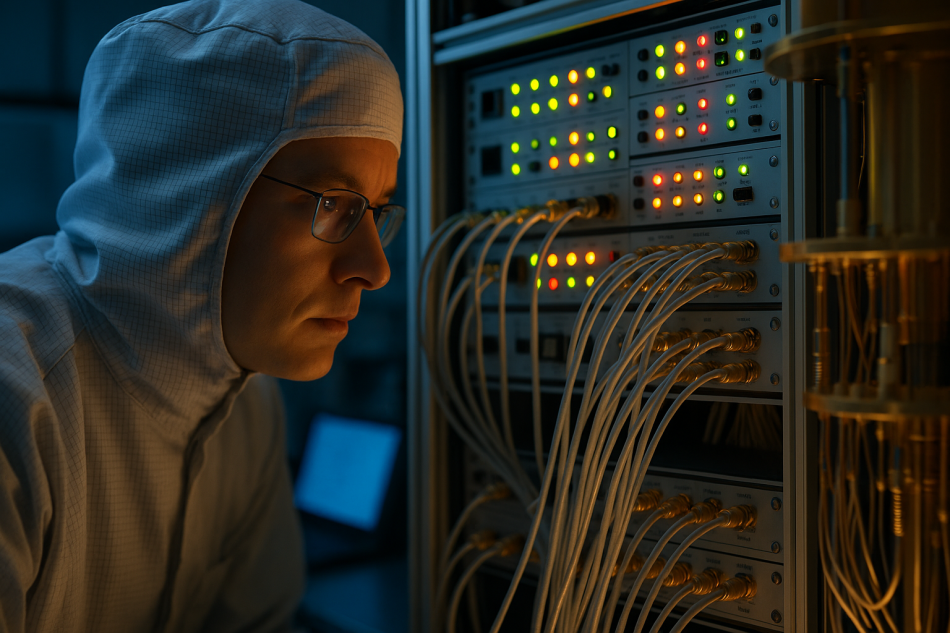

Buy a classical chip and it behaves the same on Tuesday as it did on Monday. A quantum processor does not offer that courtesy. Left alone overnight, its qubits shift their frequencies, its gates lose a sliver of fidelity, and its readout starts misjudging zeros and ones. By morning the carefully tuned machine from the day before is subtly wrong. This is why nearly every quantum computer on the cloud runs a recalibration routine, often daily or even more frequently, before it will accept a single customer job.
What actually drifts
A superconducting qubit has a resonant frequency, the particular microwave note it responds to. That frequency depends on physical quantities that refuse to hold still. The Josephson junction at the qubit's heart is sensitive to tiny changes in magnetic flux and to defects in the surrounding materials. Stray two-level systems, the atomic-scale flaws lurking in oxides and interfaces, wander in and out of resonance with the qubit and nudge its frequency as they go. Temperature at the millikelvin stage wobbles by fractions of a degree. Even the control electronics upstairs drift as racks warm up and cool down.
None of these shifts is large. A qubit frequency might wander by a few hundred kilohertz out of several gigahertz. But a gate is calibrated to deliver an exact rotation using a pulse of precise amplitude, duration, and frequency. When the target note moves, the old pulse overshoots or undershoots. Errors that were comfortably below threshold creep upward. Run a deep circuit on a stale machine and the accumulated drift quietly poisons the answer.
The calibration cascade
Retuning is not one measurement but a dependency chain, and the order matters. Calibration generally starts at the bottom and works up:
- Find each qubit's current frequency, usually with a spectroscopy sweep that pings the qubit across a band of microwave tones and watches for the response.
- Recalibrate single-qubit gates, adjusting pulse amplitude so a rotation lands exactly where intended. Techniques that repeat a gate many times amplify small errors into something measurable, letting the system home in on the right setting.
- Retune readout, remeasuring where the zero and one states sit in the amplifier's output so the discriminator draws its dividing line in the right place.
- Recalibrate two-qubit gates, the most delicate step, since entangling operations depend on both qubits and on the coupler between them.
Each stage feeds the next. If a qubit's frequency estimate is off, every gate built on top of it inherits the mistake. On a processor with a hundred or more qubits, this cascade can consume a large share of the machine's uptime, time during which no paying workload runs.
Why it eats into real work
Calibration is overhead, and overhead competes with throughput. A system that recalibrates everything from scratch every few hours is a system that spends a meaningful fraction of its life measuring itself rather than computing. That is one reason operators have pushed toward smarter schedules: track which qubits have drifted furthest and retune only those, or use fast check routines that flag a problem before committing to a full sweep. Some groups run lightweight calibration checks between batches of user jobs, catching drift mid-shift instead of waiting for the next scheduled overhaul.
There is also a growing effort to make calibration automatic and model-driven. Rather than brute-force sweeping every parameter, a controller can hold a model of how the device behaves and update only the pieces that moved, closing the loop faster. Trapped-ion and neutral-atom machines face their own versions of the problem, with laser power, beam pointing, and magnetic fields drifting instead of Josephson frequencies, but the principle is identical: the hardware degrades against its own calibration continuously, and someone has to fight it back.
The hidden cost of scale
Drift is not a bug that better engineering will someday erase. It is the physics of operating delicate quantum systems in an imperfect world. As processors grow, calibration becomes a scaling problem of its own. A million-qubit machine cannot afford to sweep each qubit individually every morning; the measurement time alone would swamp the computation. Building calibration that scales sublinearly, that keeps a vast array tuned without a vast tuning bill, is quietly one of the harder tasks standing between today's cloud devices and the fault-tolerant machines on everyone's roadmap.







