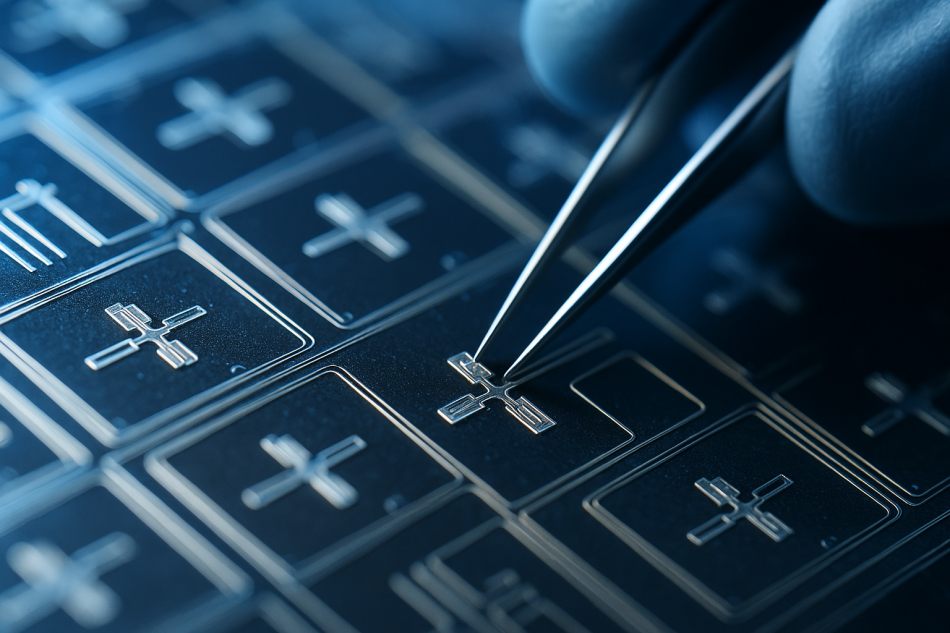

Strip away the golden chandelier of a dilution fridge, the forest of coaxial cables, and the control electronics humming in the next room, and a superconducting qubit comes down to one strange little structure: two slabs of superconducting metal separated by an insulating gap so thin it is almost not there. That gap is the Josephson junction, and without it the entire field of superconducting quantum computing would not exist.
A barrier that leaks on purpose
In an ordinary circuit, an insulator blocks current. In a Josephson junction, the insulating layer is only one or two nanometers thick, thin enough that pairs of electrons bound together into what physicists call Cooper pairs can quantum-mechanically tunnel straight through it. Brian Josephson predicted this behavior in 1962, as a graduate student, and shared a Nobel Prize for it a decade later. The effect he described is deceptively simple to state: a supercurrent can flow across the barrier with no voltage at all, and the size of that current depends on the quantum phase difference between the superconductors on either side.
What makes this useful for a qubit is that the junction behaves like an inductor, but a deeply nonlinear one. Its effective inductance changes depending on how much current is flowing. That nonlinearity is the secret ingredient. A plain circuit of a capacitor and a linear inductor is a harmonic oscillator, and its energy levels are all evenly spaced like rungs on a ladder. You cannot use it as a qubit, because any pulse meant to move the system from the ground state to the first excited state would just as happily push it on to the second, third, and beyond.
Making the ladder uneven
The junction fixes this. Because its inductance is nonlinear, it bends the energy ladder so the rungs are no longer evenly spaced. The gap between the lowest two levels differs from the gap above it, usually by a few hundred megahertz. Engineers call this anharmonicity, and it is what lets a carefully tuned microwave pulse address only the bottom two states while leaving the rest alone. Those two states become the 0 and 1 of the qubit. Every transmon, every fluxonium, every cat qubit built from superconducting circuits inherits this trick. The junction is the thing that turns a dumb resonator into a controllable two-level system.
Pair two junctions in a small loop and you get a SQUID, a structure whose combined inductance can be tuned by threading a magnetic field through the loop. That is how many chips make their qubit frequencies adjustable, and how tunable couplers switch the conversation between neighboring qubits on and off.
The fabrication lottery
The catch is that these junctions are maddeningly hard to make identically. The standard recipe evaporates aluminum onto a chip at an angle, lets a whisper of oxygen grow a thin oxide layer, then evaporates a second aluminum film from a different angle so the two overlap across the oxide. The classic version of this, the Dolan bridge technique, uses a suspended strip of resist to create the overlap. The trouble is that the tunneling current depends exponentially on the thickness of that oxide. A barrier that is a fraction of a nanometer too thick in one spot can shift a qubit's frequency by tens of megahertz.
That sensitivity is one of the quiet reasons large superconducting processors are difficult to scale. When you fabricate a hundred qubits on a wafer, the junctions come out with a spread of properties, and some land close enough in frequency to collide with their neighbors. Teams at IBM, Google, and elsewhere have poured enormous effort into tightening this spread, using laser trimming to nudge finished junctions toward their target frequencies and refining the oxidation step to shrink the variation from the start.
There is a deeper worry too. The amorphous oxide barrier is a prime home for the two-level-system defects that steal energy from qubits and limit their lifetimes. Much of the materials research aimed at longer coherence, including the switch from niobium and tantalum base layers and experiments with cleaner junction interfaces, circles back to this same sandwich.
Small part, outsized stakes
It is a strange thing to build a billion-dollar industry on a structure you cannot see without an electron microscope and cannot reliably reproduce twice in a row. Yet the Josephson junction remains the beating heart of the superconducting approach. Every improvement in gate fidelity, every longer coherence time, and every cleaner frequency map traces part of its lineage back to how well that two-atom-thick barrier was grown. Get the junction right, and the rest of the machine has a chance. Get it wrong, and no amount of clever software upstream can save the qubit.







