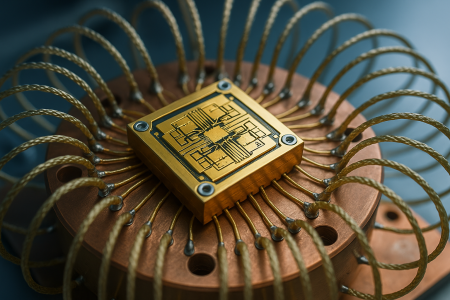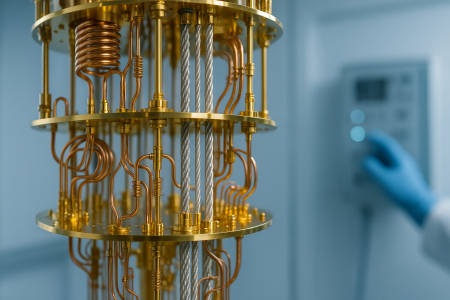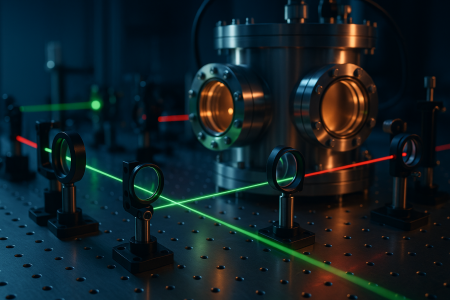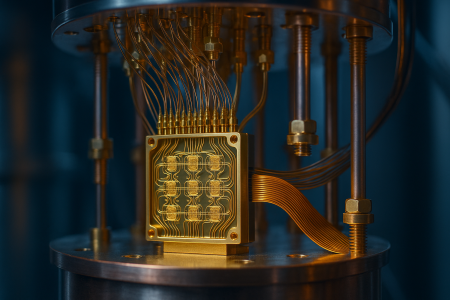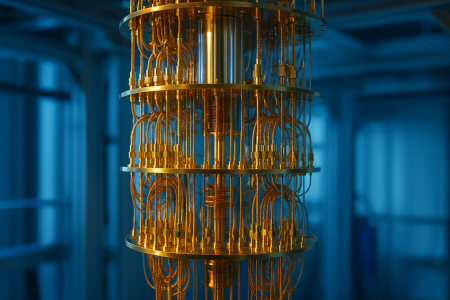

Walk into most quantum computing labs and the hardware barely resembles a computer chip. Trapped-ion machines use vacuum chambers and lasers. Superconducting processors are dwarfed by the refrigerators that cool them. But one approach has a quieter, more industrial pitch: build qubits out of single electrons held in silicon, using the same lithography lines that already churn out billions of transistors a year.
What a spin qubit actually is
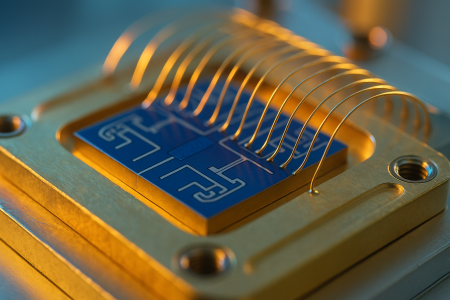
A silicon spin qubit stores information in the quantum spin of a single electron, which can point up, down, or any superposition of the two. To trap that electron, engineers pattern tiny metal gates on top of a silicon substrate. Voltages applied to those gates carve out a microscopic pocket, a quantum dot, that can hold just one electron. The spin of that electron becomes the 0 and 1 of the qubit, and microwave pulses or local magnetic fields flip it between states.
The appeal is size. A spin qubit can be tens of nanometers across, far smaller than a superconducting transmon, which sprawls across hundreds of microns. In principle you could pack millions of them onto a die no bigger than a fingernail. That density is exactly the property a fault-tolerant machine will eventually need, since useful quantum computing demands huge numbers of physical qubits to protect a handful of logical ones.
The Intel angle
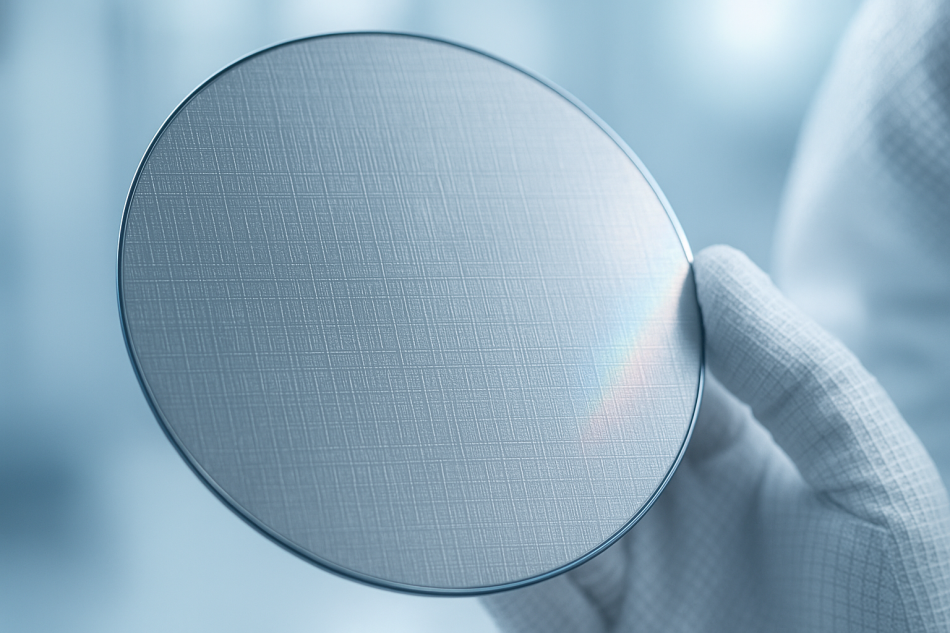
Intel has made silicon spin qubits its central bet, and the logic is corporate as much as scientific. The company does not want to invent an entirely new manufacturing process. It wants to repurpose the trillion-dollar infrastructure it already owns. Intel has fabricated spin qubit test chips on 300mm wafers, the same diameter used for commercial processors, and has built control electronics meant to sit close to the quantum layer rather than relying on a forest of cables running out of the fridge.
That manufacturing pedigree matters because the rest of the field struggles with reproducibility. Many quantum processors are still hand-tuned, near-bespoke devices. If spin qubits can ride the same yield improvements and process discipline that made classical chips reliable, the argument goes, scaling becomes an engineering problem rather than a series of physics miracles.
Why it has not won yet
The catch is that spin qubits arrived late and have spent years catching up on the basics. Two-qubit gate fidelities, the measure of how cleanly you can entangle a pair of qubits, lagged behind superconducting and trapped-ion systems for a long time. Research groups in the Netherlands, Australia, Japan, and at Intel itself have since pushed single- and two-qubit fidelities above 99 percent in isolated devices, which is roughly the neighborhood error correction needs. But hitting those numbers consistently across many qubits on one chip is far harder than hitting them on a carefully isolated pair.
Variability is the recurring villain. The same tiny size that makes spin qubits attractive also makes them exquisitely sensitive to atomic-scale imperfections. A single stray charge or a slightly misplaced dopant can shift a qubit's behavior. Each dot needs its own finely tuned voltages, and tuning many of them at once is a serious bottleneck. Researchers are now leaning on automated tuning routines to manage the problem before arrays get large.
There is also a materials wrinkle. Many spin qubit teams use isotopically purified silicon-28, which strips out the magnetic nuclei that would otherwise scramble the electron's spin. That purification gives spin qubits genuinely long coherence times, a real advantage, but it adds a specialized material that ordinary fabs do not stock.
The scaling promise
What keeps the bet alive is the trajectory. Spin qubits operate at slightly warmer temperatures than superconducting qubits in some designs, occasionally above one kelvin, which would let control electronics share the same cold stage and ease the brutal wiring problem that plagues every architecture. Their footprint leaves room for the dense two-dimensional arrays that error correction schemes assume. And the manufacturing story, if it holds, sidesteps the question of how you build a million-qubit machine one handcrafted device at a time.
None of this guarantees victory. Superconducting and trapped-ion systems have a substantial head start in qubit count and demonstrated algorithms. Silicon spin qubits remain mostly in the tens, not the hundreds. But in a field where the eventual winner may be decided by who can manufacture at scale rather than who reaches a milestone first, the idea of printing qubits like transistors is too plausible to dismiss.