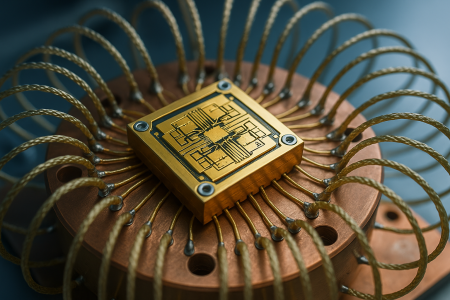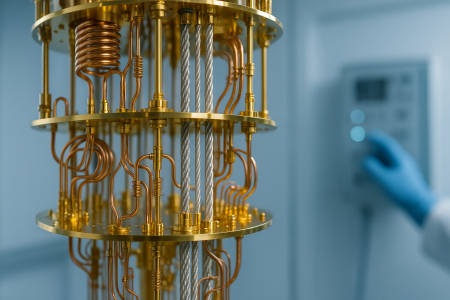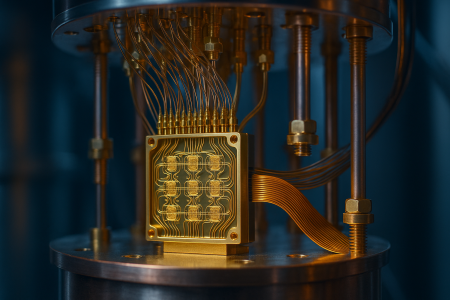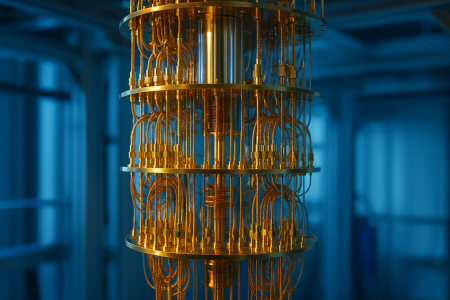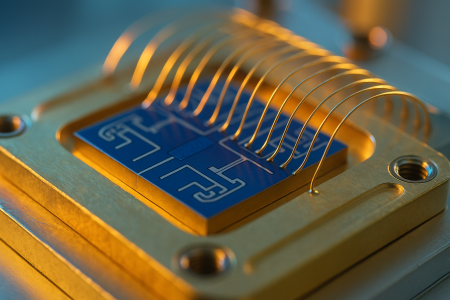

Most descriptions of why quantum computers are fragile focus on heat, electrical noise, and the jitter of the qubits themselves. But there is a stranger source of trouble that has crept into the engineering conversation over the past few years: particles arriving from space. A superconducting quantum chip, chilled to a hair above absolute zero and shielded inside a steel-and-copper refrigerator, is still struck constantly by cosmic rays and by faint radioactivity in the materials around it. Sometimes one of those strikes does real damage.
What actually happens when a particle hits
Superconducting qubits are built on a slab of silicon or sapphire. When a high-energy particle, a muon from a cosmic-ray shower or a gamma ray from trace radioactivity in the concrete and solder, slams into that substrate, it deposits energy that spreads through the chip as a burst of vibrations called phonons. Those phonons travel surprisingly far across the wafer.
Here is the problem. A superconductor works because electrons pair up and move without resistance. The energy from a particle strike breaks some of those pairs, creating stray charge carriers known as quasiparticles. Quasiparticles are poison for a qubit. They sap its stored energy and scramble its quantum state. A single event can briefly degrade not just the qubit nearest the impact but dozens of qubits across a wide region of the chip at the same instant.
Why correlated errors are the scary part
Quantum error correction is the strategy the whole field is betting on to reach useful machines. It works by spreading one logical qubit's worth of information across many physical qubits, so that a random error here or there can be detected and undone. The math behind it leans hard on one assumption: that errors are mostly independent, hitting one qubit at a time, scattered in space and time.
Cosmic-ray strikes break that assumption in the worst possible way. They cause correlated errors, many qubits failing together in one localized burst. Error-correcting codes like the surface code are not designed to absorb a hit that flips a whole neighborhood of qubits simultaneously. A single energetic event can overwhelm the code and corrupt the logical information it was protecting. Researchers measuring real devices have seen these events arrive every few seconds to every few tens of seconds, depending on the chip and its shielding, and each one can wipe out coherence across the processor for a fraction of a millisecond.
How engineers are fighting back
There is no single fix, so teams are working several angles at once.
- Shielding and depth. Some experiments have moved underground, where layers of rock block much of the cosmic-ray flux. Lead and other dense shielding inside the lab cuts down on local radioactivity.
- Cleaner materials. Trace radioactive isotopes in solder, circuit boards, and even the chip packaging contribute to the background. Choosing low-radioactivity materials, a trick borrowed from dark-matter and neutrino detector builders, reduces the hit rate.
- Phonon traps. Engineers add metal structures on the chip that soak up the phonons before they can spread, so a strike stays local instead of taking out a whole region.
- Gap engineering. Tweaking the superconducting materials so that quasiparticles are steered away from the sensitive parts of the qubit helps the chip recover faster.
- Smarter codes. On the software side, researchers are studying error-correction schemes and decoders that can recognize a burst event and treat it differently from ordinary random noise.
Why this matters for the roadmaps
The big public timelines from superconducting players point toward processors with thousands and eventually millions of physical qubits running deep error-correction cycles for hours. At that scale, a problem that strikes every few seconds is not a curiosity. It is a hard ceiling. A fault-tolerant computation that runs for an hour will sit through hundreds or thousands of cosmic-ray events, and every one of them is a chance to ruin the result unless the hardware and the code can shrug it off.
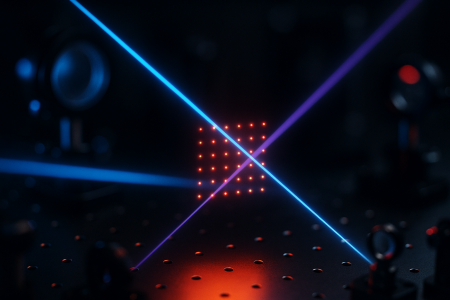
It is worth noting that not every qubit technology shares the pain equally. Trapped-ion and neutral-atom machines, which encode information in individual atoms rather than in a superconducting film on a chip, are far less vulnerable to phonon bursts in a substrate. That difference rarely makes headlines, but it is one more variable in the long argument over which hardware approach reaches large-scale fault tolerance first.
The cosmic-ray problem is a reminder that quantum computing is as much a materials and shielding challenge as it is a physics one. The qubits get all the attention, but keeping the universe from reaching in and flipping them may turn out to be just as important.