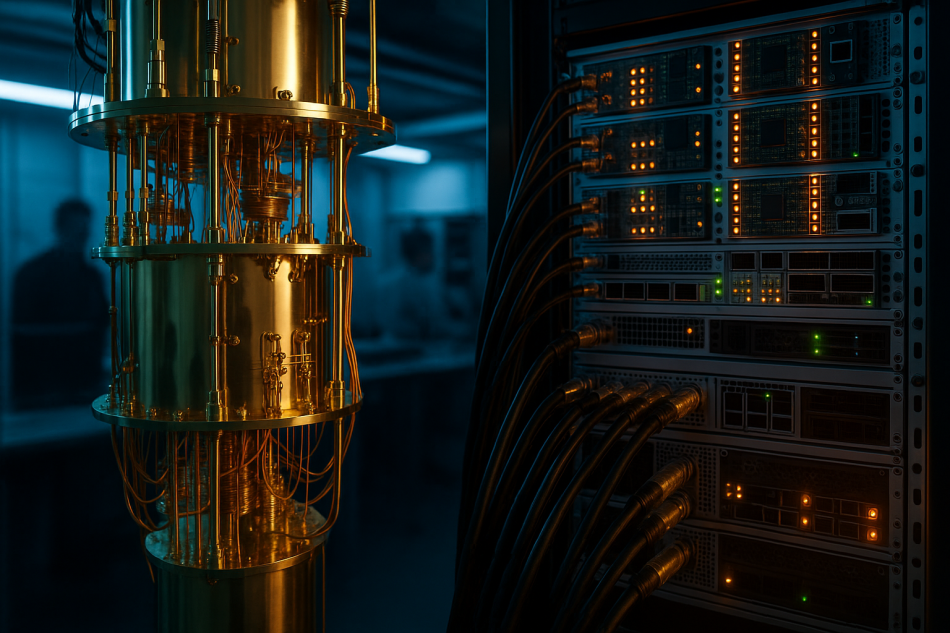

Most stories about quantum error correction focus on the qubits: how many you need, how to wire them into a surface code, how often they fail. But there is a less glamorous component sitting just outside the refrigerator that decides whether any of that effort pays off. It is a classical computer, and its job is to read a torrent of measurement data and figure out, in real time, what went wrong and how to fix it. Engineers call this the decoder, and it is becoming one of the field's hardest problems.
What the decoder actually does
In an error-corrected machine, the information you care about is spread across many physical qubits that together form a single logical qubit. You never measure those data qubits directly, because that would destroy the quantum state. Instead, the system repeatedly measures a set of helper qubits, sometimes called ancillas, that report on the relationships between neighbors. Each measurement produces a string of bits known as a syndrome. A syndrome does not tell you the answer. It tells you that an error of some kind occurred somewhere in the lattice.
The decoder's task is inference. Given a stream of syndromes, it has to deduce the most likely pattern of errors and prescribe a correction. Get it right and the logical qubit survives. Get it wrong and you have introduced a logical error, which is exactly the failure the whole apparatus was built to prevent.
Why speed is everything
The catch is timing. A superconducting processor runs a round of syndrome measurement in roughly a microsecond. The qubits keep accumulating errors the entire time the decoder is thinking. If the decoder cannot keep pace with the rate at which syndromes arrive, the backlog grows without bound, a problem researchers call the backlog or throughput problem. Once you fall behind, you never catch up, and the computation drowns in unprocessed data.
For some operations, particularly the non-Clifford gates that make a quantum computer genuinely useful, the machine actually has to wait for the decoder's answer before it can proceed. That makes decoder latency a direct tax on every algorithm. A slow decoder does not just risk errors. It stalls the entire processor.
An inference problem that scales badly
The most accurate decoding approaches treat the problem as finding the optimal explanation for the observed syndromes, which in general is computationally expensive. Minimum-weight perfect matching, a popular workhorse for surface codes, pairs up syndrome signals using graph algorithms borrowed from operations research. It works well, but its cost grows as the code gets larger, and a fault-tolerant machine will run thousands of logical qubits at once. Every one of them needs decoding, continuously, forever.
That has pushed researchers in several directions:
- Faster matching algorithms that trade a little accuracy for big speed gains.
- Union-find decoders that sacrifice some precision for near-linear runtime.
- Neural-network decoders trained to recognize error patterns directly.
- Sliding-window schemes that decode the data in overlapping chunks so the machine never has to wait for a full history.
Moving the brain closer to the cold
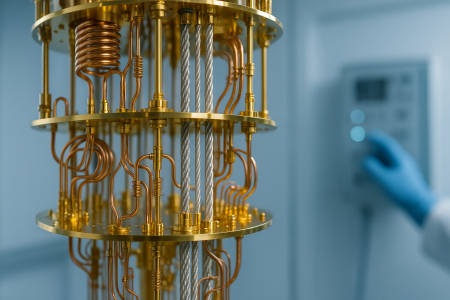
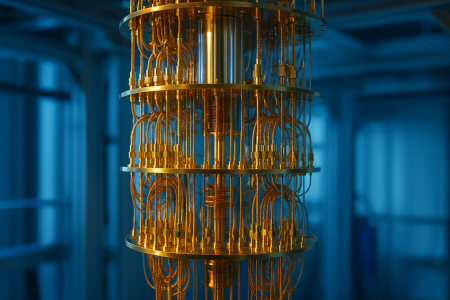
Latency is not only about algorithms. It is also about physics. The qubits live in a dilution refrigerator at a few thousandths of a degree above absolute zero. The decoder, by contrast, has to be a powerful classical processor, which generates heat and cannot sit at the coldest stage. Every cable that carries syndrome data from the fridge to a room-temperature server adds delay.
This is why some groups are experimenting with decoding hardware built into FPGAs or custom chips placed as close to the cryostat as possible, and why others are exploring decoders that can run at intermediate cryogenic temperatures. The goal is to shrink the round trip between measurement and correction until it disappears into the noise of the qubits' own clock.
Why it matters for the roadmaps
When companies publish charts promising thousands of logical qubits, the decoder is the part of the system that rarely appears in the headline number. Yet a fault-tolerant computer is a tightly coupled pair: a quantum processor and a classical one, locked in a feedback loop that has to close faster than errors can accumulate. Demonstrations of below-threshold error correction, where adding more physical qubits actually lowers the logical error rate, have leaned heavily on decoders fast and accurate enough to keep up in real time.
The lesson is that scaling quantum computers is not purely a quantum engineering project. Some of the deciding work happens in ordinary silicon, in algorithms and circuits whose only job is to make sense of the chaos and tell the qubits what to do next.