The strangest thing about quantum computing is how ordinary the front door looks. You do not need a cleanroom, a physics PhD, or a refrigerator colder than deep space. You need a browser, an account, and a willingness to wait in line. The machines themselves sit in a handful of labs and data centers around the world, humming inside their cryostats or vacuum chambers, and you reach them the same way you reach any other cloud service: over the internet.
Why nobody buys the hardware
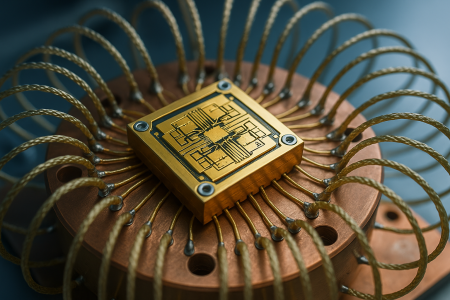
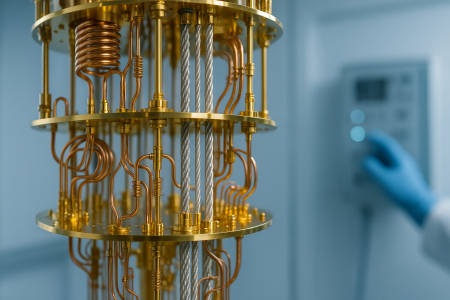
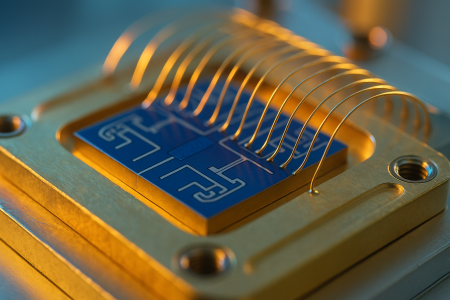
A working quantum computer is a temperamental, expensive instrument. A superconducting system needs a dilution refrigerator, racks of microwave control electronics, and a team of engineers who recalibrate it constantly. A trapped-ion machine needs ultra-high vacuum and banks of precisely tuned lasers. The capital cost runs into the millions, and the operating cost is not trivial either. Selling that as a boxed product to ordinary customers makes no sense, so the industry settled early on the same answer the classical world reached with supercomputers and GPUs: time-sharing.
You rent access by the shot or by the minute. The provider keeps the device alive, tuned, and cooled. You submit a circuit, it joins a queue, the hardware runs it a few thousand times, and the measurement results come back to you. Most users never see the machine and never need to.
The three layers of the stack
What looks like a single click actually passes through several layers. At the top you write a program, usually in a Python framework like Qiskit, Cirq, or PennyLane. That high-level description gets compiled down to the specific gates a given processor supports, a step called transpilation. Different hardware speaks different native languages: a trapped-ion device might support all-to-all connectivity, while a superconducting chip only lets neighboring qubits interact, so the compiler has to insert extra operations to shuffle information around.
Below that sits the scheduler. Because demand outstrips supply, jobs wait in queues that can stretch from seconds to hours depending on the machine's popularity and your subscription tier. Underneath everything is the control system, the classical electronics that turn your abstract gates into precisely timed pulses of microwaves or laser light, then read the qubits back out and ship the raw counts upstream.
Who is renting out the qubits
Three patterns have emerged. Some companies build the hardware and sell access directly. IBM has run its machines over the cloud since 2016 and now offers a fleet of superconducting processors through a tiered plan. IonQ and Quantinuum expose their trapped-ion systems the same way. D-Wave offers its quantum annealers as a live cloud service.
Then there are the aggregators. Amazon Braket and Microsoft Azure Quantum do not, for the most part, build qubits themselves. Instead they act as marketplaces, letting you pick from several vendors' machines through one account and one billing relationship. That is genuinely useful, because it lets a developer run the same circuit on a superconducting chip and an ion trap and compare the results without signing three separate contracts.
Finally there are simulators. Most platforms offer classical emulators that pretend to be quantum hardware for circuits small enough to fit in conventional memory. They are perfect for debugging, free or cheap, and they never queue. The catch is that simulating a quantum computer on a classical one gets exponentially harder as you add qubits, which is the whole point, so simulators top out somewhere around forty qubits before they become impractical.
What the cloud hides, and what it cannot
The cloud model is brilliant at hiding plumbing. It cannot hide physics. When your results come back noisy, the queue did not cause that. The qubits decohere, the gates misfire at a rate of roughly one error in a hundred or a thousand operations, and readout adds its own mistakes. The cloud gives you easy access to machines that are still, fundamentally, error-prone prototypes.
That is why most serious cloud quantum work today is experimental: testing error-mitigation tricks, benchmarking hardware, training students, prototyping algorithms that will only become useful once error-corrected machines arrive. The access model is mature. The machines on the other end are not.
Still, the arrangement has quietly done something important. It turned quantum computing from a spectator sport into something a curious developer can try on a Tuesday afternoon. The hardware remains rare and fragile. The doorway is wide open.