
Walk through the physics of most quantum computers and you meet exotic hardware: superconducting loops chilled to a whisper above absolute zero, or single atoms suspended in vacuum by lasers. Intel has spent years pushing a quieter idea. What if a qubit could be built from the same material, and on the same kind of production line, that already turns out the world's microprocessors? That is the promise of the silicon spin qubit, and it is one of the boldest long-range bets in the field.
A qubit the size of a transistor
The heart of a spin qubit is a single electron. Trap one inside a tiny pocket of silicon called a quantum dot, and the electron's intrinsic spin becomes the two-level system every qubit needs: spin up and spin down, the quantum equivalent of one and zero. To hold and manipulate that electron, engineers lay down a stack of metal gates that squeeze the silicon into a well just big enough for one particle. Apply the right microwave pulse and you flip the spin. Nudge two dots close together and their electrons interact, giving you the two-qubit gate that makes computation possible.
What makes this seductive is the scale. A superconducting qubit sprawls across hundreds of microns. A spin qubit is measured in tens of nanometers, roughly the footprint of a modern transistor. Pack them tightly and a single chip could, in principle, hold millions of them in the space a superconducting processor devotes to a few hundred. For a company whose entire business is squeezing more devices onto silicon, that density is not a novelty. It is home turf.
Borrowing the world's most advanced factory
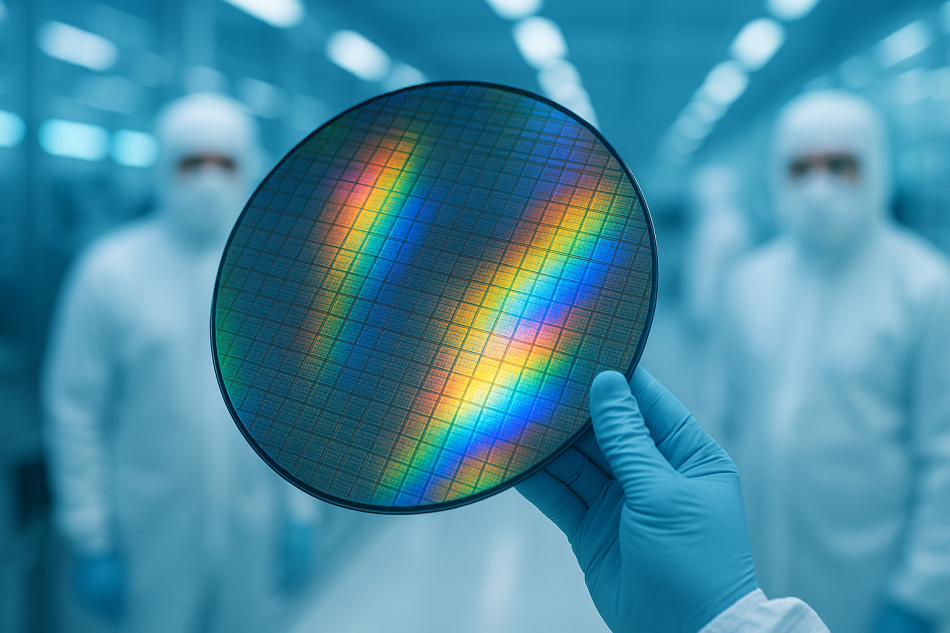
Intel's real advantage is not the qubit itself but where it is made. In 2023 the company released a research chip called Tunnel Falls, a 12-qubit silicon device fabricated on its own 300-millimeter wafers using the same extreme-ultraviolet lithography and process controls that produce commercial logic chips. Instead of hand-building a handful of qubits, Intel can print thousands of test devices across a wafer and measure how consistently they behave. That statistical view matters enormously. The gap between a lab demo and a manufacturable technology is uniformity, and uniformity is exactly what a mature foundry is built to deliver.
Tunnel Falls was not sold as a product. Intel shipped it to universities and national labs so outside researchers could probe spin qubits without building their own fabrication line. The strategy echoes how the semiconductor industry itself grew: standardize the part, hand it to a community, and let a thousand experiments push the physics forward.
The advantages, and the catch
Spin qubits carry a few genuine perks. They can operate at temperatures somewhat warmer than superconducting qubits, which sounds trivial until you remember that every fraction of a kelvin makes the cooling system easier and cheaper. Their long coherence, especially in silicon purified to remove the isotope that carries a disruptive nuclear spin, means the stored quantum information survives comparatively long. And their size hints at a path past the wiring bottleneck that haunts larger architectures.
The catch is that small is hard to control. Each dot must trap exactly one electron, and the gate voltages that define the dot are exquisitely sensitive to tiny imperfections in the silicon. Two neighboring qubits can behave slightly differently, forcing individual tuning. Gate fidelities in the best silicon devices have climbed above the 99 percent mark that error correction demands, which is a real milestone, but doing it across a large array rather than a lucky pair remains the central challenge. Reading out a single spin is also delicate, often relying on converting the spin state into a charge signal faint enough to be drowned by noise.
The slow-burn bet
Intel has never pretended spin qubits would win a race for qubit count. Rivals crossed the thousand-qubit line with other technologies while Intel stayed in the tens. The wager is that quantity means little without manufacturability, and that whoever masters making qubits reliably, wafer after wafer, will eventually leap ahead when scaling matters most. It is a patient, industrial argument rather than a headline-grabbing one.
Whether it pays off depends on solving control and uniformity at scale, problems that no amount of foundry pedigree makes automatic. But if a fault-tolerant machine really does need millions of physical qubits, the ability to print them like transistors could turn out to be the quiet advantage that decides the field. Intel is betting that the future of quantum computing looks less like a physics experiment and more like a chip.







