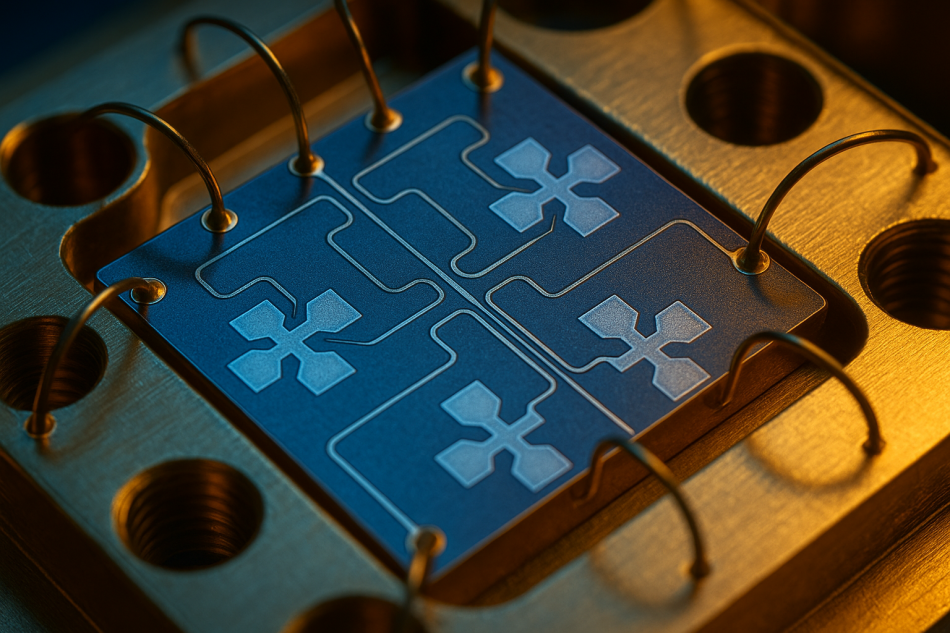

If you log into a quantum computer today through IBM's cloud, Google's lab, or a Rigetti processor, odds are you are talking to a transmon. It is the most widely deployed qubit design on the planet, and yet its name gives away almost nothing about why it won. The story of the transmon is really a story about surrender: engineers stopped trying to shield a qubit from electrical noise and instead built one that could not hear the noise in the first place.
The problem with counting charges
The transmon descends from an earlier device called the Cooper pair box. That design stored quantum information in the number of Cooper pairs, the paired electrons that flow without resistance through a superconductor, sitting on a tiny metal island. Add or remove a single pair and the qubit changed state. It was elegant and it was fast, but it had a fatal weakness. The energy of those charge states depended sharply on the surrounding electrical environment. Any stray voltage wandering across the chip, and there is always stray voltage, would jiggle the qubit's frequency. That jitter, known as charge noise, scrambled the delicate phase relationships that quantum computing depends on. Coherence lasted mere nanoseconds.
Researchers tried the obvious fixes. They filtered the wiring, cooled the chip harder, and hunted for cleaner materials. Charge noise proved stubborn, partly because much of it comes from microscopic defects baked into the surfaces and interfaces of the device itself. You cannot filter away a flaw living inside the metal.
Flattening the curve
The breakthrough, introduced by a team at Yale in the mid-2000s, was to change the shape of the qubit's energy landscape. In a superconducting qubit, two quantities compete: the energy it costs to move charge onto the island, and the energy stored in the Josephson junction, the thin insulating gap where the superconducting current tunnels through. The transmon design deliberately makes the junction energy overwhelmingly large compared to the charging energy, usually by a factor of fifty or more.
The consequence is subtle but powerful. When you plot the qubit's energy against the background charge, the wiggly curve that used to make the Cooper pair box so sensitive flattens out almost completely. A passing bit of charge noise slides the qubit along a nearly level line, so its frequency barely budges. The qubit has become, in effect, deaf to the very noise that killed its ancestor. Coherence times jumped from nanoseconds toward microseconds, and later, with better materials, to hundreds of microseconds.
The price of quiet
Nothing in engineering is free. Flattening the charge sensitivity also flattens something else: the spacing between the qubit's energy levels. A good qubit needs its lowest two states to sit at a different energy gap than the next levels up, so that a control pulse tuned to the qubit does not accidentally push it higher. This property is called anharmonicity, and the transmon has rather little of it. That forces engineers to shape their microwave pulses carefully and to keep gate operations from running too fast, lest the qubit leak into a third state it was never supposed to visit.
The other cost is size. That giant junction energy is achieved by adding a large capacitor, typically a pair of broad metal pads. A transmon is physically bigger than the tiny island it replaced, which matters when you are trying to cram a thousand qubits onto a chip and route control lines to each one.
Why it still dominates
Despite the compromises, the transmon carried superconducting quantum computing from a laboratory curiosity to machines with hundreds of qubits. Its appeal is practical. It is fabricated with the same lithography and thin-film techniques the semiconductor industry already understands. It couples strongly to microwave resonators, which makes it easy to read out and to entangle with its neighbors. And its recipe is well documented, so a new group can spin up a working device without reinventing the physics.
Newer designs like the fluxonium and the cat qubit promise longer memories or built-in error resistance, and they may eventually displace the transmon in fault-tolerant machines. But every roadmap that talks about scaling toward useful computation is still measured against the transmon's track record. For now, the charge-shy qubit remains the quiet default humming inside the cloud.







