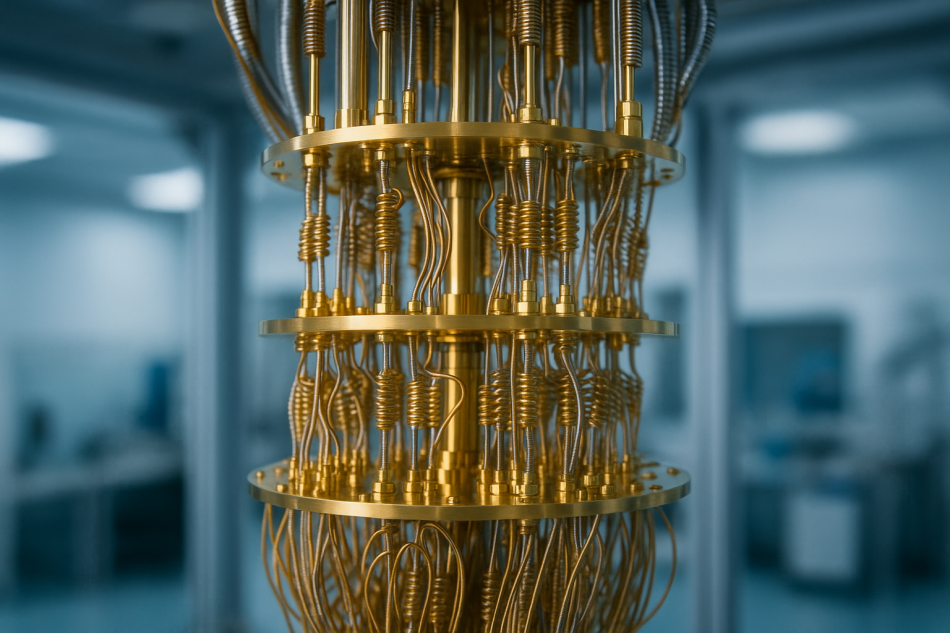

Look at almost any photo of a superconducting quantum computer and you will not see the chip. What you see is the fridge: a gleaming brass-and-gold structure hanging upside down like a chandelier, ringed by plates and threaded with hundreds of cables. The processor itself is a fingernail-sized square bolted to the very bottom, hidden inside a shield. Everything above it exists for one purpose, to make that square colder than anywhere in the natural universe.
Why the cold matters
A transmon qubit stores information in the faint energy difference between two states. That gap is tiny, and heat is the enemy. Warmth is just random jiggling, and any stray thermal energy can knock a qubit out of its ground state or scramble a delicate superposition. To keep the environment quiet, the chip must sit near a temperature where thermal noise falls well below the qubit's energy scale. In practice that means roughly 10 to 20 millikelvin, or about a hundredth of a degree above absolute zero. Deep space, warmed by leftover radiation from the Big Bang, sits at a balmy 2.7 kelvin by comparison, more than a hundred times hotter.
The trick with two heliums
Getting to a few kelvin is the easy part. Ordinary closed-cycle coolers, called pulse tubes, use compressed helium gas to reach around 3 to 4 kelvin. The last, hardest stretch is where the dilution refrigerator earns its name. It exploits a strange quirk of the two stable isotopes of helium, helium-3 and helium-4.
When you mix them and cool the blend below about 0.87 kelvin, the liquid separates into two layers, like oil and water. One layer is rich in helium-3, the other is dilute, holding only a small fraction of helium-3 dissolved in helium-4. The magic happens at the boundary. Coaxing helium-3 atoms to cross from the concentrated side into the dilute side costs energy, and that energy is pulled from the surroundings as heat. It behaves a little like evaporation, except it never stops, because the dilute phase can always absorb more helium-3. Pumps circulate the helium-3 continuously, so the cooling runs around the clock with no moving parts down in the cold zone. That continuous, vibration-free chill is exactly what a fragile qubit needs.
Reading the plates
The stacked plates you see in the photos are temperature stages, each colder than the one above. A rough tour from top to bottom:
- A 50-kelvin plate cooled by the pulse tube, catching the bulk of the heat leaking in from room temperature.
- A 4-kelvin plate, the working floor for the first helium stage.
- A still, around 0.7 kelvin, where helium-3 is pumped away.
- A cold plate near 100 millikelvin.
- The mixing chamber at the very bottom, where the phase boundary lives and where the quantum chip is mounted.
Each stage is a thermal anchor. Every cable running down to the qubit is deliberately clamped to these plates so that heat sheds off in steps rather than pouring straight onto the processor.
The cable problem in the cold
Those cables are the fridge's headache. Every qubit needs microwave lines to control it and read it out, and each line is a highway for heat from the warm world above. Engineers use attenuators to tame incoming signals, superconducting cables that carry current without generating heat, and bulky low-noise amplifiers cooled at intermediate stages. As machines grow past a few hundred qubits, the sheer count of lines threatens to overwhelm the fridge's cooling power, which at the mixing chamber is measured in mere microwatts to milliwatts. This is one reason companies are exploring cryogenic control chips and multiplexed readout, pushing to move more electronics into the cold without cooking the qubits.
The gold and the glow
The warm color comes from real gold plating over copper. Copper conducts heat superbly, spreading it evenly across each plate, and a thin gold layer stops the copper from oxidizing, which would ruin its thermal contact. There is nothing decorative about it. Every surface is chosen for how well it moves or blocks heat.
Cooling one of these systems from room temperature takes a day or more, and once cold it stays running for weeks or months at a stretch. It is a heavy, power-hungry, plumbing-intensive machine, ironic company for a processor that sips almost no power itself. But without this inverted chandelier holding the line at a few thousandths of a degree, the superconducting qubit as we know it would not exist at all.







