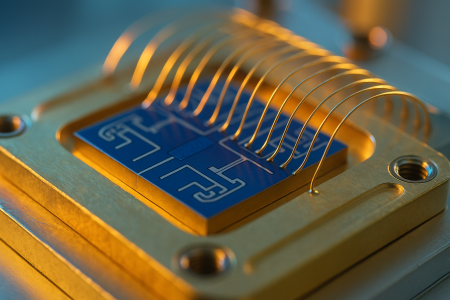

If you could shrink down and peer inside one of the quantum computers built by IonQ or Quantinuum, you would not see a chilled silicon chip humming with wires. You would see a tiny vacuum chamber, lasers crossing at sharp angles, and a row of individual atoms hovering in empty space, held in place by nothing but carefully shaped electric fields. Each of those atoms is a qubit. The approach is one of the oldest in quantum computing, and despite a wave of flashier rivals, it refuses to be counted out.
How you trap an atom
The trick starts by stripping an electron off an atom such as ytterbium or barium, giving it a net positive charge. A charged particle can be pushed around by electric fields, and a clever arrangement of electrodes called a Paul trap creates a kind of invisible bowl that holds the ion suspended in the middle of a vacuum. Line up several ions and they repel one another into an evenly spaced row, like beads on a string that no one can see.
Information is stored in the ion's internal energy states. Two specific electron configurations stand in for the 0 and 1 of a qubit. Because these states are properties of a single isolated atom rather than a manufactured circuit, every ion of a given element is identical. There is no fabrication variation, no qubit that came out of the cleanroom slightly worse than its neighbor. Nature makes them all the same.
The fidelity advantage
The headline reason trapped ions matter is accuracy. Operations are performed by firing precisely tuned laser or microwave pulses at the ions, nudging them between states or entangling pairs through their shared motion in the trap. These gates can be performed with error rates among the lowest of any quantum platform, with the best two-qubit operations crossing into the 99.9 percent fidelity range. In a field where errors pile up fast, every fraction of a percent matters enormously, because it determines how much overhead you need to spend on error correction later.
Ions also hold their quantum state for a long time. Coherence, the stretch of time before a qubit forgets its information, can run into seconds for trapped ions, an eternity compared with the microseconds typical of superconducting circuits. A patient qubit gives you room to run longer algorithms before noise drowns the signal.
Everyone can talk to everyone
There is another structural perk. Because the ions share a common motion in the trap, any qubit can be entangled directly with any other qubit in the chain. This all-to-all connectivity means a programmer does not have to shuffle information across a grid of neighbors just to connect two distant qubits, a problem that plagues chip-based designs. Fewer shuffling operations means fewer chances to introduce error, which partly offsets the platform's biggest weakness.
The catch: ions are slow
That weakness is speed. Laser-driven gates take microseconds, while superconducting gates run in nanoseconds, roughly a thousand times faster. For a machine that needs to perform billions of operations, that gap is real. Trapped-ion builders argue that raw speed matters less than getting the right answer, since a fast computer that makes constant mistakes is not useful. Still, scaling up exposes the tension. A single long chain of ions becomes harder to control as it grows, because the shared vibrations that enable gates also get more crowded and unwieldy.
Scaling without one giant trap
The favored answer is to stop trying to build one enormous string. Quantinuum's machines use a quantum charge-coupled device architecture, physically shuttling ions around a chip-like trap with multiple zones, moving them into position for gates and then back out. IonQ has talked about networking smaller trap modules together with photonic links, the same modular philosophy now spreading across the whole industry. Both companies have published roadmaps that lean on these techniques to push qubit counts up while protecting the fidelity that makes the platform attractive in the first place.
A different bet on the same goal
What makes trapped ions worth watching is that they optimize for quality over quantity from the start. The bet is that fault-tolerant computing will be won by whoever needs the fewest physical qubits per reliable logical one, and clean, slow, highly connected ions are well positioned for that math. Whether the speed penalty proves fatal or merely inconvenient is the open question. For now, the row of glowing atoms floating in a vacuum remains one of the most credible paths to a useful quantum computer.