
When a superconducting qubit finishes a calculation, it has to tell you what it holds. It does this by nudging a tiny microwave signal, a pulse so weak that measuring it is closer to hearing a single mosquito across a football stadium than reading a value off a screen. The story of how that whisper gets amplified into something a room-temperature instrument can digitize is one of the quietest engineering battles in quantum computing, and it decides how fast and how accurately a machine can be read.
Why the signal is so small
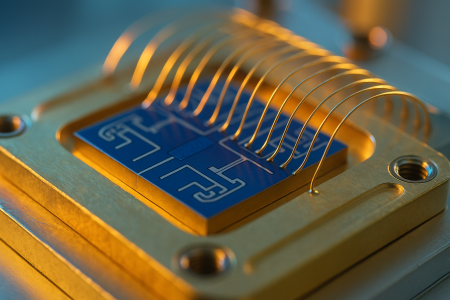
A superconducting qubit is coupled to a small microwave cavity, the readout resonator. The qubit's state, zero or one, shifts the resonator's frequency by a hair. To find out which state the qubit is in, engineers send a probe tone at the resonator and listen to how it comes back. The problem is power. Push too much energy at the qubit and you disturb it, kicking it out of the state you are trying to measure or exciting unwanted transitions. So the probe has to be feeble, often only a handful of photons. Recovering the answer from a signal that faint, before it drowns in thermal and electronic noise, is the whole game.
The amplifier chain
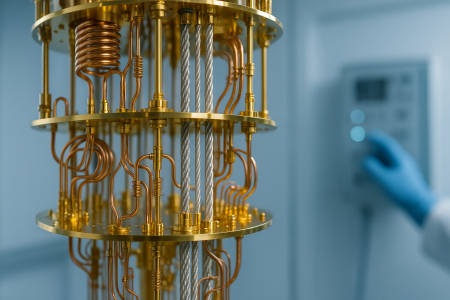
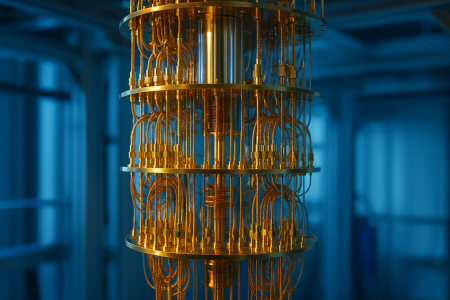
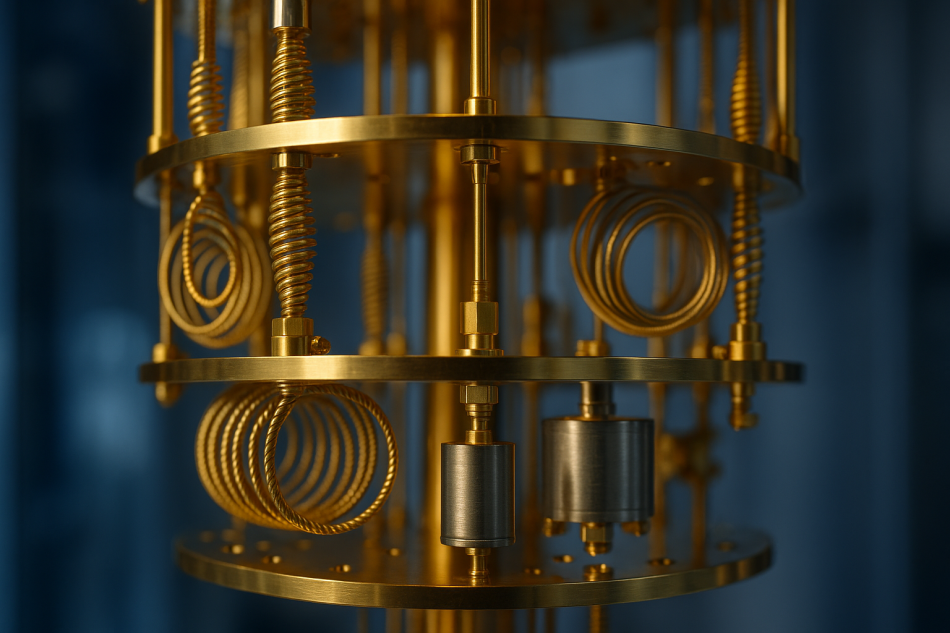
The solution is a relay of amplifiers stacked from the coldest part of the fridge up to the electronics rack. The order matters enormously, because the first amplifier in the line sets most of the final noise. Whatever junk it adds gets multiplied by everything downstream. That is why the first stage sits at the coldest stage of the dilution refrigerator, millikelvins above absolute zero, and why so much effort goes into making it as quiet as physics allows.
- The first stage is often a Josephson parametric amplifier, or JPA, built from the same superconducting circuits as the qubits themselves. It can reach the so-called quantum limit, adding only the minimum noise that quantum mechanics forbids you from avoiding.
- A newer favorite is the traveling-wave parametric amplifier, or TWPA, which spreads the amplification along a long meandering line. Unlike a JPA it works across a wide band, so one device can read out many qubits at once.
- Above these sit high-electron-mobility transistor amplifiers, HEMTs, mounted at the four-kelvin stage. They are noisier but rugged, and they carry the now-boosted signal the rest of the way out.
By the time the signal reaches room temperature it has been amplified by a factor of many millions, and the trick is that the noise added along the way stays close to the quantum floor rather than swamping the message.
The quantum limit, and cheating around it
Physics says any amplifier that boosts a signal without knowing anything about it must add at least half a photon of noise. Parametric amplifiers can hit that bound. Some can even go below it for one part of the signal by squeezing, trading precision in a quantity you don't care about for precision in the one you do. That extra edge shortens how long you must listen, and readout time is precious. Every microsecond spent measuring is a microsecond the other qubits sit idle, decohering.
Why this is a scaling headache
A single JPA reading one qubit is manageable. A machine with hundreds or thousands of qubits is not. Each amplifier needs its own pump tone, its own bulky microwave circulators to keep signals flowing one way, and its own real estate on crowded fridge plates. Circulators in particular are large magnetic components that resist miniaturization, and they clash with the tight wiring budgets every large machine faces. Broadband TWPAs help by letting one amplifier serve many qubits through frequency multiplexing, where each qubit's readout tone rides at a slightly different frequency and gets sorted out later.
None of this shows up in the headline qubit count, yet it quietly caps how good a machine can be. A processor with beautiful qubits and a noisy readout chain will still report the wrong answer too often. As error correction demands fast, repeated, high-fidelity measurements, cycle after cycle, the amplifier chain stops being a supporting act. It becomes one of the load-bearing walls of the whole enterprise.