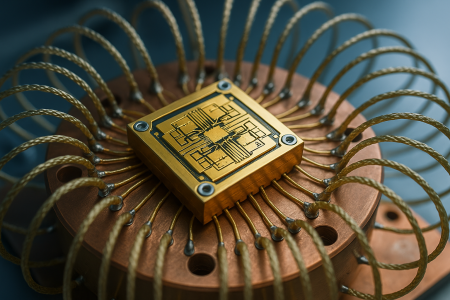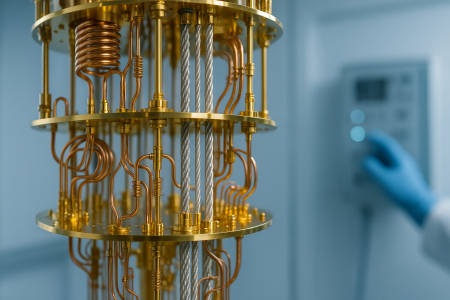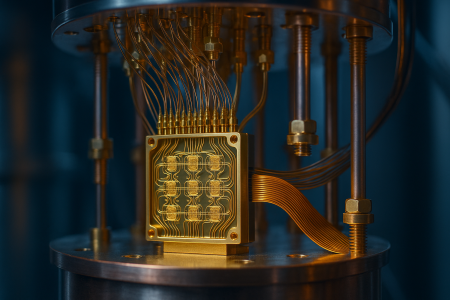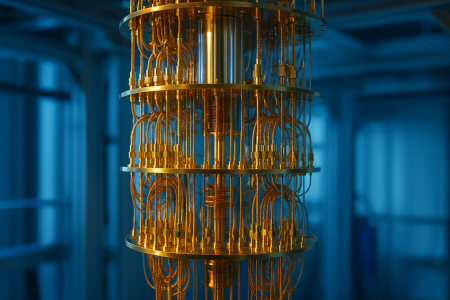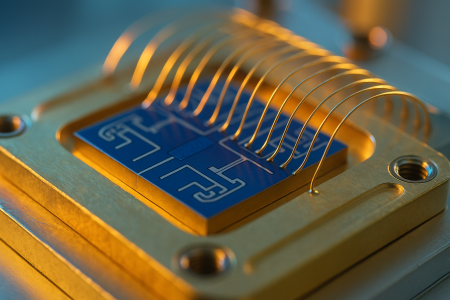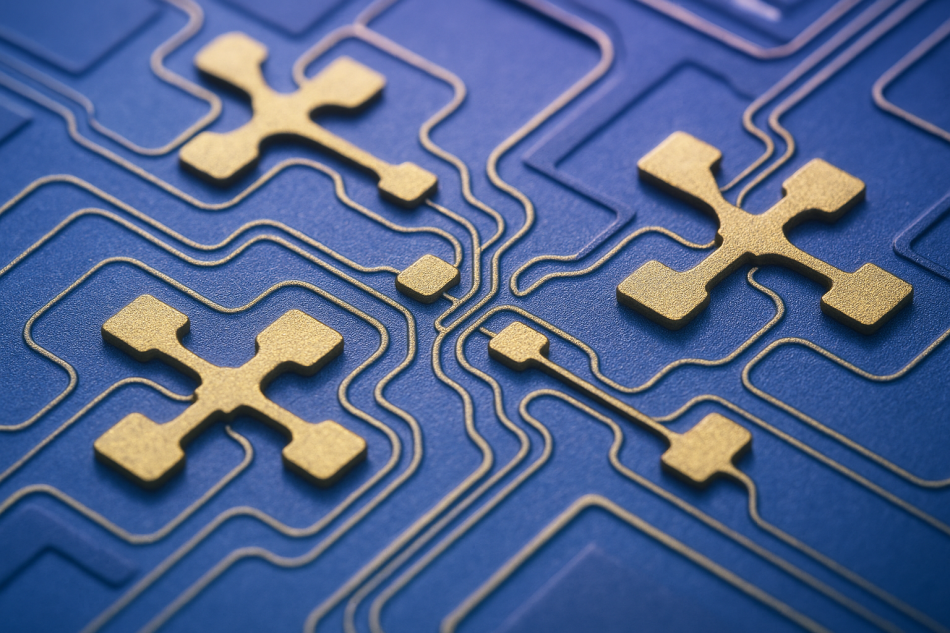

Two qubits sitting side by side on a superconducting chip have a problem: they can hear each other whether you want them to or not. Physics does not come with an off switch. Any two circuits close enough to entangle for a fast two-qubit gate are also close enough to leak signal into each other when they are supposed to be idle. That unwanted whispering, called residual coupling or static ZZ, quietly corrupts computations. The tunable coupler is the piece of hardware engineers added to give qubits a volume knob they can turn all the way down.
Why fixed coupling is a trap
The simplest way to connect two transmon qubits is a capacitor or a shared bus. Cheap, reliable, and permanent. The trouble is the word permanent. If the interaction strength is baked into the metal, you are stuck with a compromise. Make the coupling strong and your two-qubit gates run fast, but the qubits also disturb each other constantly, so a qubit that is supposed to be waiting picks up phase errors from its neighbors. Make the coupling weak and the idle crosstalk drops, but now your gates crawl, and a slow gate spends more time exposed to decoherence.
For a handful of qubits you can live with the tradeoff. For a processor with dozens or hundreds of them packed onto a lattice, the always-on chatter piles up. Every qubit has several neighbors, and each neighbor contributes a little error to every idle moment. Scaling makes the problem worse, not better.
A third circuit in the middle
A tunable coupler is a small extra circuit, usually itself a kind of tunable transmon, placed between two data qubits. Instead of letting the qubits interact directly, both of them interact with the coupler. The clever part is that the coupler contributes two competing pathways for the signal to travel between the qubits: a direct capacitive route and an indirect route through the coupler. When the coupler is tuned to a particular frequency, those two pathways cancel almost perfectly, and the effective interaction drops close to zero. Slide the coupler's frequency somewhere else with a magnetic flux pulse, and the cancellation breaks, so the coupling switches on strongly for as long as you need to perform a gate.
The result is a switch with a huge dynamic range. In the off state the residual ZZ can be pushed down by orders of magnitude compared with a fixed link. In the on state the interaction is strong enough to run a two-qubit gate in tens of nanoseconds. You get the fast gate and the quiet idle, not one or the other.
Why the big machines adopted it
Tunable couplers are not a niche trick. Google leaned on them heavily for its Sycamore and Willow processors, where fast, clean two-qubit gates were essential to its benchmarking claims and its error-correction work. The flux-tunable coupler lets Google run its signature gates and dial down crosstalk across a two-dimensional grid. Other superconducting groups have followed, because as soon as you commit to running surface-code error correction, you need thousands of gate operations to behave predictably, and lingering neighbor-to-neighbor coupling is exactly the kind of correlated noise that error correction struggles to absorb.
The cost of the extra knob
Nothing on a quantum chip is free. Adding a coupler between every pair of qubits means adding more circuitry, more fabrication steps, and more places for something to go wrong. Each tunable coupler needs its own flux control line, which adds to the wiring bottleneck that already haunts large processors. A tunable element is also, by definition, sensitive to flux noise, so the very knob that gives you control introduces a new channel for errors if the control electronics are not clean. Calibrating the exact flux point where the coupling nulls out is another entry on the long list of things a quantum computer must be tuned for, and that sweet spot can drift.
There is also a design philosophy question. Every coupler you add is a circuit that does no computing of its own. It is overhead in service of control. Groups that favor fixed coupling argue you can suppress crosstalk with careful frequency planning and clever pulse shaping instead, keeping the chip simpler. The debate mirrors a recurring theme in hardware: whether to solve a problem with more physics or with more control.
For now, the tunable coupler has won a lot of converts because it attacks the scaling problem head-on. A quantum computer is only as good as its quietest idle moment, and a switch that can silence a qubit's neighbors on command turns out to be one of the more valuable pieces of real estate on the chip.