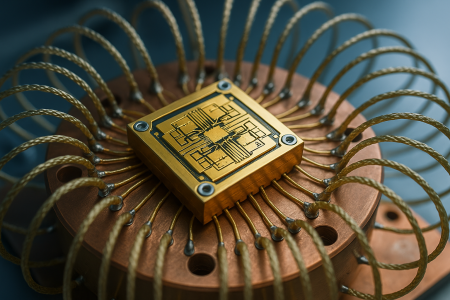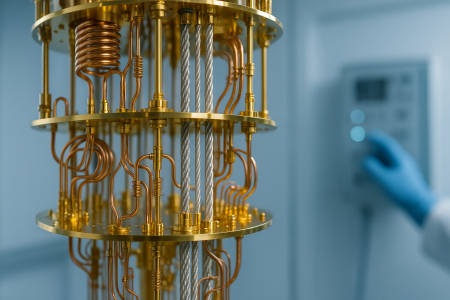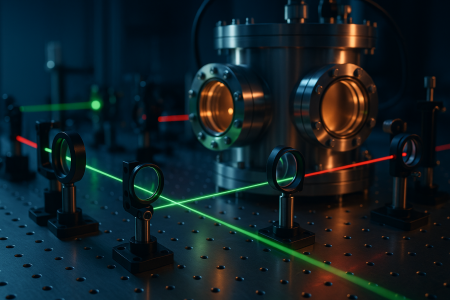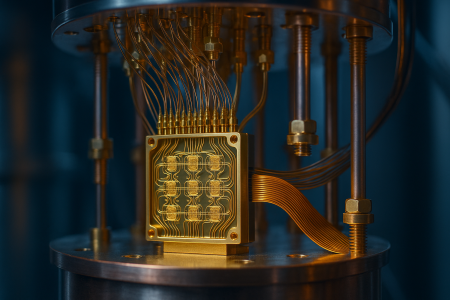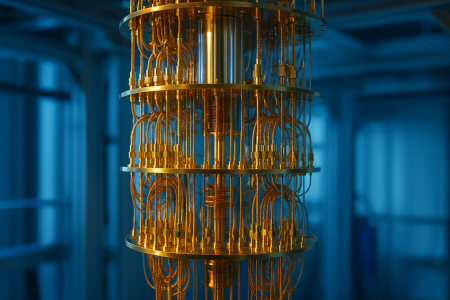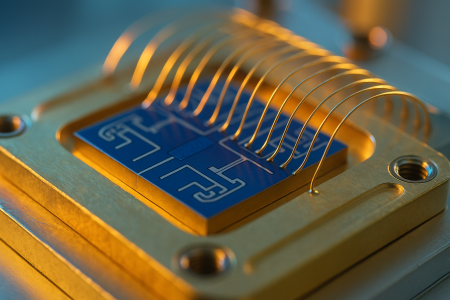

Ask why quantum computers are so hard to build and the answer usually starts with temperature. Superconducting and spin qubits typically operate around 10 to 20 millikelvin, colder than interstellar space, because even faint thermal noise scrambles their fragile states. But a quieter contest has been unfolding around a counterintuitive idea: instead of chasing ever colder chips, make qubits that tolerate a little more heat. The prize is not comfort. It is the ability to build machines with far more qubits than today's fridges can handle.
Why a Fraction of a Degree Matters
The distinction between 20 millikelvin and 1 kelvin sounds trivial. In cryogenics it is enormous. A dilution refrigerator's cooling power grows dramatically as the target temperature rises. At the coldest stage, where qubits live, a typical fridge can remove only a few hundred microwatts of heat. Push the operating point up to around one kelvin and the available cooling power jumps by orders of magnitude.
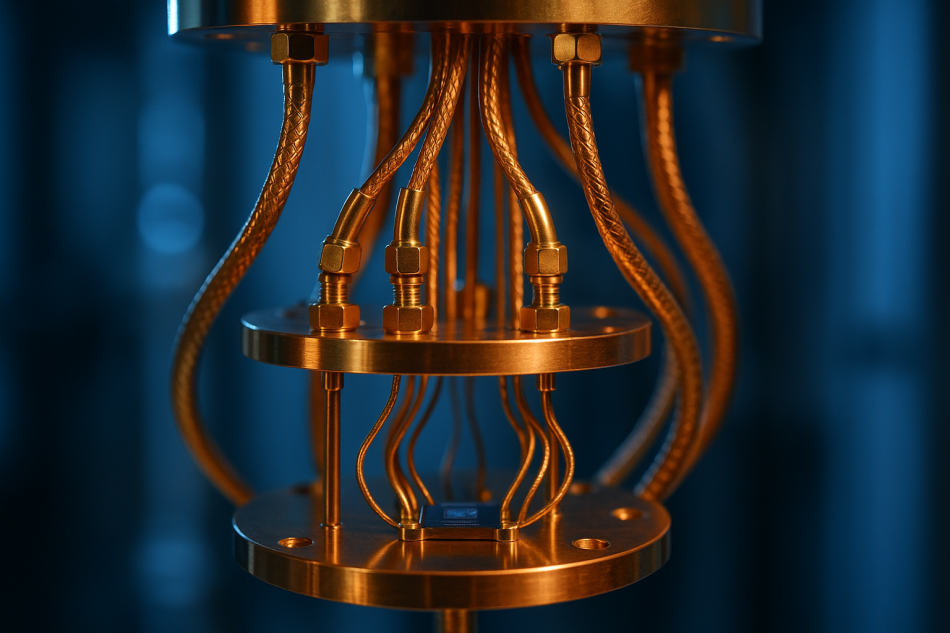
That headroom is precious because qubits do not sit alone. Each one needs control and readout electronics, and every wire running from room temperature into the cold carries heat and takes up space. Today those amplifiers and controllers mostly sit outside the coldest zone, connected by dense bundles of coaxial cable. Scaling to the millions of qubits that error correction demands means that plumbing becomes impossible. If the qubits could run warmer, control chips built from ordinary silicon transistors could sit right beside them, slashing the wiring nightmare.
The Silicon Spin Angle
The strongest push for hot qubits comes from the silicon spin camp. These qubits encode information in the spin of a single electron trapped in a quantum dot, fabricated with techniques close to those used in commercial chip factories. Because the energy scales involved can be larger than in some other designs, spin qubits are natural candidates for higher-temperature operation.
Research groups have demonstrated silicon spin qubits performing logic operations at temperatures above one kelvin, a regime sometimes called "hot" only by the absurd standards of quantum hardware. The results showed that coherence and gate fidelity, while degraded compared to the coldest operation, did not collapse. That was the crucial proof: the physics does not forbid useful qubits at these temperatures. Intel, which has invested heavily in silicon spin technology, has publicly framed higher-temperature operation as central to its manufacturing-driven strategy, precisely because it wants to integrate control logic on the same wafer.
The Catch Nobody Ignores
Warmer qubits are not free. Raising the temperature adds thermal noise, which tends to shorten coherence times and lower gate fidelity. Error correction is unforgiving about fidelity; small drops in per-gate quality translate into steep increases in the overhead needed to protect a single logical qubit. A hot qubit that runs at 99.5 percent fidelity might need far more physical partners than a cold one at 99.9 percent. The engineering question is whether the cooling and wiring savings outweigh the extra qubits demanded by lower quality.
There is also the problem of the electronics themselves. Cryogenic control chips, often called cryo-CMOS, generate their own heat when they switch. Placing them next to the qubits solves the wiring bottleneck but creates a local thermal load that the fridge must absorb. Designers walk a tightrope: the control circuitry has to be power-efficient enough that it does not cook the very qubits it serves.
A Bet on the Whole System
What makes the hot qubit gambit interesting is that it reframes the goal. For years the assumption was that better qubits meant colder, cleaner, more isolated ones. The hot qubit view treats the quantum computer as a full system, where the winner is not the chip with the longest coherence time but the architecture that can actually be manufactured and scaled.
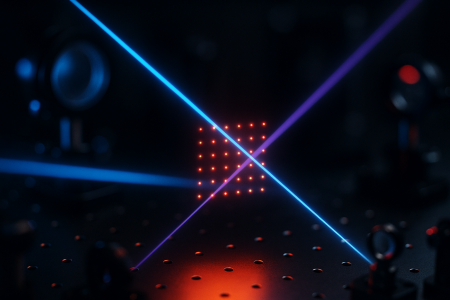
Not everyone is convinced. Trapped-ion and neutral-atom platforms operate at very different conditions and do not share the same millikelvin constraint, so they sidestep the debate entirely. Among superconducting groups, most still favor keeping qubits as cold as possible and improving fidelity first. The hot qubit route is a wager that integration matters more than isolation, and that a slightly noisier qubit you can build a million of beats a pristine one you cannot wire up. The next few years of silicon results will show whether that trade pays off.